





Work Ready Parents eligibility is worth checking before you plan a return to work or study around the new Australian service. The free online trial offers preparation support to eligible primary carers. It does not promise a job, a course place, childcare or an income payment.
Start with two separate questions: do the official criteria fit your circumstances, and what is the smallest useful next step for you? Our guide includes the current source links, two charts, a goal-choice infographic and four CSV tools. The two-week planner is an original teaching tool, not the programme’s required timetable.
Work Ready Parents eligibility: check the official criteria
The DEWR launch announcement of 24 November describes a voluntary online trial for up to 2,700 parents until October 2028. Its eligibility conditions include being at least 18, being the primary carer of a child under 18, and having no paid employment or self-employment. The residence and citizenship, residency or visa/work-rights conditions also apply.
Read the full current DEWR eligibility page rather than relying on one condition alone. Existing participation in Workforce Australia or Parent Pathways does not automatically exclude a parent. The department also says this voluntary service does not meet mutual-obligation requirements or count towards a points target.
A self-check is a way to organise questions, not a decision on acceptance. If a criterion is uncertain, write down that question and ask the provider through its official channel. Do not send identity documents or private family details through a publicly shared planning sheet. Keep the notes you need locally and securely.
Check the current intake, not only the launch headline
The FW Jobs Academy provider page, checked on 26 November, says its next intake starts in early 2027 and applications open in December 2026. It currently offers interest registration. Registering interest is different from an open application, and neither is confirmation of acceptance. Recheck the page before committing to an intake date.
Online access can remove a journey, but it does not remove the time and attention a family may need to arrange. Ask about the timing of a particular activity before planning around it. A live session and an on-demand resource can create different practical demands even when both are delivered online.
Keep capacity, trial length and personal support separate
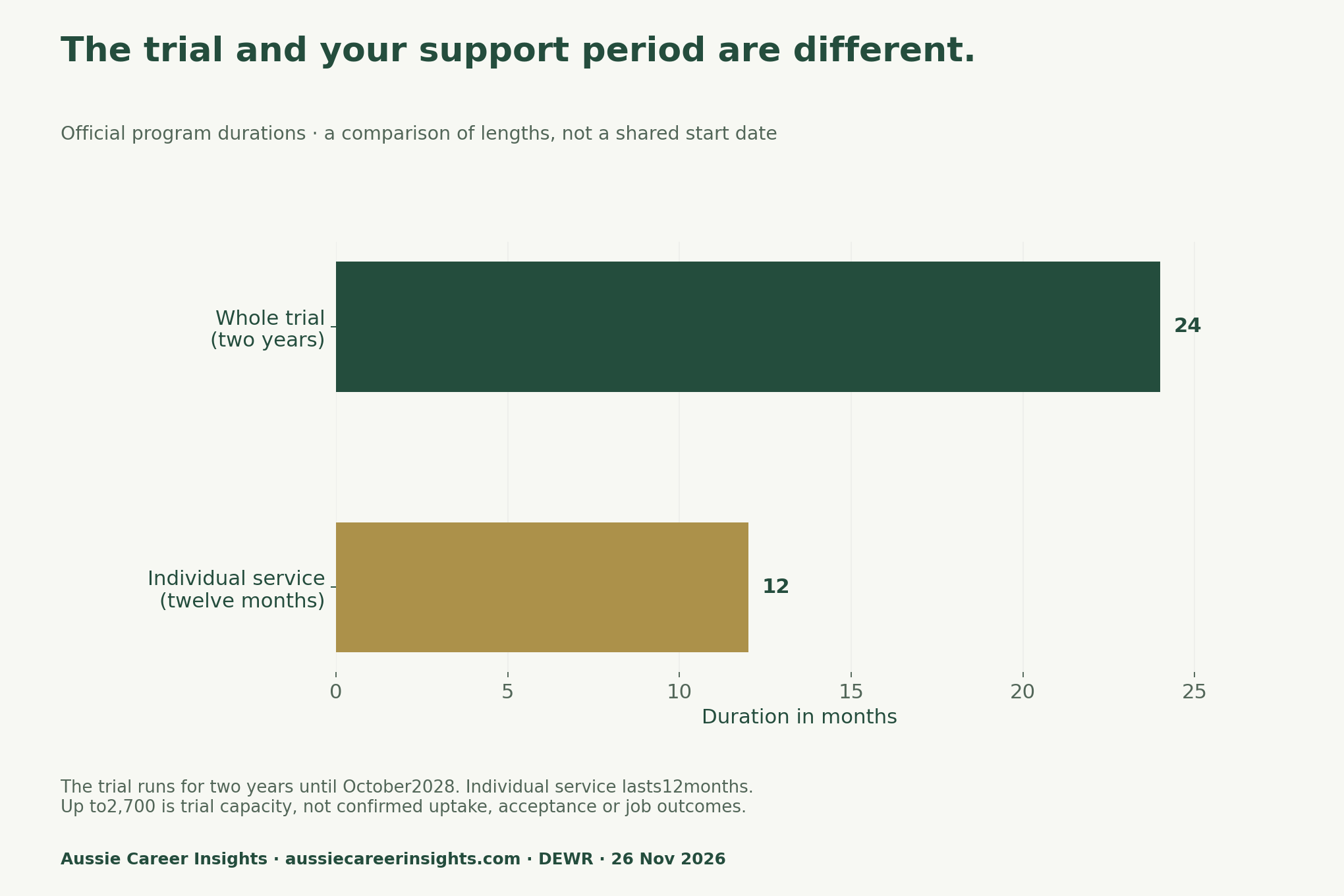
A capacity announcement answers how many people a trial is designed to support. It does not answer how many places remain, whether a particular applicant will be accepted or how many people will find work. This report does not calculate a success rate because the required outcome data are not supplied by that capacity figure.
Choose one goal for your first conversation
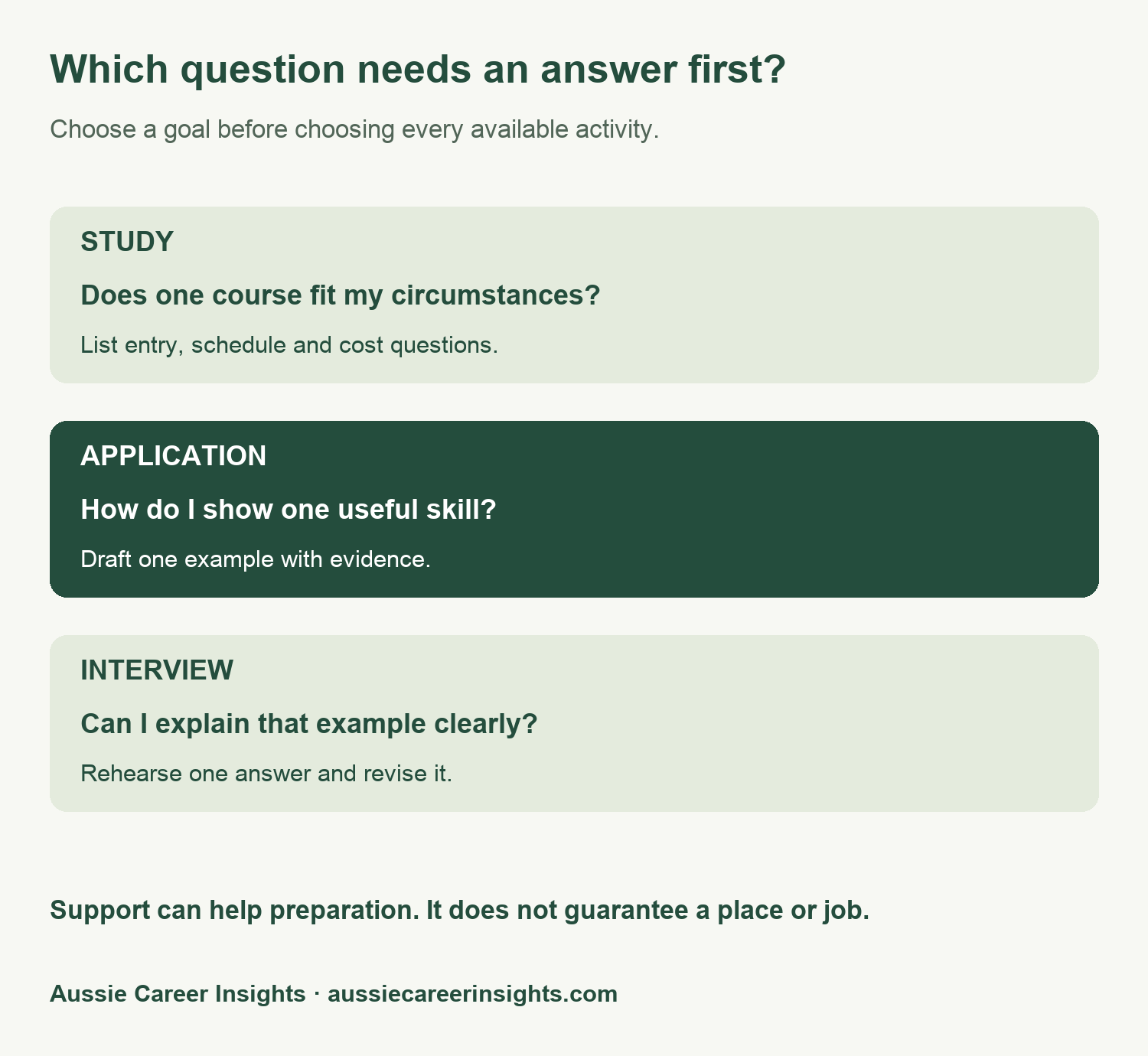
For a study decision, choose one course to investigate. Write three questions: what entry evidence is required, when would you need to attend, and what costs would remain? The useful output is a clearer decision, not an immediate enrolment. Ask which available support can help you answer the unresolved questions.
For an application, begin with one example of a skill you can support with evidence. State the task, what you did and what changed. Do not invent a job title or claim an unpaid activity was paid employment. A small, accurate paragraph is easier to check and improve than a generic résumé full of unsupported descriptions.
For an interview, rehearse that example aloud. Notice which part is unclear, too long or missing context. You can then ask for targeted feedback on one answer. This is a practical preparation exercise; it does not establish what any particular employer will ask or how they will assess you.
Build a two-week plan with a fallback
Our fictional example spreads one application goal across two weeks. Week one uses 15 minutes to choose the goal, 20 to list an example and 25 to draft a paragraph. Week two uses three 20-minute blocks to review it, ask a question and make a revision. Each week totals 60 minutes; those numbers are invented planning inputs.
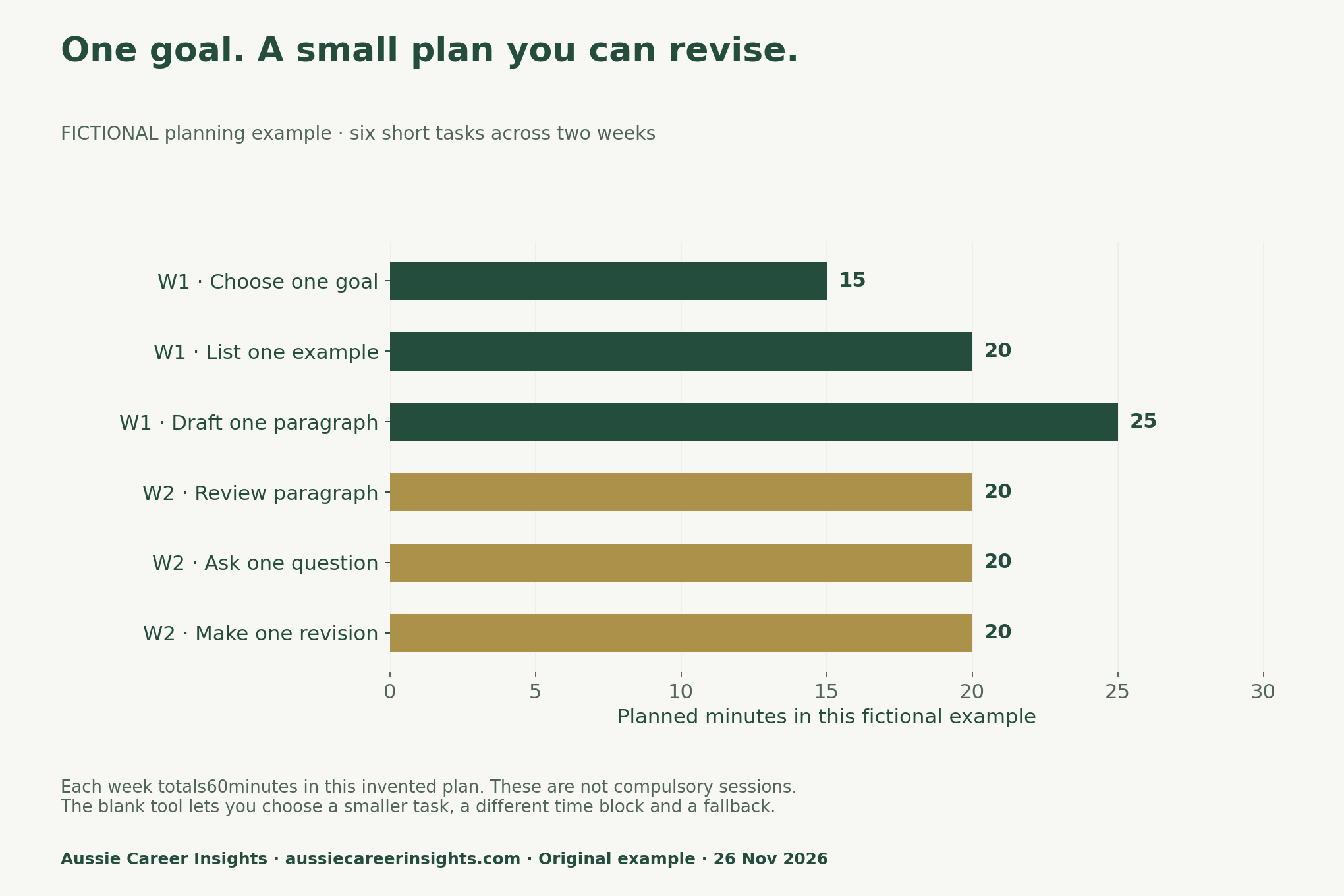
Add a family time block beside each task, then a smaller fallback. If the planned block disappears, the fallback could be one sentence, a short voice note or a saved question. Reschedule the task without treating an interrupted week as a failed attempt at returning to work. Choose a pace that fits your circumstances.
At the end of the second week, review the evidence of progress rather than counting activities alone. Is one question answered? Is one paragraph clearer? Do you know which support to ask for next? A short record can make the next conversation more specific without pretending that attendance itself guarantees an outcome.
Download the self-check and planning files
The source-data file separates numerical programme facts from their limits. The goal table links three common reader questions to outputs. The blank two-week sheet contains no personal identifiers, and the fictional time file exposes every minute used in the chart. We use two charts because the available data support duration and planning comparisons, not a fabricated outcomes dashboard.
Your Personalized Career Strategy
Unlock your potential with tailored career consulting. Get clear, actionable steps designed for your success. Start now!
Get Started- Programme facts, current intake notes and limits (CSV)
- Study, application and interview goal options (CSV)
- Blank two-week task and fallback planner (CSV)
- Fictional task-time calculations (CSV)
Browse related Education and Training reporting and Research & Reports. Suggested citation: Aussie Career Insights, “Work Ready Parents Eligibility: Plan Your First Step”, 26 November 2026.