




Australia part-time employment October 2026 figures show a large seasonally adjusted net decline in people employed part-time. They do not count available vacancies or tell an individual where to apply. Use the national result as context, then test a clearly defined local search before changing direction.
The ABS October release, published 19 November, reports total employment down 43,500, comprising a 40,600 part-time fall and a 2,900 full-time fall. Trend total employment rose 7,200. These are different statistical views, not contradictory counts of separate groups.
Australia part-time employment October 2026: what fell?
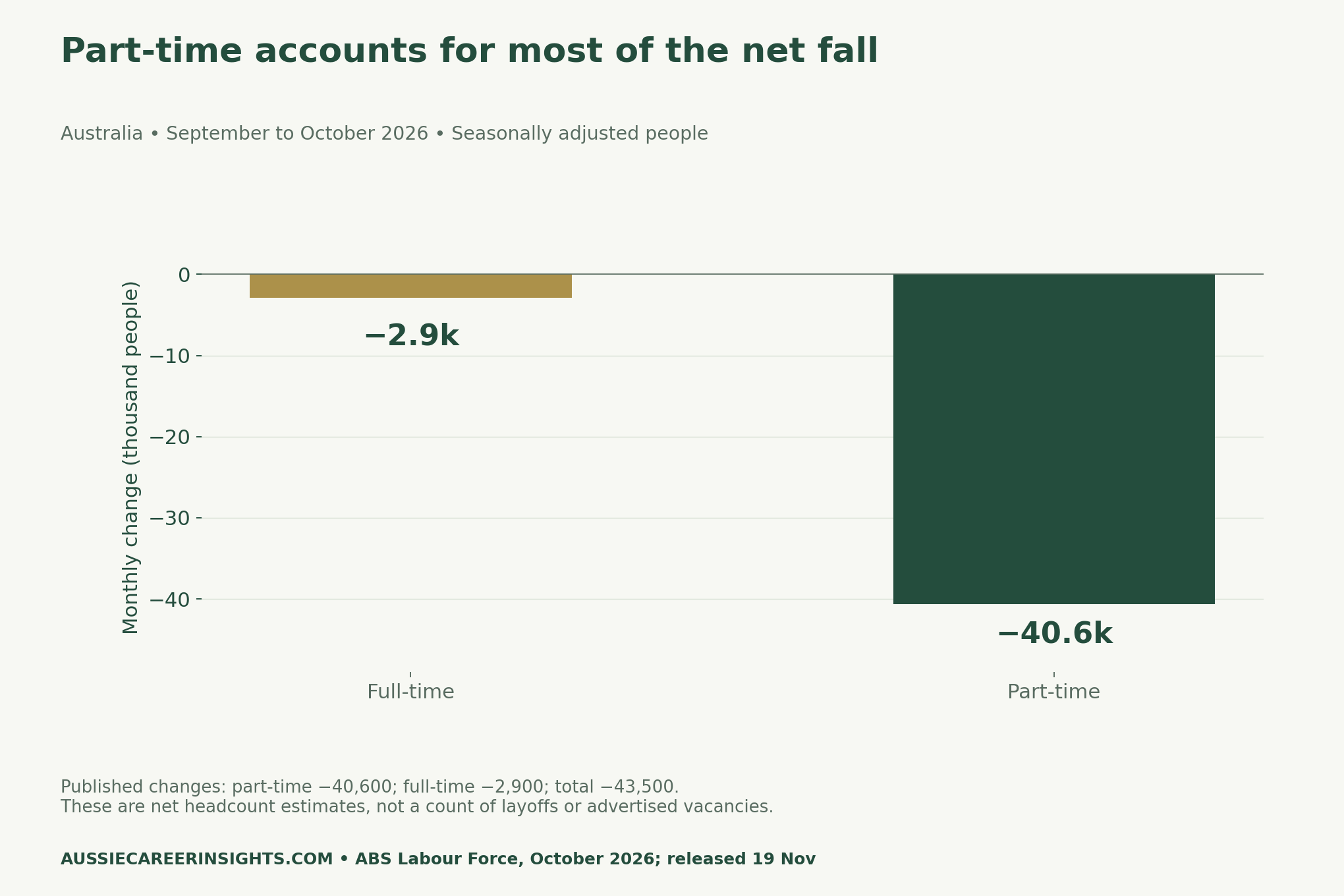
The part-time movement is about 93.3% of the magnitude of the published total decline: 40,600 ÷ 43,500 × 100. That is an arithmetic description of these net changes. It is not the share of workers laid off, a probability of losing a role or the proportion of advertised jobs that disappeared.
ABS uses an hours-based distinction between full-time and part-time employment across a person’s jobs. A job advertisement’s contract label is a different piece of evidence. Do not substitute casual for part-time or assume every listing with flexible hours falls into the same category.
Why the adjusted headline and trend differ
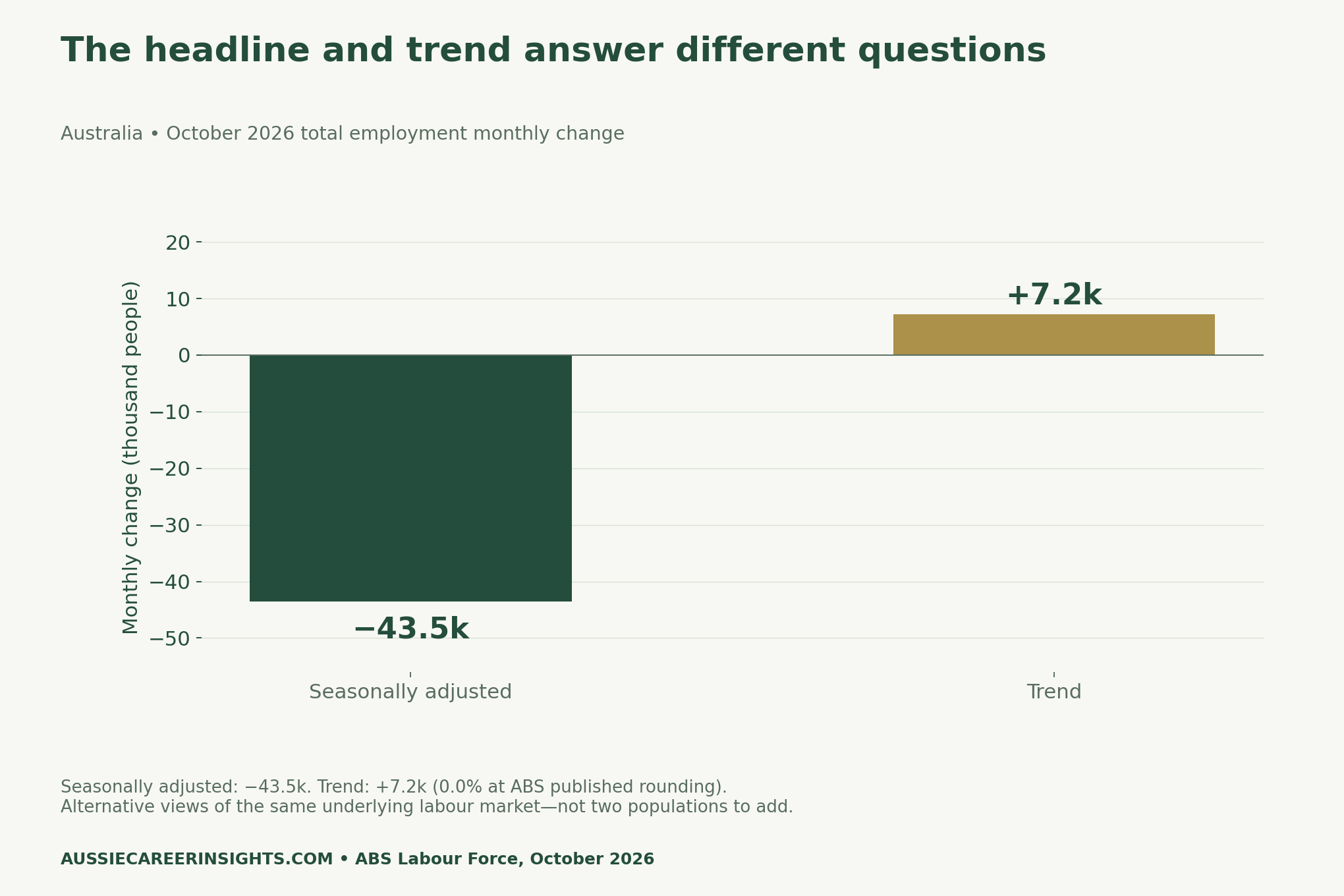
Seasonal adjustment deals with recurring seasonal patterns. The trend smooths the series to help describe underlying movement. The ABS reports the trend monthly percentage change as 0.0% after rounding, even though the headcount change is positive. Do not replace the published headcount with zero.
Use the published movement fields. Subtracting rounded endpoint levels can produce a different answer, and reconstructing percentage-point changes from rounded rates can mislead. The accompanying CSV retains each series, unit and measure separately so the original labels remain visible.
A survey estimate also has uncertainty
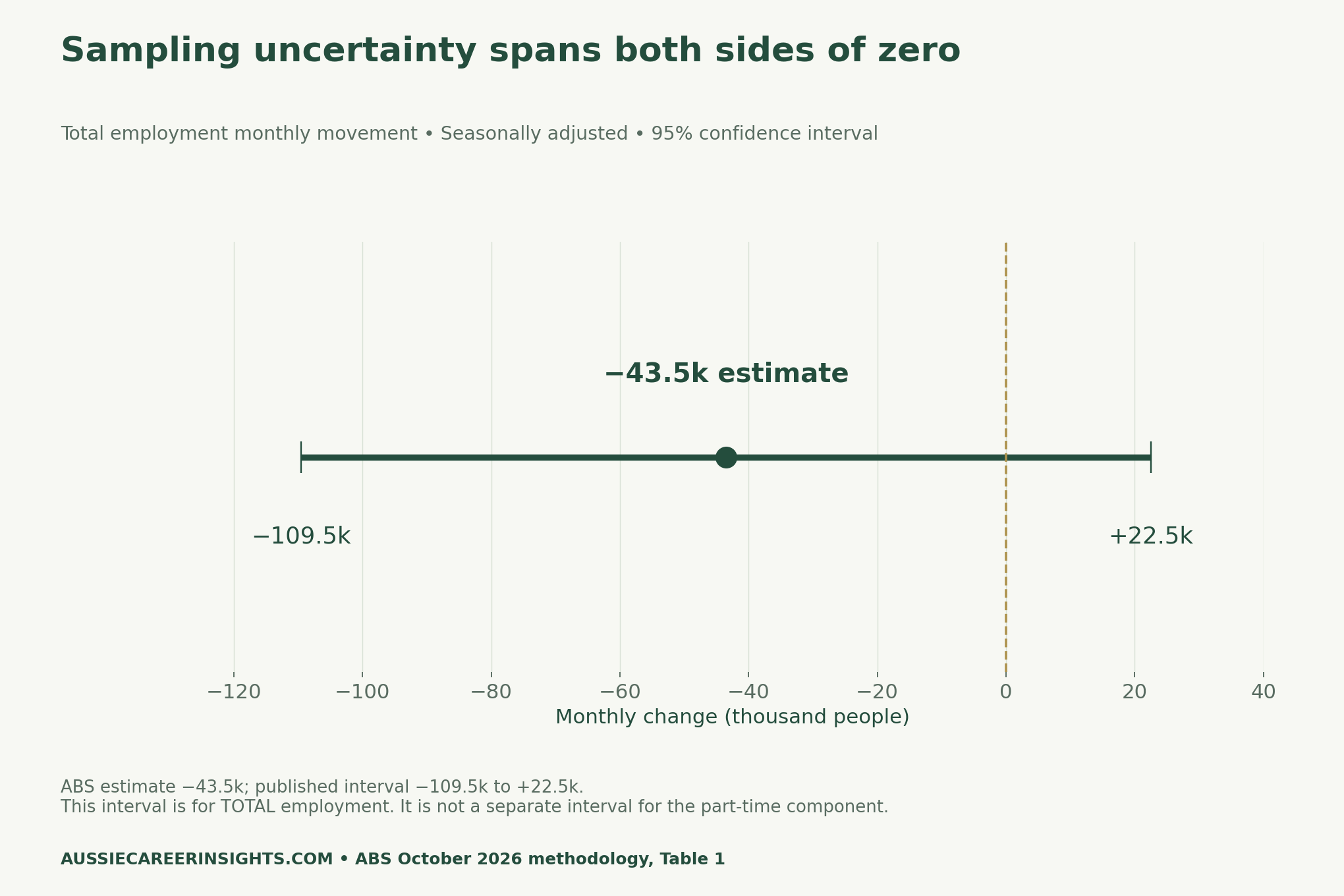
The October methodology, Table 1, supplies that total-employment interval. Its sampling and rotation notes also explain why monthly results need care. We have not calculated a new part-time interval or tested a difference between the component changes.
The interval crossing zero is a reason to avoid certainty about a precise monthly population movement. It does not prove that the labour market is unchanged or that every local job search is easy. National estimation and a reader’s actual opportunities remain different questions.
Keep unemployment and underemployment labels intact
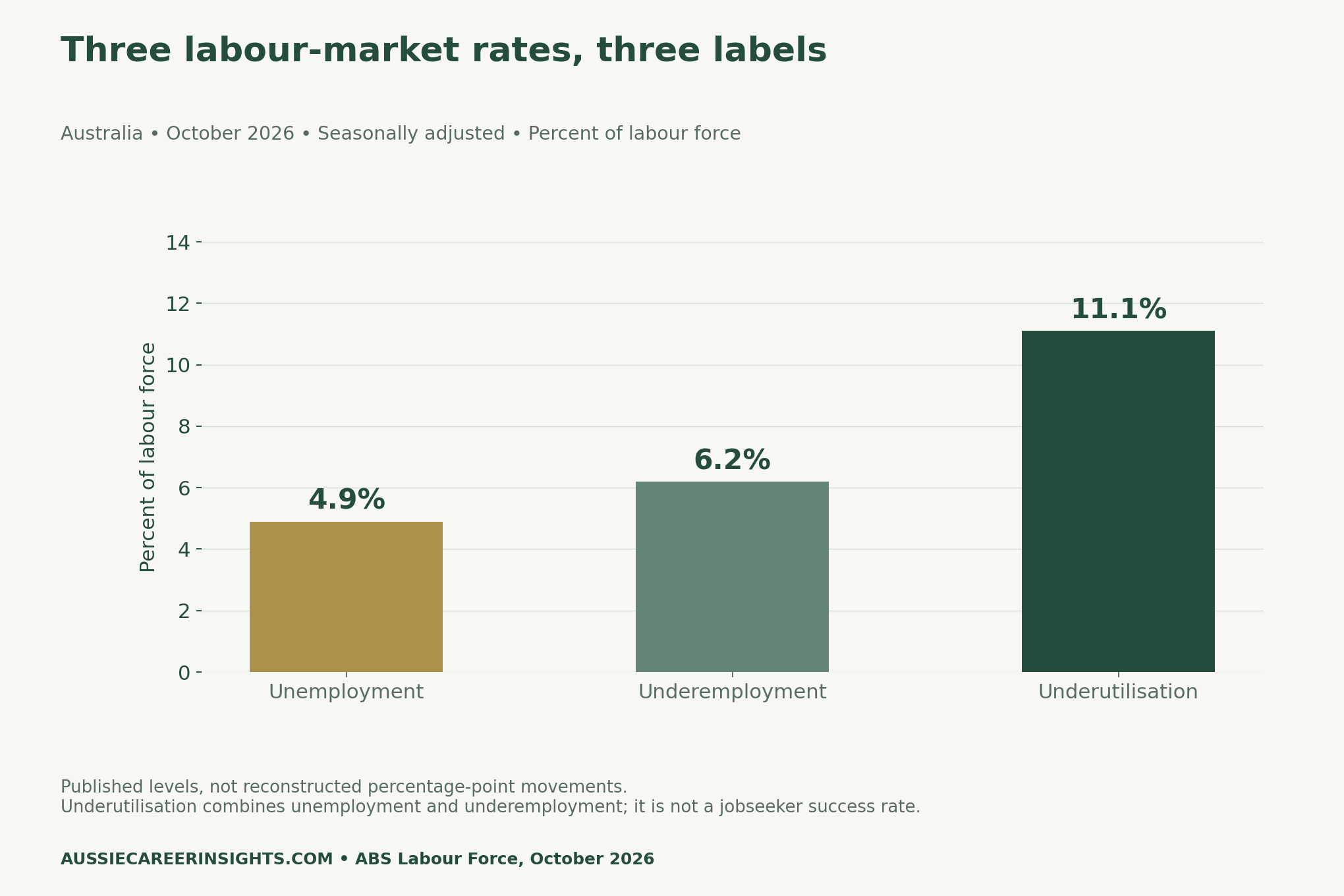
The ABS media release discusses unemployment and hours worked, and distinguishes trend underemployment from the adjusted series. Trend underemployment is 6.3%, while the adjusted figure is 6.2%. Keep the series label when quoting either number.
A low or high national rate does not establish whether a particular role fits a commute, care schedule or study timetable. To make a search decision, document those constraints and the actual listings that meet them. Do not widen everything at once and then attribute a change in results to one factor.
Run a two-week search with a fixed comparison
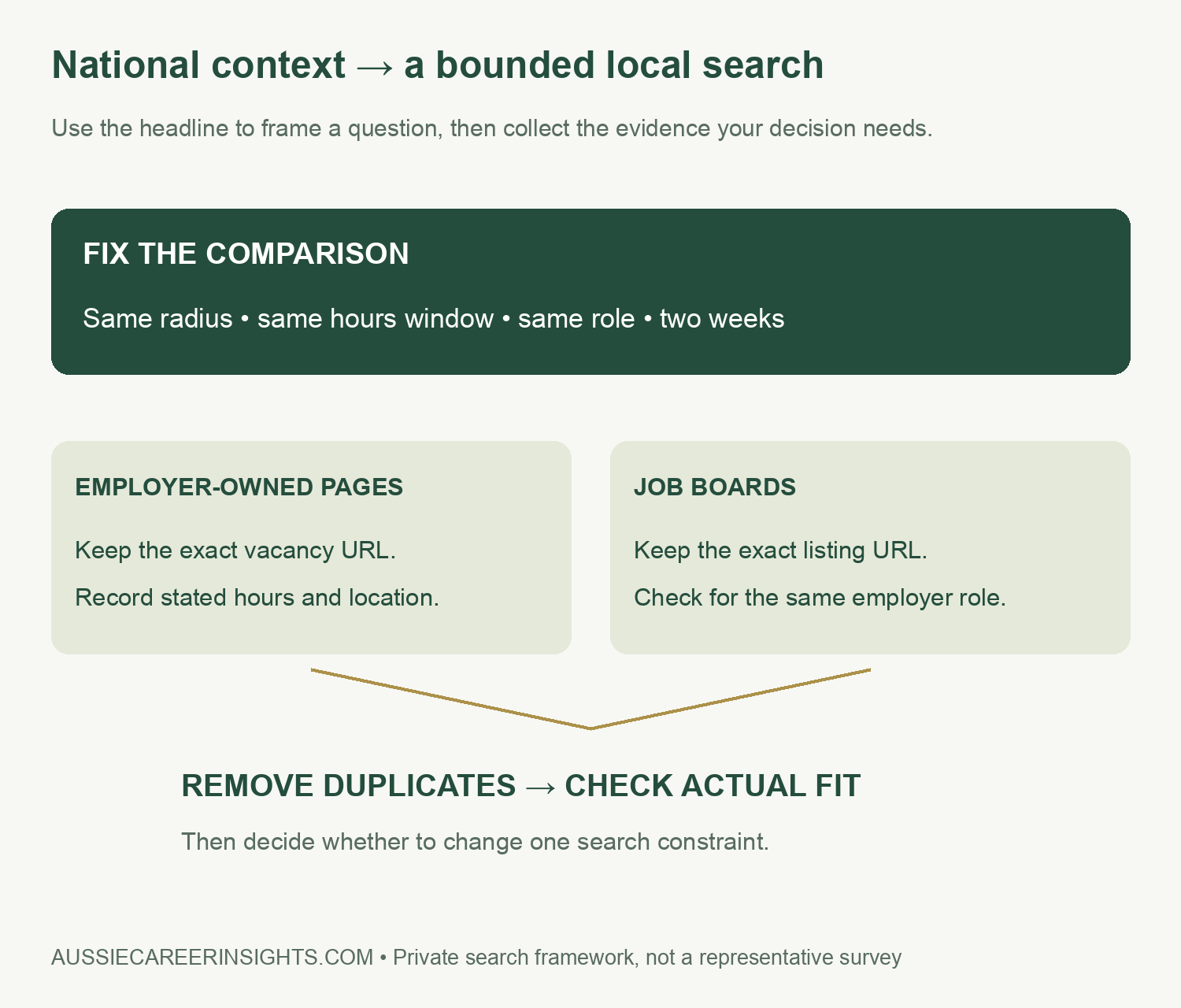
Choose a radius, hours window and role that you can state clearly. Keep them unchanged for the initial two-week observation. Search employer-owned pages and job boards within that same scope. Record the exact URL, employer, location, stated part-time status and actual hours where provided.
When the same opportunity appears twice, keep both source references but count the role once. Use the duplicate field to connect the rows. If the hours are not stated, leave that question unresolved instead of counting the listing as a confirmed fit.
Log applications and responses separately. An automated acknowledgement is not an interview, and silence after a few days is not a final rejection. Keep observation dates so you do not compare a newly submitted application with one that has had much longer to receive a response.
At the end, inspect where the mismatch occurs. If many unique roles miss the hours window, decide whether that constraint can realistically change. If there are few suitable listings, consider one controlled change to radius, role or channel. Record the change and start a new comparison period; do not claim a hiring-probability estimate.
Method, limitations and downloadable records
We transcribed ABS published changes, rates and the total-employment confidence interval, then calculated the part-time magnitude share. We did not subtract rounded employment levels, merge vacancy-ad series or run a local job-market survey. The worksheet is blank and makes no claim about an observed community or sector.
Your Personalized Career Strategy
Unlock your potential with tailored career consulting. Get clear, actionable steps designed for your success. Start now!
Get StartedNational monthly estimates do not identify local vacancies or forecast the next release. Later revisions can alter the series. Keep the reference period, publication date and adjustment type with any citation. For a separate decision about a particular agency offer, our Victorian provider-licence guide addresses identity and status rather than national employment movement.
- ABS published measures and confidence interval (CSV)
- Original calculation and interpretation notes (CSV)
- Blank two-week duplicate-controlled search sheet (CSV)
- Measure and search-field dictionary (CSV)
Sources: Australian Bureau of Statistics, Labour Force, Australia, October 2026, methodology and full-time/part-time explanation, checked 22 November 2026. Suggested citation: Aussie Career Insights, “Part-Time Jobs in Australia: Read the October Data Correctly”, 22 November 2026. Original charts and arithmetic with ABS attribution.


