





Cancer Australia rural placements offer a small, specific professional-development opportunity: two six-week supported placements for eligible rural, regional or remote health-service leaders. Before asking your employer for endorsement, define what you would learn and what your home service could realistically use afterwards.
This guide separates the official opportunity from our original planning tools. It includes two charts, a responsibility infographic and four CSV files. The service-improvement example is fictional and uses no patient information. It is a planning exercise, not clinical guidance or evidence that a placement improves patient outcomes.
Cancer Australia rural placements: dates and scope
Cancer Australia’s 24 November announcement opens two placements with Chris O’Brien Lifehouse and the Peter MacCallum Cancer Centre. Applications close at 5 pm AEDT on 23 December 2026. Each placement lasts six weeks; the programme page places them between March and May 2027.
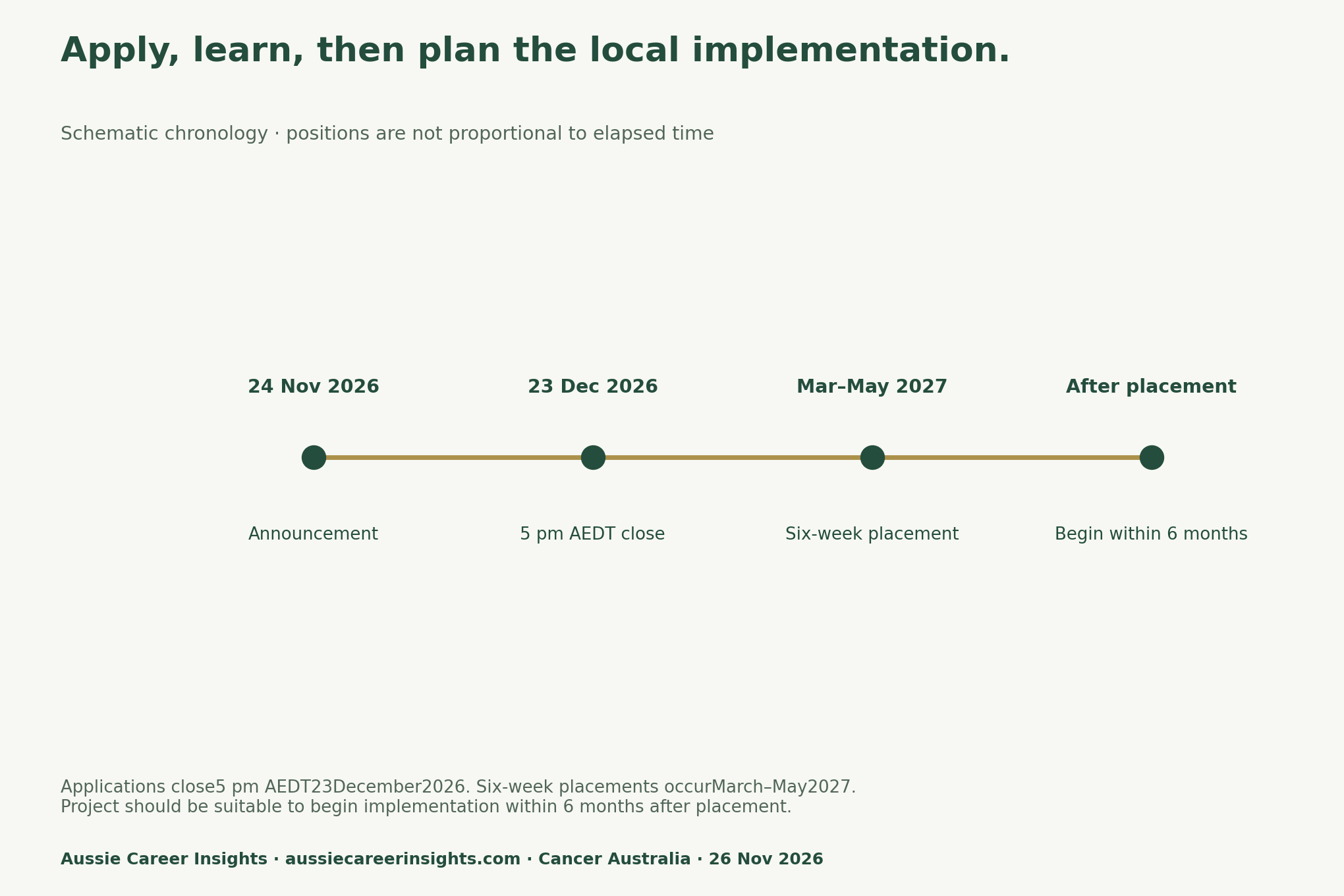
Do not treat this as an entry-level nursing intake, an agency job or a general recruitment drive. Its value is a supported learning period linked to the applicant’s existing service responsibilities. A suitable application should explain the local problem and the authority available to act on what is learned.
Check the applicant, employer and relationship conditions
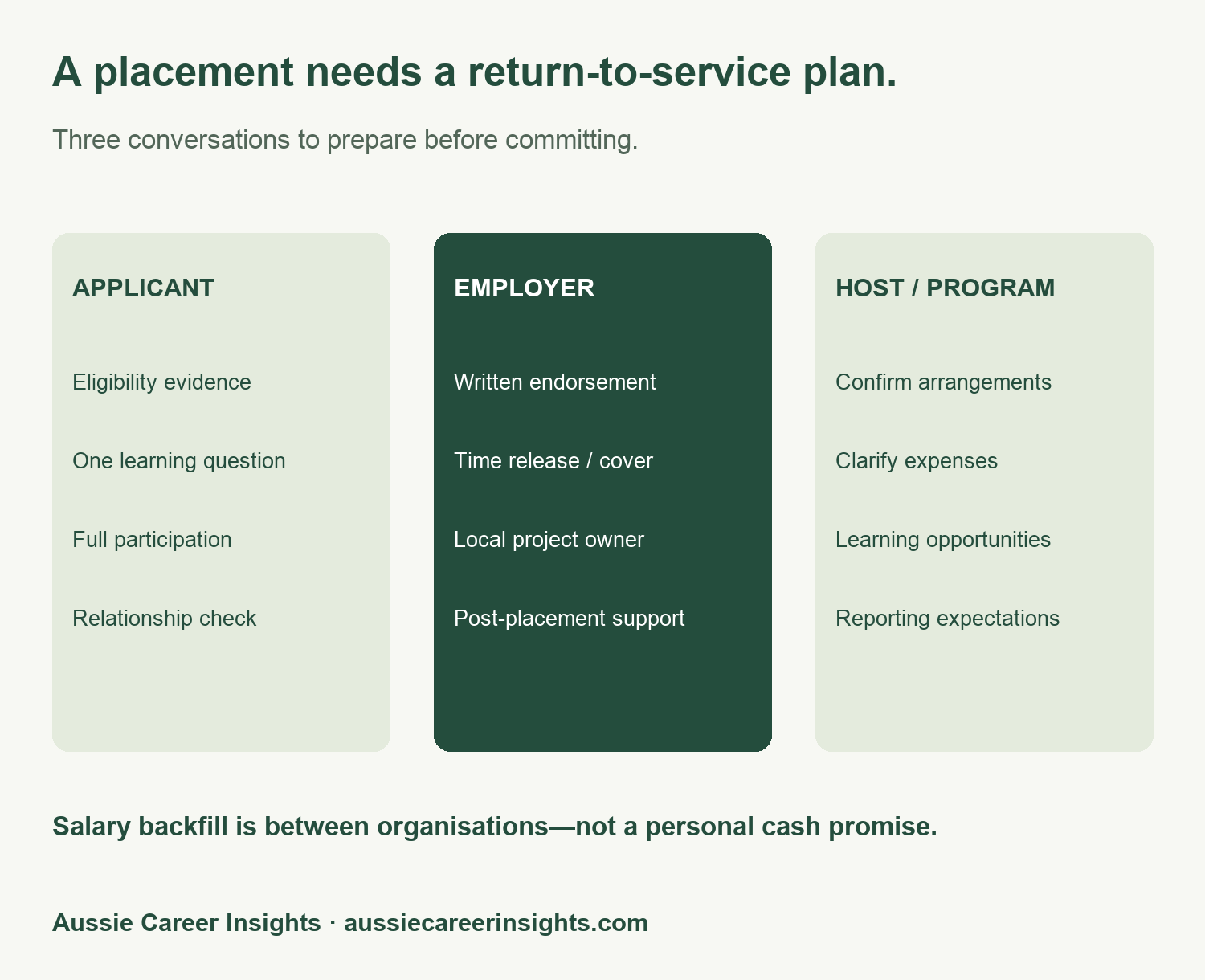
The official eligibility page requires ACCN registration, eligible rural/regional/remote employment, a relevant role and influence over service change, full participation and written employer endorsement. It separately requires organisational support for participation, local learning and follow-up. Read all mandatory conditions together; a job title alone is not enough.
There is also an existing-relationship exclusion involving either host centre. The official definition includes specified employment, secondment, fellowship, governance, advisory, training and formal professional-development arrangements. Ask the programme if your circumstances are unclear rather than assuming an informal description settles the question. Do not omit a relationship to make an application appear eligible.
Use the endorsement sheet to assign each unresolved question to an owner. The applicant may gather role evidence, while the employer confirms release and local support. Mark an unanswered item as pending. This helps distinguish a complete eligibility record from a persuasive project idea that still lacks an essential organisational commitment.
Clarify the financial arrangement before planning expenses
The programme describes salary backfill support through an arrangement between the host comprehensive cancer centre and the employer organisation. That is different from a promised personal payment. Do not enter an assumed cash amount in your household budget based on the word “supported”.
Ask who confirms travel, accommodation and any other expenses, what is included and what remains your or your employer’s responsibility. Leave unspecified amounts blank until you have written clarification. Keep these practical arrangements beside the release plan so a funding assumption does not become a last-minute obstacle.
Draft one useful improvement proposal
Our fictional example concerns a referral handoff record. The proposed question is whether a local team can make confirmation of receipt easier to record and find. A process owner would first define the handoff, the record source and the review period. Any real service would need its own approvals and privacy arrangements before collecting information.
Suppose an invented audit contains 20 handoff records. Twelve have confirmation documented and eight do not. The documentation proportion is 12 ÷ 20 = 60%. The remaining 40% describes an absent record field, not proof that care failed or a referral was lost. Keep the measure tied to what was actually observed.
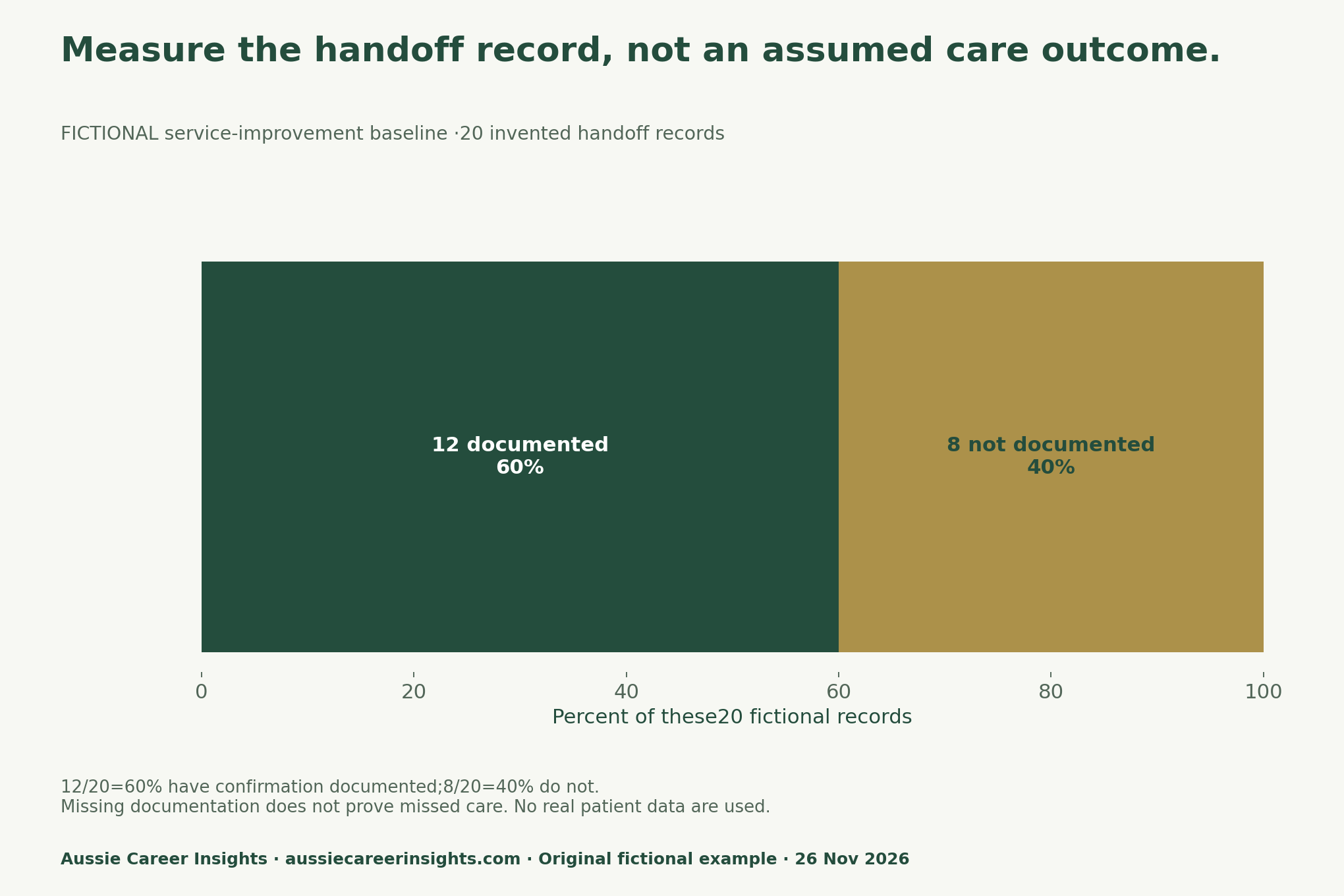
A focused learning question could be: “How does the host make handoff responsibility and receipt confirmation visible to the sending team?” The home-service proposal would then name a local owner, one small change to test, the approval needed and the same documentation definition for a later check. Do not promise an improvement percentage before a real evaluation.
| Proposal element | Fictional example | What remains to confirm |
|---|---|---|
| Problem | Receipt confirmation hard to find | Local definition and baseline access |
| Owner | Named local process lead | Authority and protected time |
| Learning question | How is handoff responsibility visible? | Host learning opportunities |
| First action | Review one recording workflow | Local approval and feasibility |
| Evaluation | Repeat the same documentation measure | Timing, privacy and interpretation |
Plan the return, not only the six weeks away
The programme expects a potential project suitable to begin implementation within six months after the placement. Beginning is different from completing the project or demonstrating a result. Write the first local decision, who will make it and what evidence that decision needs. Then identify a feasible start window with your employer.
The endorsement conversation should also cover how you will share learning with colleagues. A short debrief and a practical process note may answer different needs. Record the intended audience and output, then confirm the reporting and evaluation activities required by the programme. Avoid treating a presentation alone as proof that local practice changed.
Download the endorsement and proposal tools
The official-facts file records dates, duration and funding scope. The endorsement sheet keeps the three eligibility groups distinct. A blank project page supports one focused proposal, while the fictional baseline file reproduces the chart. Two charts are enough here: chronology and a clearly labelled documentation example; no vacancy or outcome statistics are invented.
Your Personalized Career Strategy
Unlock your potential with tailored career consulting. Get clear, actionable steps designed for your success. Start now!
Get Started- Official opportunity facts and boundaries (CSV)
- Applicant and employer endorsement checks (CSV)
- Blank one-page improvement proposal (CSV)
- Fictional handoff-documentation calculations (CSV)
Read more in Healthcare and Medical Services and Research & Reports. Suggested citation: Aussie Career Insights, “Cancer Australia Rural Placements: Plan What You Bring Back”, 26 November 2026.