





An APS section 26 transfer can support a temporary move between Australian Public Service agencies, but a promising conversation is not the completed agreement. An ongoing APS employee needs the right written arrangement, clear dates and an understanding of the conditions that will apply.
This guide combines the latest reported mobility figures with an original agreement planner. It includes two charts, a three-party infographic and four CSV tools. The national figures provide workforce context; they do not reveal an individual’s chance of securing a temporary transfer.
What the new APS mobility figures actually count
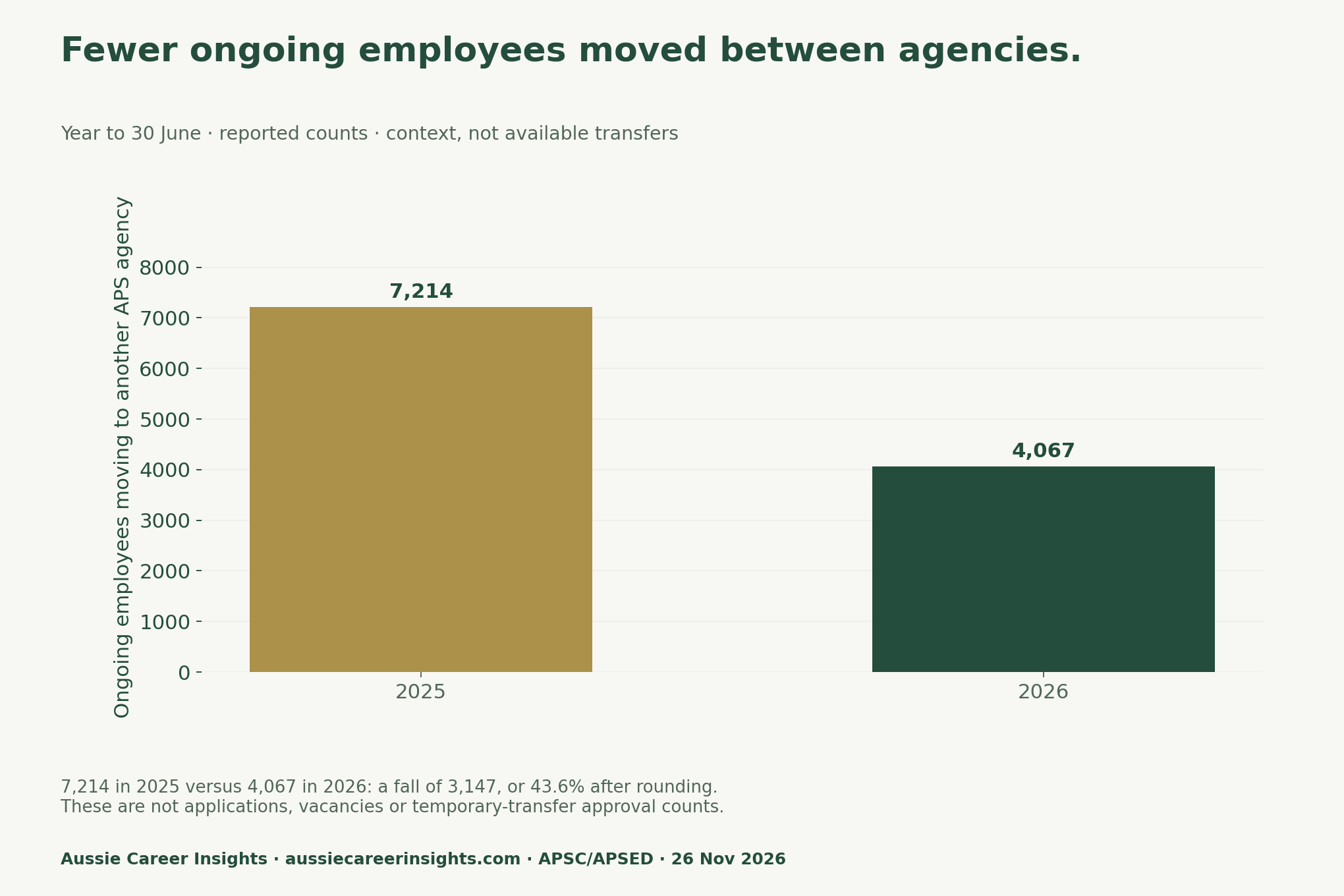
The 2025–26 State of the Service report’s workforce section records 4,067 ongoing employees moving to another APS agency in the year to 30 June 2026. The previous year’s count was 7,214. That is a fall of 3,147, or 43.6% after rounding. These are movement counts, not applications or advertised opportunities.
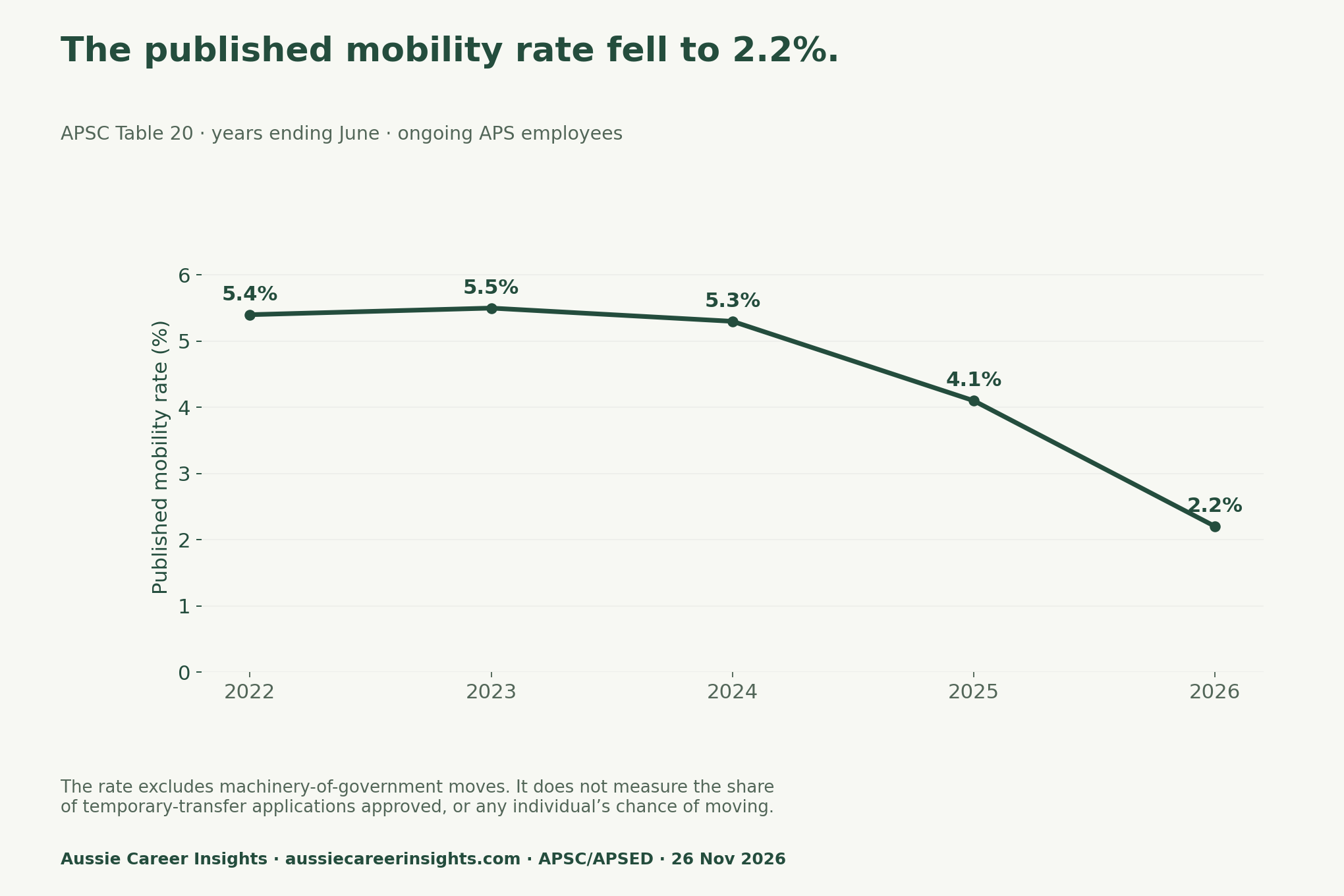
The published mobility rate fell from 4.1% to 2.2%, a change of 1.9 percentage points. The report notes that the rate excludes machinery-of-government moves. A lower workforce rate cannot be converted into the probability that your proposed six-month move will be agreed. The relevant application denominator is not provided by this table.
APS section 26 transfer: who agrees to a temporary move?
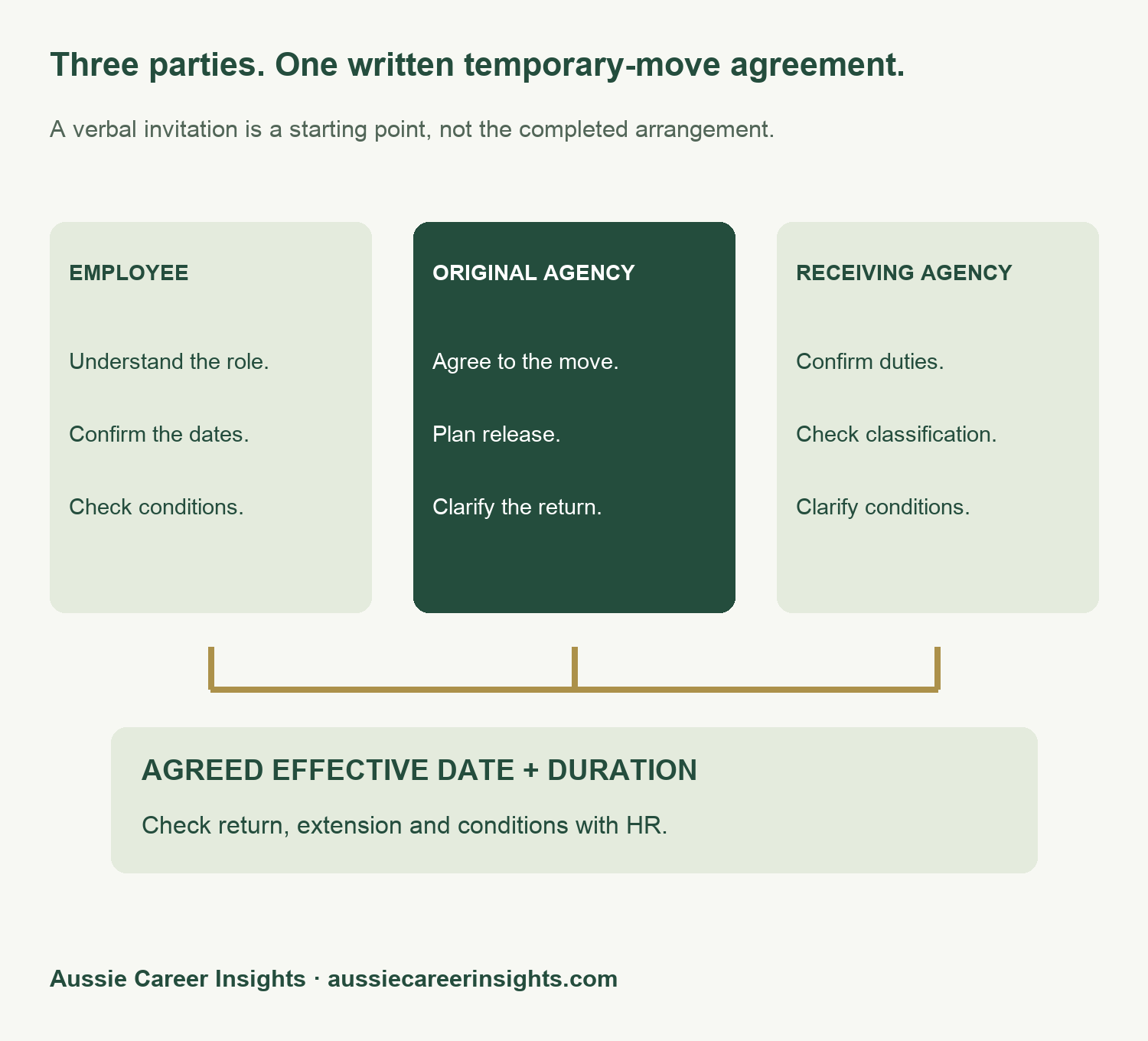
APSC’s employee-movement guidance explains that a temporary move requires written agreement from the ongoing employee and the heads of the original and receiving agencies. All parties must agree the effective date and duration in writing. The guidance does not prescribe a universal minimum or maximum term for this arrangement.
This route concerns ongoing APS employees moving between APS agencies. Do not present it as an entry route for an external applicant, a state public servant or every kind of secondment. If you are unsure which movement mechanism applies, ask HR before using a template intended for a different arrangement.
Start with the role and its conditions
Ask for the role title, actual duties, classification and work location. Then ask HR how the receiving agency’s pay and conditions apply to the proposed period. Keep the answer linked to the relevant instrument or written advice. A familiar classification label alone is not enough to establish that every condition will remain identical.
APSC explains that the receiving agency becomes the employer during a section 26 transfer, including a temporary one. Check the practical implications for pay, leave and service records with HR. Do not use an informal promise from a potential team manager as a substitute for the authorised agreement and conditions check.
A fictional six-month proposal: interest is not agreement
Imagine an ongoing employee whose potential host manager expresses interest in a six-month project move. At this stage, the employee has an opportunity to discuss, not a confirmed temporary arrangement. The original agency still needs to address release, while the receiving agency and employee need to clarify the role and conditions.
The employee can use the planner to record one question per row: who agrees, when the move would start, how long it would last, what duties apply, and what happens at the end. An answer should be marked confirmed only when the appropriate written evidence exists. Leave unresolved items visible rather than filling them with assumptions.
| Fictional stage | What it establishes | What it does not establish |
|---|---|---|
| Host expresses interest | A conversation can begin | All-party temporary-move agreement |
| Home agency discusses release | A practical issue is being considered | Written consent already given |
| HR checks conditions | Relevant questions and instruments identified | All terms automatically unchanged |
| Written arrangement completed | Agreed parties, date and duration documented | A promotion or extension automatically follows |
Agree the end of the move before it begins
The APSC mobility guidance for HR practitioners stresses care with the written terms and variations. Ask how the return will be arranged, who will contact each party before the end, and what process would be used for an extension or early change. A diary reminder can support that conversation, but it cannot itself vary an agreement.
In the fictional case, the employee schedules a check-in before the six months end. That is an original planning suggestion, not a statutory notice period. If an extension is proposed, the parties should use the applicable written process. Do not treat continuing project work or verbal enthusiasm as proof that the original duration has changed.
Keep temporary, ongoing and promotion decisions distinct. A move can raise several employment questions at once, but one label should not silently answer the others. Record the specific question and ask the responsible HR team to identify the correct process. Individual circumstances may require a more detailed check than this general planning tool.
Download the source data and agreement planner
The source file retains the five published mobility rates and the two reported counts. The calculation register exposes the count and percentage-point changes. The blank agreement planner and fictional case log separate discussion from confirmation. Two charts cover the distinct numerical evidence; the infographic explains the three-party arrangement without inventing approval statistics.
- Published mobility counts and rates (CSV)
- Blank written-agreement discussion planner (CSV)
- Fictional six-month proposal log (CSV)
- Calculations, units and evidence boundaries (CSV)
Read more Public Service and Government reporting and Research & Reports. Suggested citation: Aussie Career Insights, “APS Section 26 Transfer: Agree the Temporary Move in Writing”, 26 November 2026.
Your Personalized Career Strategy
Unlock your potential with tailored career consulting. Get clear, actionable steps designed for your success. Start now!
Get Started