







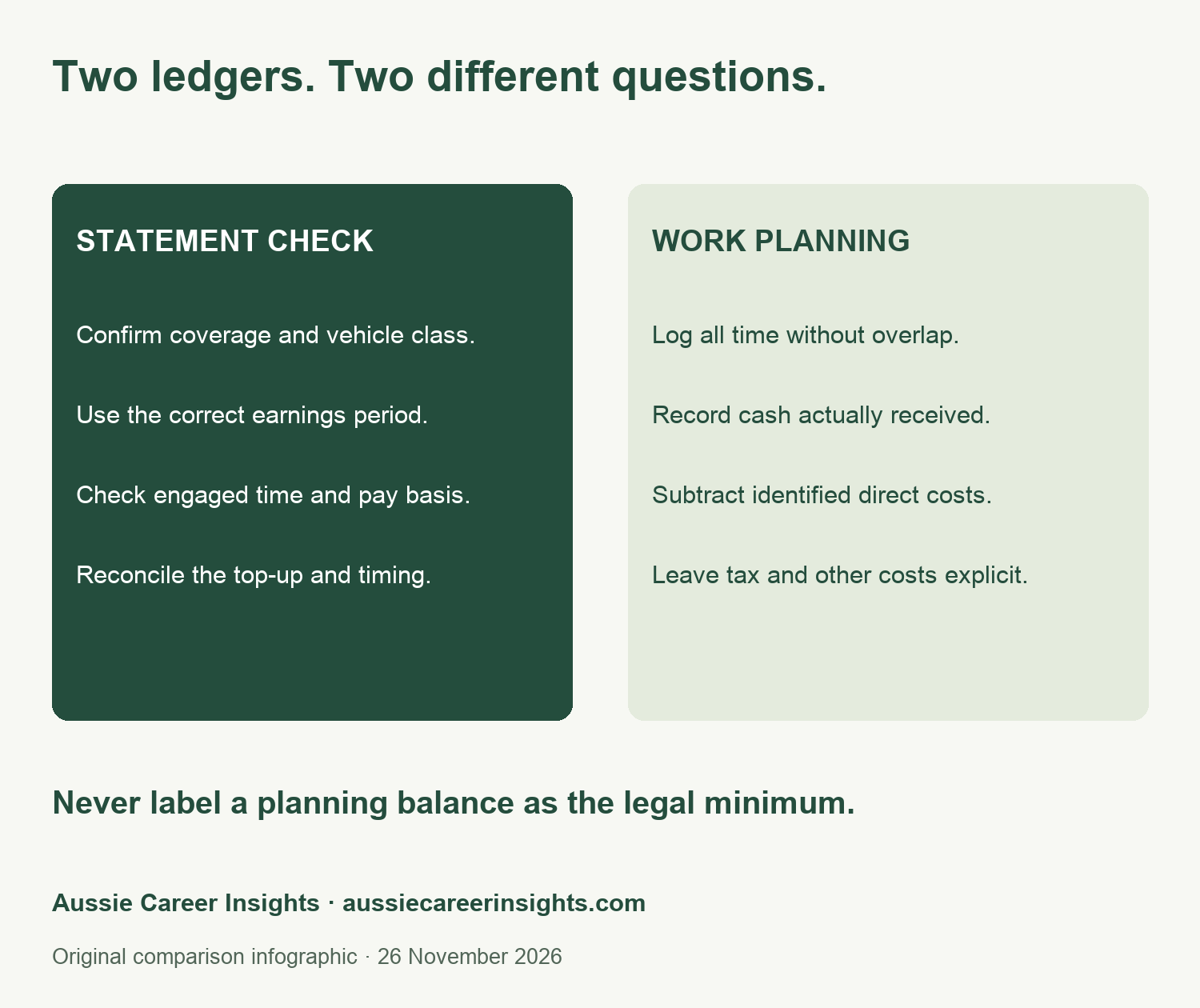
Food delivery engaged time is the starting point for checking the applicable Australian delivery-pay floor. It is not the same as every hour you commit to a shift. A useful statement check therefore keeps the legal calculation separate from your own after-cost time budget.
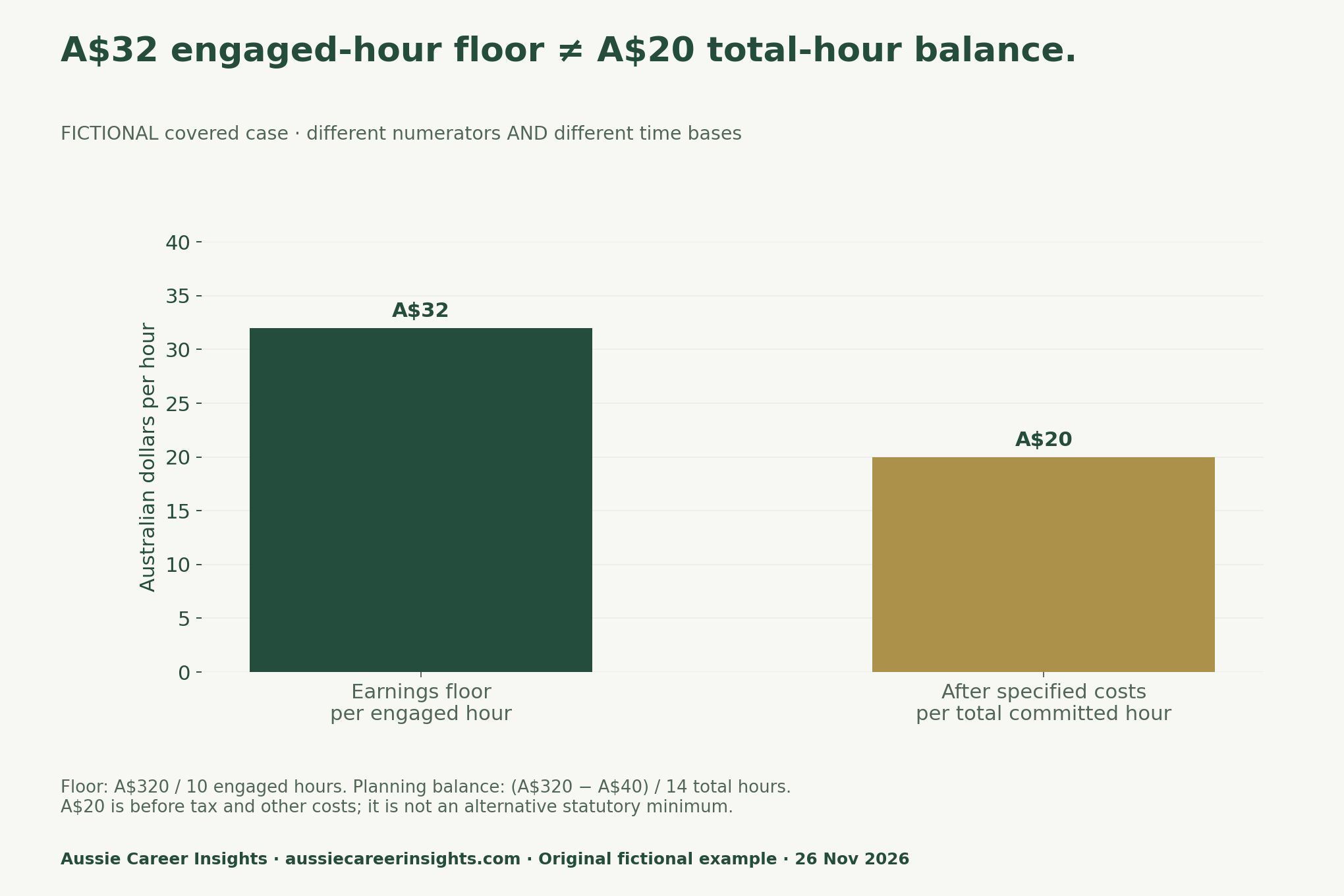
Our fictional covered car example has 10 engaged hours, A$300 in assumed comparable pay and 14 total hours committed. The earnings-floor calculation produces A$320. If that amount is ultimately received and direct expenses are A$40, the planning balance is A$280, or A$20 per total hour before tax and other costs.
Start with coverage, vehicle class and period
The Fair Work Ombudsman’s order guide covers specified employee-like independent contractors doing immediate app-based deliveries, not every person earning through a platform. Check that scope first. For the covered motor-vehicle class up to one tonne, the guide lists A$32 per engaged hour through December 2026 and A$32.50 from 1 January 2027.
For this example, assume the worker, work and vehicle are covered, and all 10 engaged hours fall within the A$32 rate period. Also assume A$300 is the correct comparable pay amount for that calculation. These assumptions matter. A bank deposit alone cannot establish the pay basis, and the worksheet does not decide whether a particular payment or deduction belongs in it.
Food delivery engaged time: reconcile the statement
Multiply the assumed 10 engaged hours by A$32. The result is A$320 for the period. Compare that with the assumed A$300 amount and the arithmetic difference is A$20. Keep the source statement, its period dates and any later adjustment together so the same top-up is not counted twice.
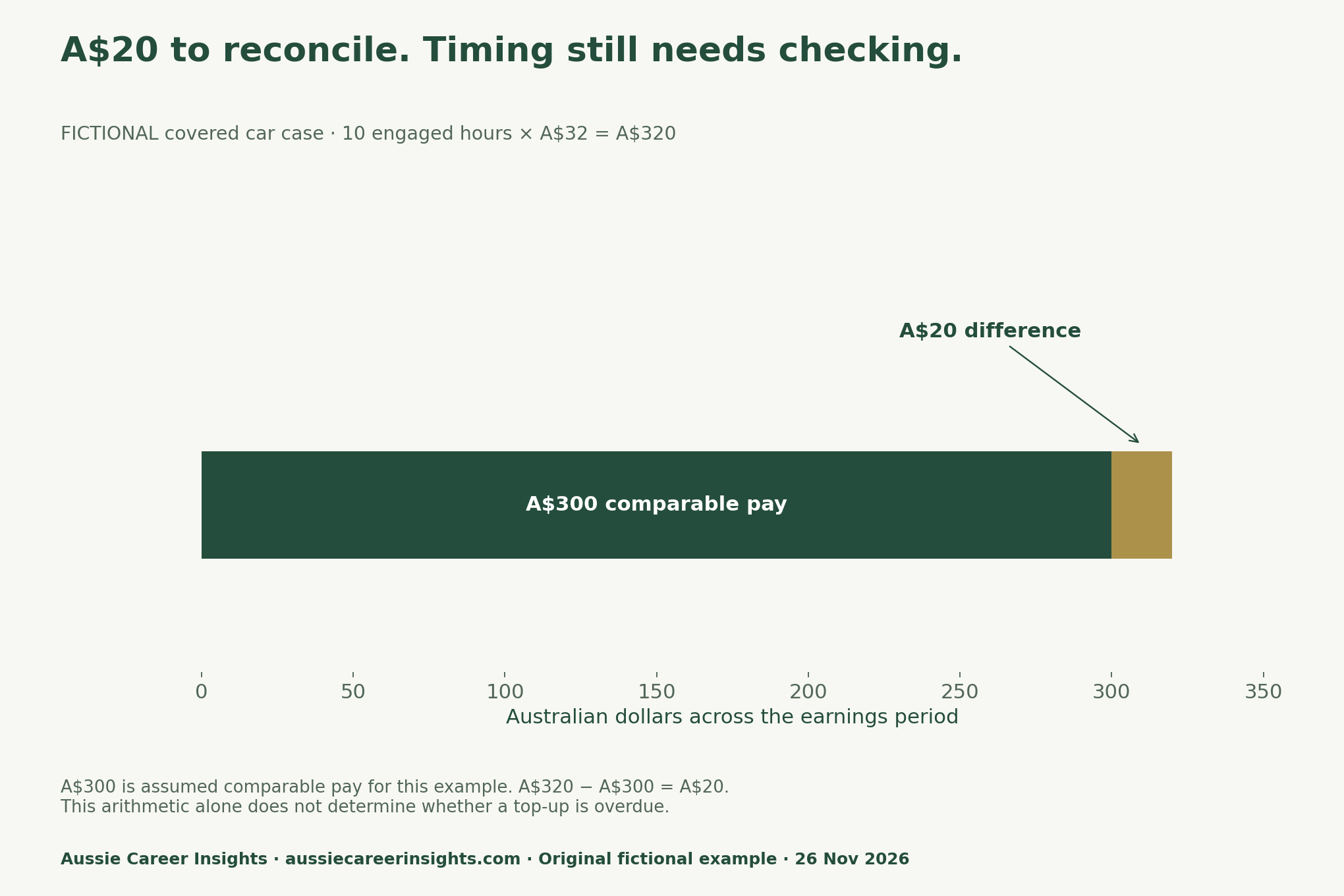
Then check the top-up window. The official guide permits payment in the next earnings period or within seven days after that next period. Do not substitute seven days after the original period. Record both period-end dates and the date of any adjustment before deciding what question to raise.
| Fictional item | Amount or time | Purpose |
|---|---|---|
| Engaged time | 10 hours | Assumed covered-time input |
| Rate | A$32 | Applicable class and period assumed |
| Earnings floor | A$320 | 10 × 32 |
| Comparable pay | A$300 | Comparison basis assumed correct |
| Difference | A$20 | Reconcile payment and timing |
Now change the question to all committed time
Suppose the worker ultimately receives the full A$320 and records A$40 in identified direct expenses. Subtracting those expenses leaves A$280. This is a limited planning balance, not a complete profit or tax calculation. Other costs could still reduce what remains.
The worker’s private time log records 14 total committed hours. Ten are engaged hours and four are other time in this invented example. Dividing A$280 by 14 gives A$20 per total hour. Dividing by only 10 would answer a different question and would hide part of the time commitment.
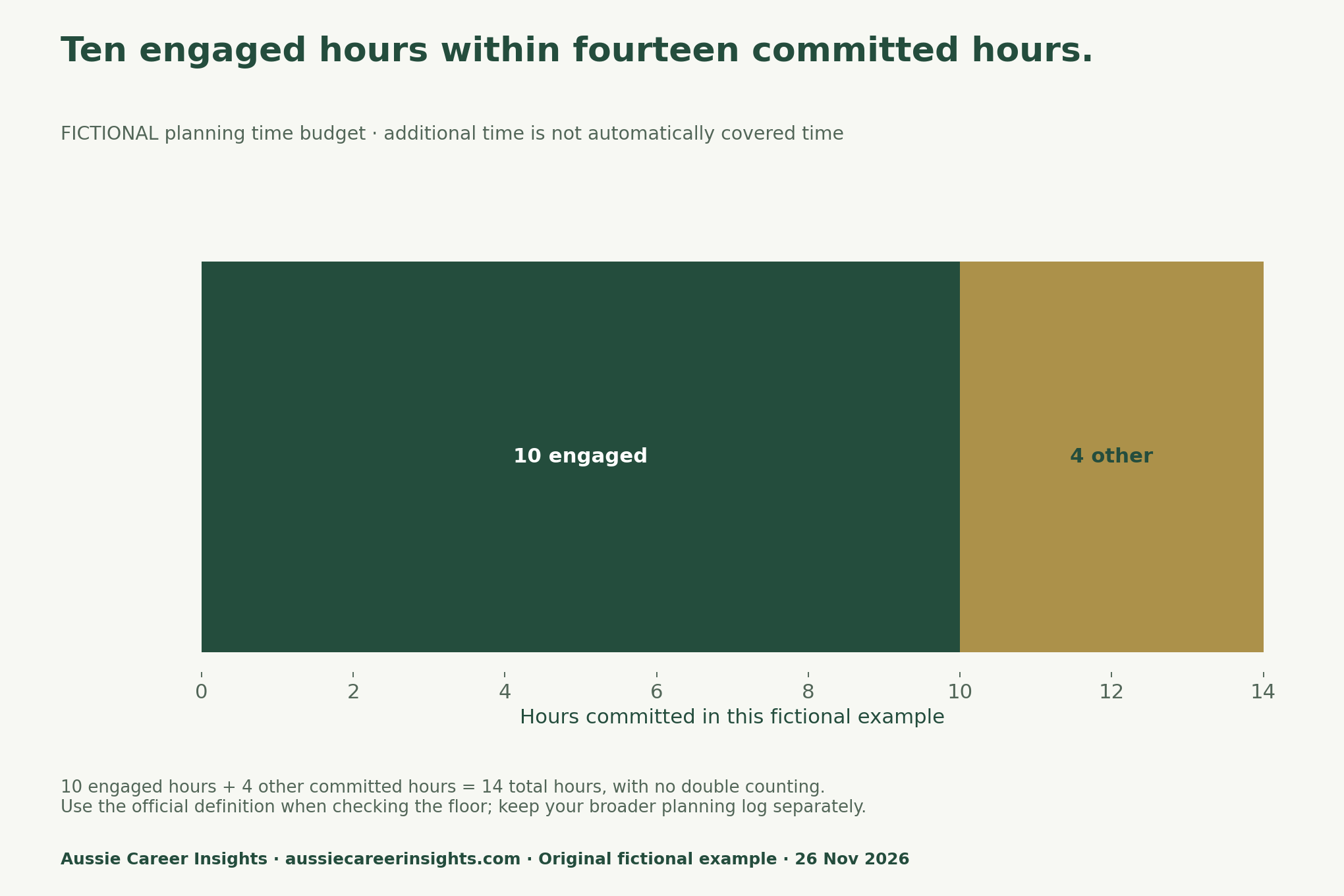
If you use more than one app, a private planning log should avoid counting the same clock hour twice. Keep an overlap note rather than simply adding two app totals. However, do not use this general bookkeeping suggestion to rewrite an operator’s legal engaged-time calculation; unresolved coverage or pay questions need the relevant official guidance.
What the new ABS platform-work figures tell us
The ABS updated Table 9 on 24 November 2026 with 2025–26 data. Its survey estimates about 180,300 people did digital platform work in the previous 12 months. Table 9b reports 52.45% doing delivery services and 32.02% treating platform work as their main job. Those are separate survey characteristics, not pay-order coverage measures.
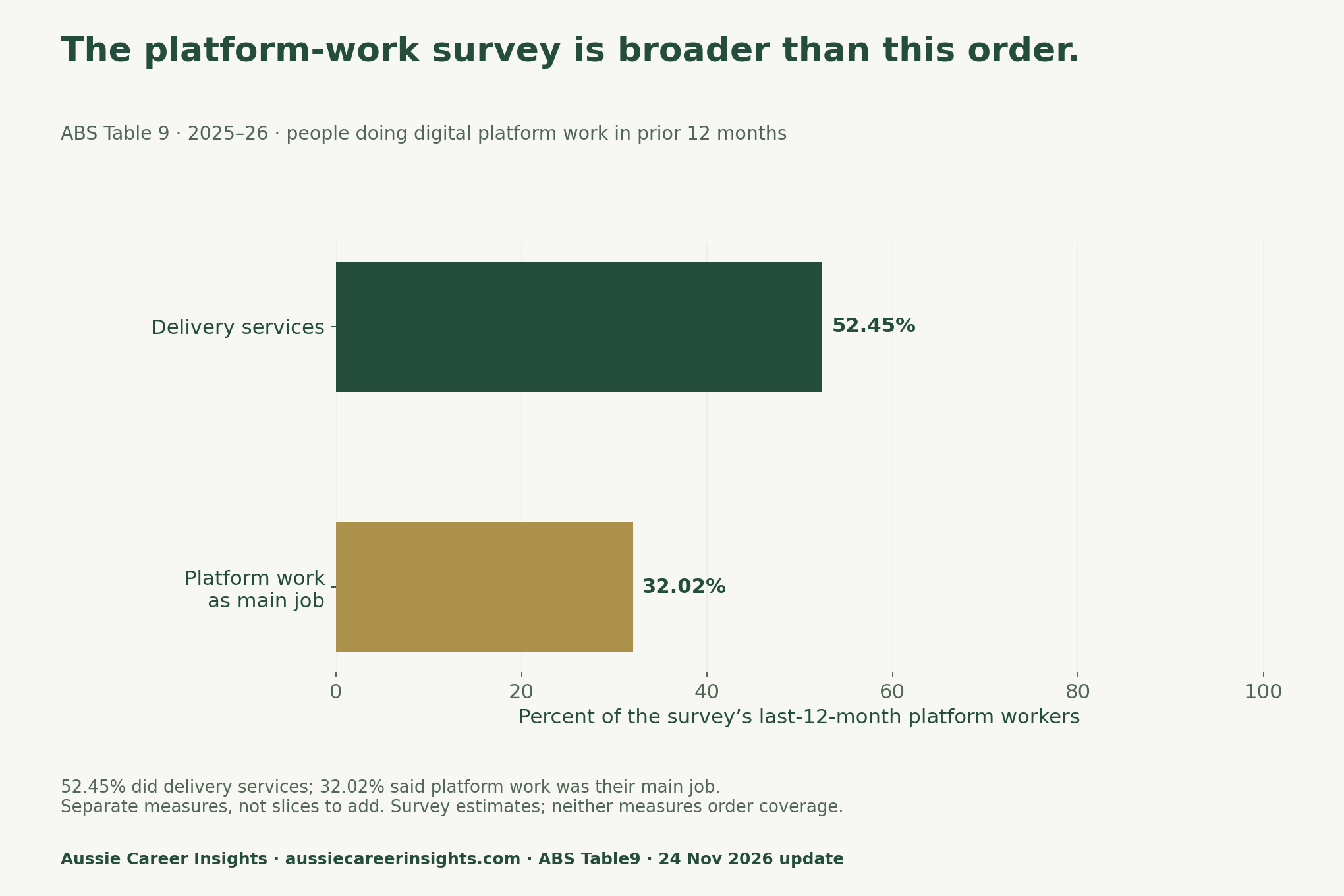
The fresh survey makes the topic timely, but it does not tell us how many workers qualify under this order, what they earn per hour or whether their statements are correct. We use it as context only. The downloadable source register retains the table location, units and reference period so readers can check that boundary.
A practical question log for an unexplained difference
Ask for clarification with the period dates, vehicle class, engaged-hour total, pay items and adjustment status. State the mismatch you can reproduce. For example: “My assumed comparison gives A$320 against A$300; which pay items and top-up dates should I use?” That is more useful than describing the whole shift as unpaid without establishing the basis.
Keep personal account details out of a shared worksheet. Retain the original statement privately and use a local reference in the blank file. If the pay basis remains unclear, mark it unresolved instead of presenting the arithmetic as a legal conclusion. Check current official guidance before applying the example to a real case.
Download the evidence and statement tools
Four charts show distinct questions: the period difference, the two hourly measures, the time budget and the survey context. We calculated the fictional amounts independently and retained the original ABS workbook. All worked pay and cost values are invented; they are not survey findings.
- ABS cells, rates and source references (CSV)
- Fictional period and total-hour calculations (CSV)
- Blank statement and time-budget check (CSV)
- Measure definitions and calculation boundaries (CSV)
Find related reporting in Transportation and Logistics and Research & Reports. Suggested citation: Aussie Career Insights, “Food Delivery Engaged Time: Check Your Australian Pay Statement”, 26 November 2026.
Your Personalized Career Strategy
Unlock your potential with tailored career consulting. Get clear, actionable steps designed for your success. Start now!
Get Started


