







Transferable skills for NSW coal workers become useful when you can show what you did, how you did it and which requirement it meets. A broad occupation label is a starting point. A dated example, a current credential and a target employer’s confirmation make the next conversation more concrete.
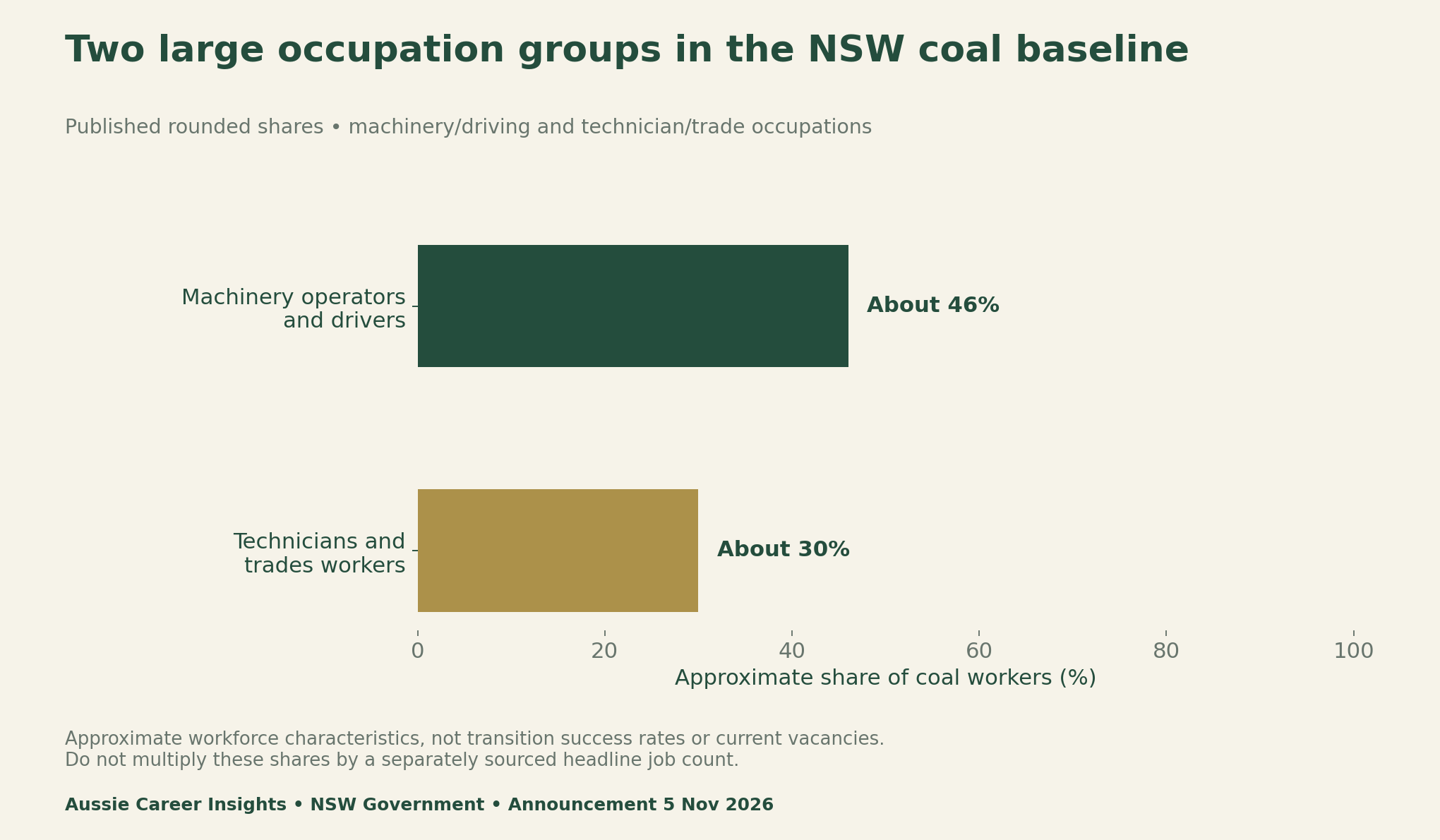
The NSW Government’s 5 November 2026 announcement puts machinery operators and drivers at about 46% of the coal workforce, and technicians and trades workers at about 30%. These figures describe a workforce baseline. They do not measure how many workers can move straight into another job. This guide turns that distinction into an evidence inventory and a cost plan.
What the NSW coal skills audit actually measured
The Skills Audit for the NSW Coal Mining Sector covers four regions and 14 local government areas. It used desktop analysis of information available in October 2026. Individual workers’ skills were not collected. Its source notes also explain that much relevant REMPLAN information is underpinned by the 2021 Census. November is the publication date, not a common observation date for every figure.
The government announcement also says about 40% of workers are 45 or older. Age alone cannot tell an adviser whether someone wants to retrain, retire, stay local or change hours. Start with the worker’s own preferences rather than assigning a pathway from a demographic group.
Build evidence of transferable skills for NSW coal workers
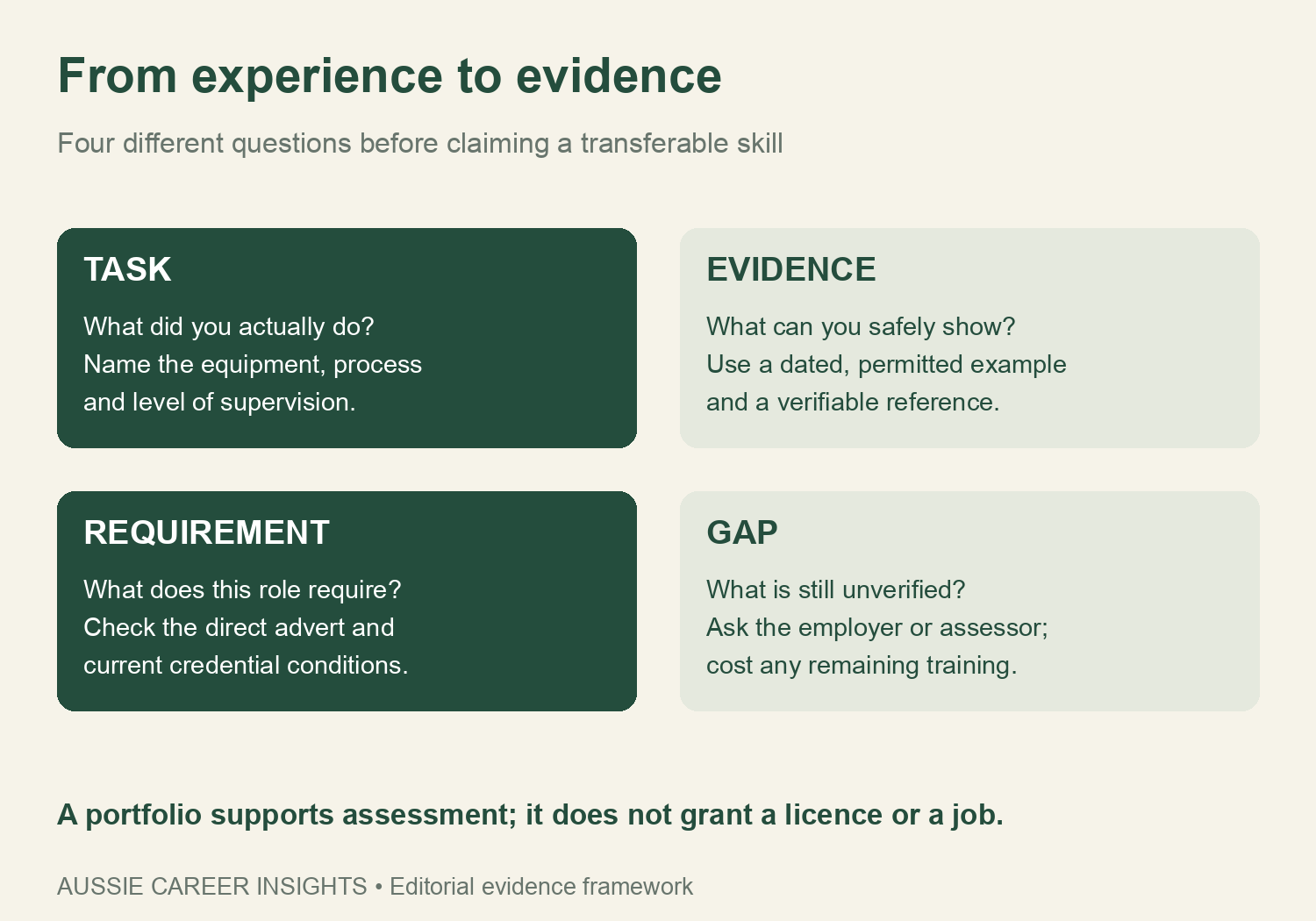
Choose one possible target role. Then write down three tasks you can explain in detail. For each task, name the equipment or process, the conditions and the supervision level. Keep doing a task separate from supervising it, teaching it or signing off another person’s work.
| Clearly fictional task example | Possible evidence to request permission to use | Question for the target employer |
|---|---|---|
| Recorded a routine equipment check under supervision | A redacted dated example and supervisor confirmation | Does this match your inspection task and supervision requirement? |
| Logged a process deviation and escalated it | A permitted blank form plus a description of the escalation route | Which reporting system and authority level does this role require? |
| Planned a maintenance handover | A sanitised task sequence and role-specific reference | What qualification, licence or authorisation must be verified? |
Ask permission before taking a work sample outside the workplace. Do not copy confidential production figures, restricted drawings, colleagues’ details or incident records into a job application. A blank template and a specific reference may explain your work without exposing information you are not authorised to share.
Use the downloadable matrix privately. Record an evidence reference rather than uploading certificates or identity documents to this website. Mark each item as confirmed, claimed or still unknown. A missing document is a question to resolve; it is not automatically proof that the worker lacks the skill.
Check credentials and recognition of prior learning
A machinery operator’s experience does not establish permission to operate every type of plant elsewhere. Read the target advert’s essential requirements. Ask the employer or relevant licensing body to confirm the particular credential, jurisdiction and expiry conditions. Keep that answer with the dated advert.
TAFE NSW’s recognition guidance describes a formal assessment process for recognition of prior learning. Evidence can include work samples, qualifications and references; further assessment may be needed. Therefore, ask the provider which units and evidence apply before assuming the course will be shorter or cheaper.
Skills NSW distinguishes recognition of prior learning from credit transfer. The former assesses existing learning; the latter concerns completed units from nationally accredited training. Neither an online worksheet nor this article grants either outcome. Request the provider’s current process and a written explanation of any fees or remaining study.
A local job search is a household decision too
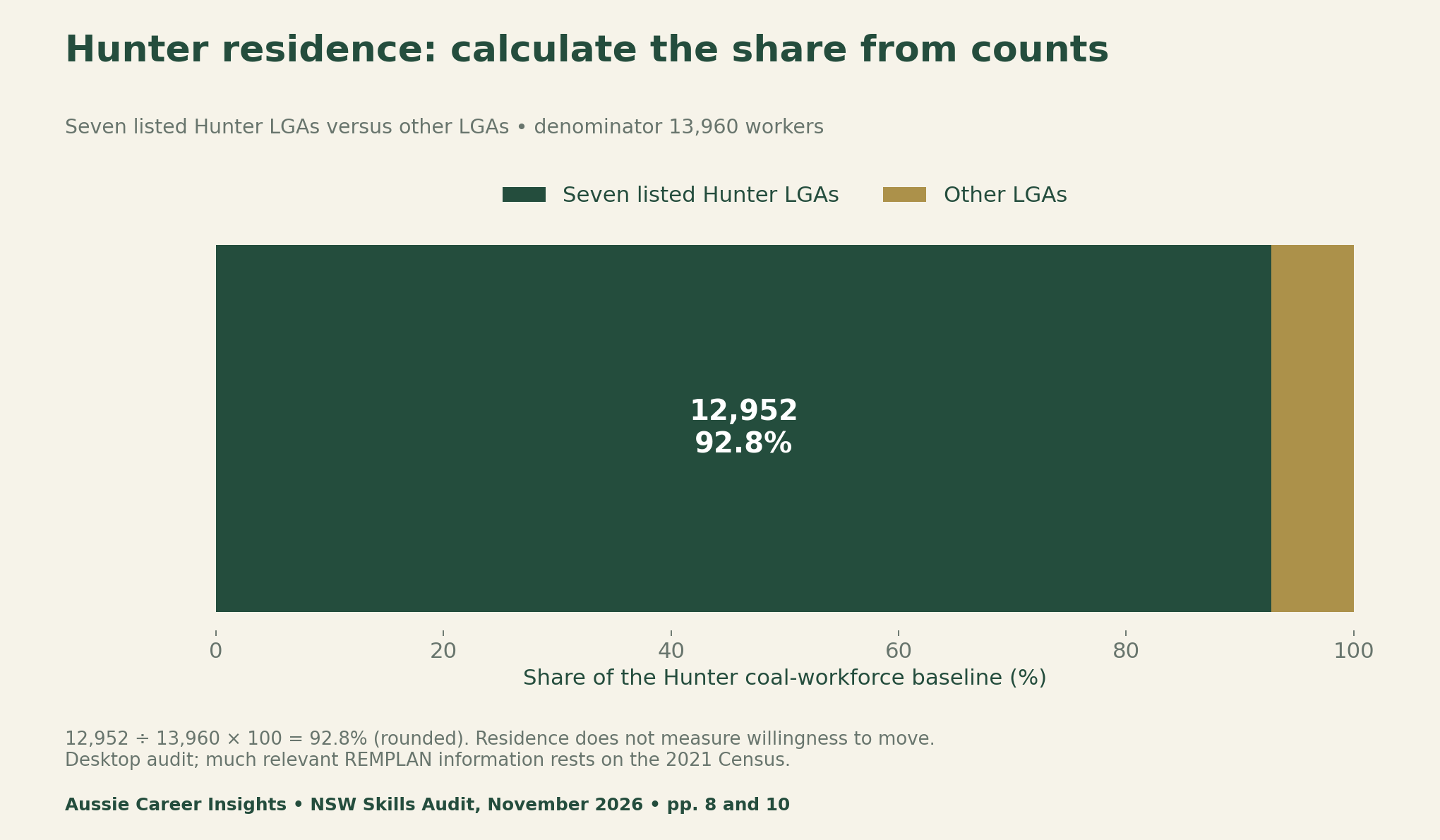
The Hunter residence table provides a useful worked calculation: 12,952 of 13,960 workers lived in the seven listed Hunter LGAs. Dividing those counts gives 92.8%, consistent with the announcement’s rounded 93%. This is a residence measure. It does not tell us who would accept a longer commute or relocate.
For your own shortlist, compare the actual work location, roster and guaranteed hours. Add the return journey, study attendance and any placement location. A role that looks close on a map may have a different practical cost when the start time falls outside public transport hours.
If you are exploring another employer group, our public-sector workforce report explains why filled-job totals differ from vacancies. Use direct employer adverts to establish current hiring. A large or growing sector is not a personal offer, a matching salary or a guarantee of suitable local work.
Cost the gap before committing to training
Separate one-off costs from ongoing household shortfall. One-off items may include verified training fees, travel for assessment or relocation. Ongoing shortfall is the gap between reliable household resources and essential spending during the chosen period. Avoid counting the same unpaid study time twice through both reduced income and a separate cash expense.
For a simple private scenario, use: required cash buffer = verified one-off costs + monthly household shortfall × months. This is a planning identity, not a universal savings target. Replace every assumption with a current quote or your own budget. If the household has no shortfall, do not invent one.
Your Personalized Career Strategy
Unlock your potential with tailored career consulting. Get clear, actionable steps designed for your success. Start now!
Get Started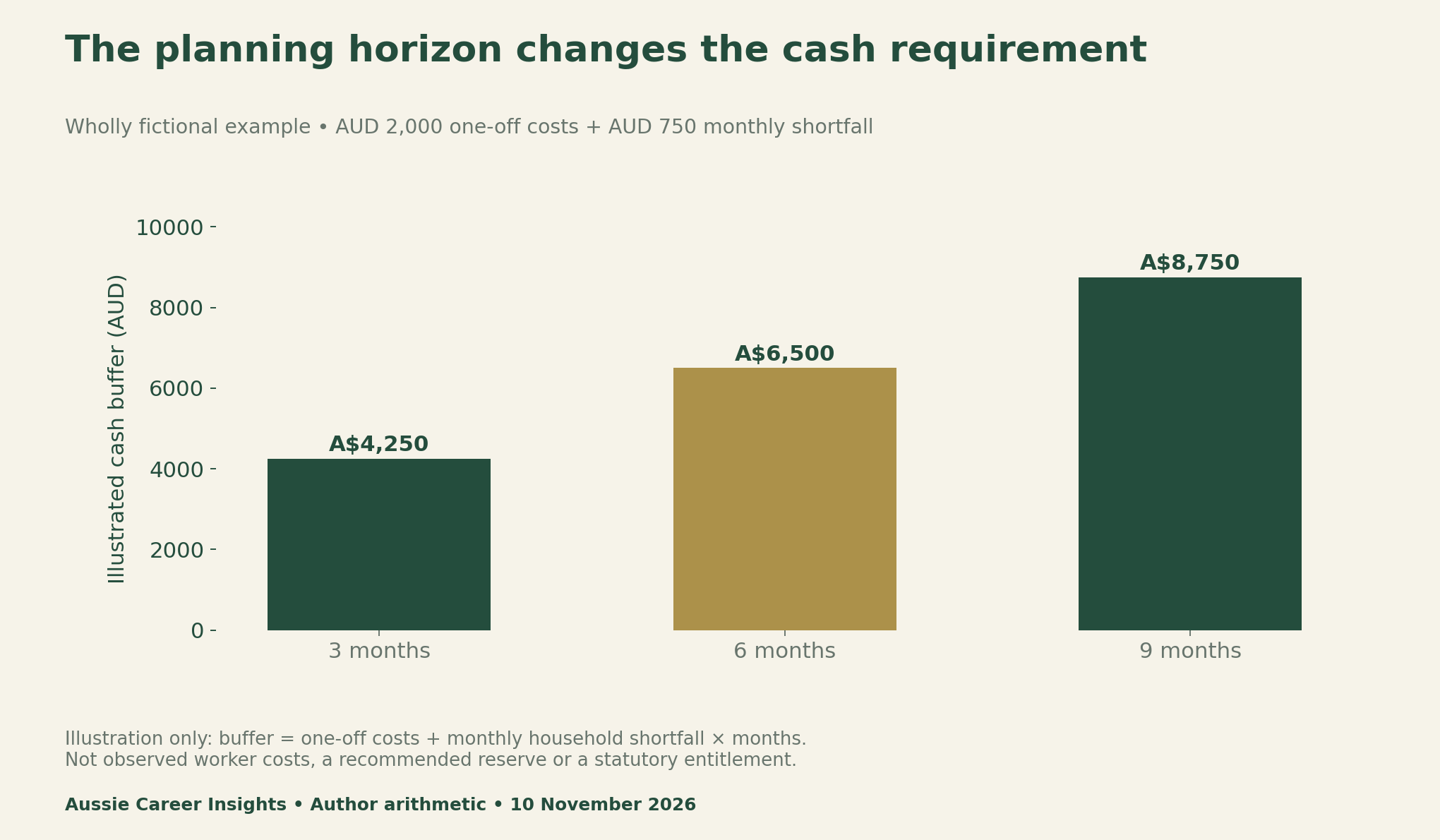
For example, A$2,000 + A$750 × 6 = A$6,500. That amount changes if a provider recognises prior learning, an employer confirms paid training or the guaranteed hours differ. Keep assistance applied for separate from assistance approved. Review the plan when a quote, roster or start date changes.
Free data and private planning tools
The source CSV records the geography, original reference notes, numerator, denominator and calculation. The two blank tools are for your own records. The scenario CSV contains only invented arithmetic inputs. None of these files is a skills assessment, a job-matching score or a request to send personal documents to us.
- Source figures and residence calculation (CSV)
- Blank private skills-evidence matrix (CSV)
- Fictional cash-buffer scenarios (CSV)
- Blank private transition-cost plan (CSV)
Method, limitations and update notes
Research checked on 10 November 2026. The occupation chart reproduces the government’s approximate shares without turning them into precise worker counts. The residence chart divides the report’s Hunter local-residence count by its stated workforce denominator. The final chart uses explicitly fictional cash inputs. No worker interviews, vacancy sample or transition outcomes were collected for this article.
We did not combine rounded occupation shares with the separately sourced headline of roughly 25,000 direct jobs. The populations and reference bases may differ. No calculation here predicts a mine closure, a transition success rate, a future salary or the availability of a particular training subsidy.
Suggested citation: Aussie Career Insights, “Transferable Skills for NSW Coal Workers: Build the Evidence,” 10 November 2026. Cite the NSW Government report alongside the relevant chart or source CSV. Recheck the target employer’s requirements and provider’s current assessment process before relying on a pathway decision.


