




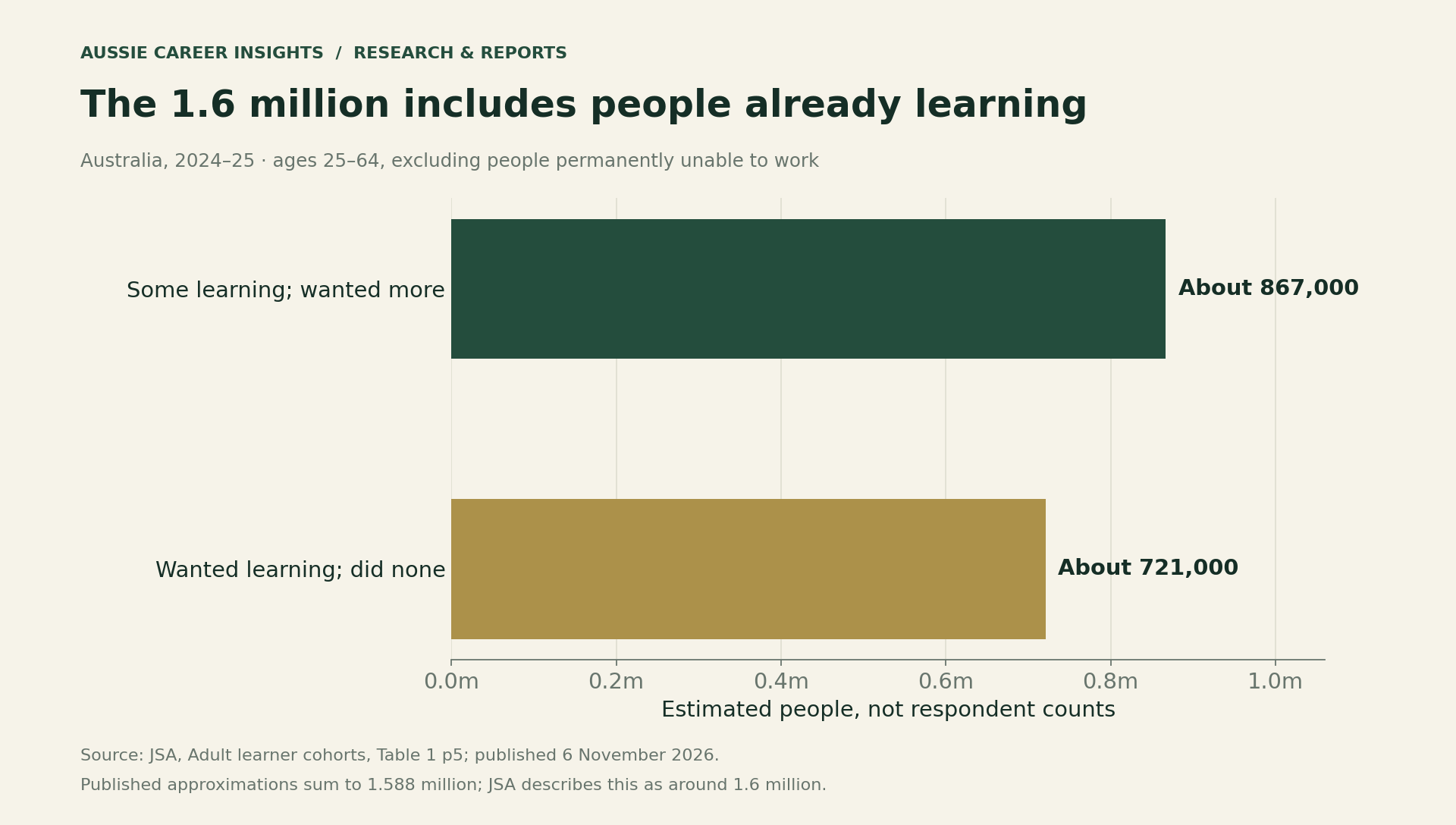
The evidence on adult learning barriers in Australia points to a practical first step: build a time and cash budget before choosing a course. Around 1.6 million adults wanted learning they did not undertake in 2024–25, according to Jobs and Skills Australia’s report published on 6 November 2026. Time, cost and caring responsibilities were prominent barriers.
That figure does not mean 1.6 million people did no learning. It combines people who participated but wanted more with people who wanted learning and did none. Understanding the difference helps you ask a better question: which conditions would make a particular course workable for you?
This guide pairs the new JSA report with reproducible planning examples and two blank worksheets. The research findings describe populations; the course hours and dollar amounts below are fictional examples, not observed costs, provider quotes or predictions of higher income.
Adult learning barriers in Australia: what the figures count
JSA separates adults into four groups according to participation and demand. Its main analysis covers people aged 25–64, excluding people permanently unable to work. Formal study and work-related training are in scope. Informal learning is outside this particular survey measure, so non-participation does not mean someone learned nothing.
| Learner group | Published rounded share | Approximate people | What it means |
|---|---|---|---|
| Met demand | 25% | 3.4 million | Participated and did not want additional learning |
| Partially met demand | 6% | 867,000 | Participated but wanted more |
| Unmet demand | 5% | 721,000 | Wanted learning but did not participate |
| No demand | 63% | 8.6 million | Did not participate and reported no demand |
Source: JSA, Adult learner cohorts, Table 1, printed page 5. Rounded shares add to 99%, so we have not forced them to total 100. Population estimates are not survey sample counts.
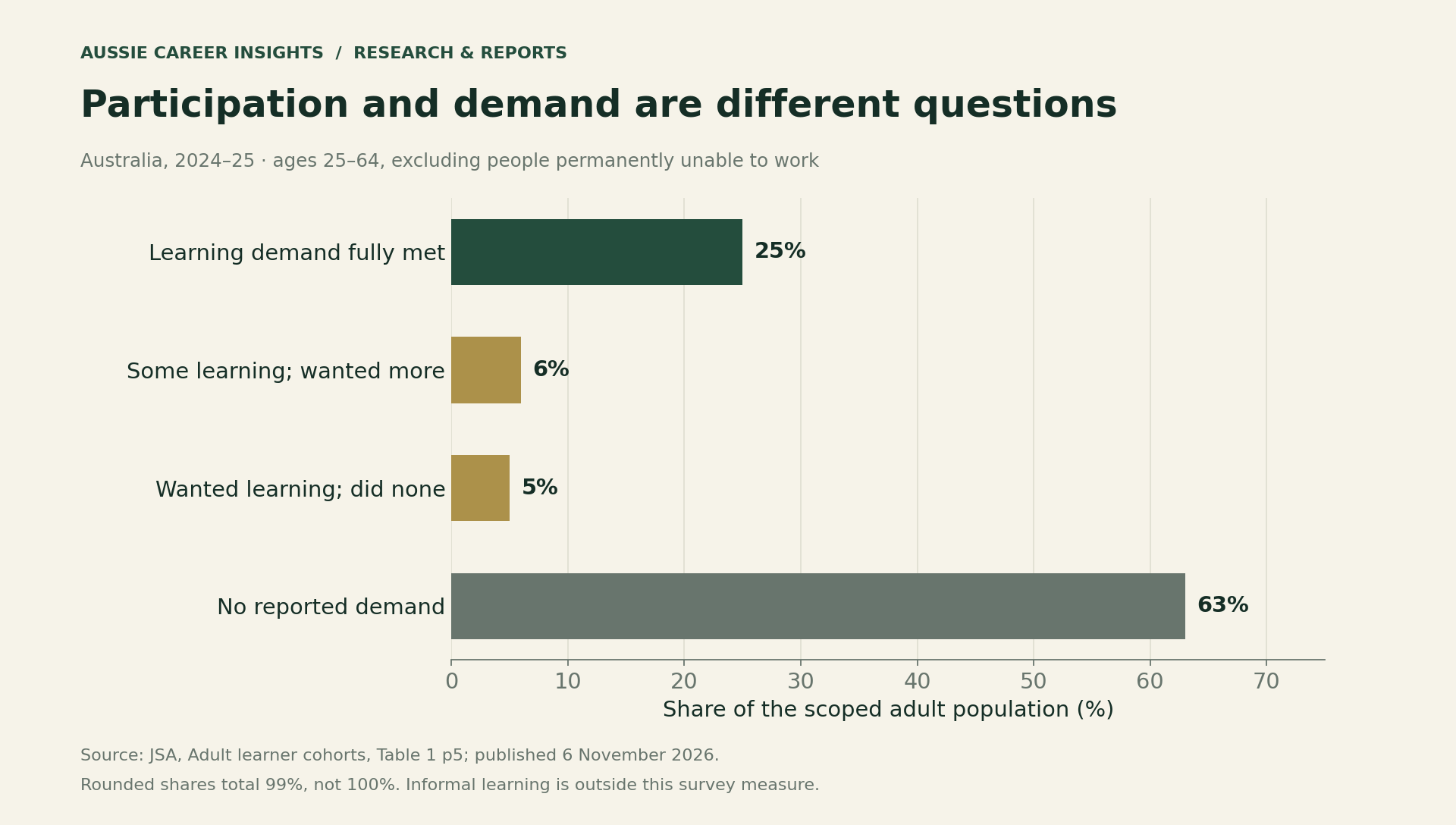
The report’s broader headline is that 31% participated in formal study or work-related training in 2024–25. However, the remaining adults should not all be described as people blocked from study. Some reported no demand, while others wanted learning they could not undertake. Likewise, completing training does not by itself establish useful skill development or a better job outcome.
Budget the hours before comparing course fees
A course advertised as flexible can still have fixed classes, timed assessments or compulsory placements. Therefore, ask the provider for the expected total weekly workload, including preparation and assessment. Then add travel and any extra administrative time to your personal schedule.
For a fictional 16-week course requiring six learning hours each week, the total is 96 hours. With no paid release from work, all 96 hours sit outside paid work. If an employer confirms two paid learning hours each week, 32 hours move into work time, leaving 64 hours outside work. The course itself still requires 96 hours.
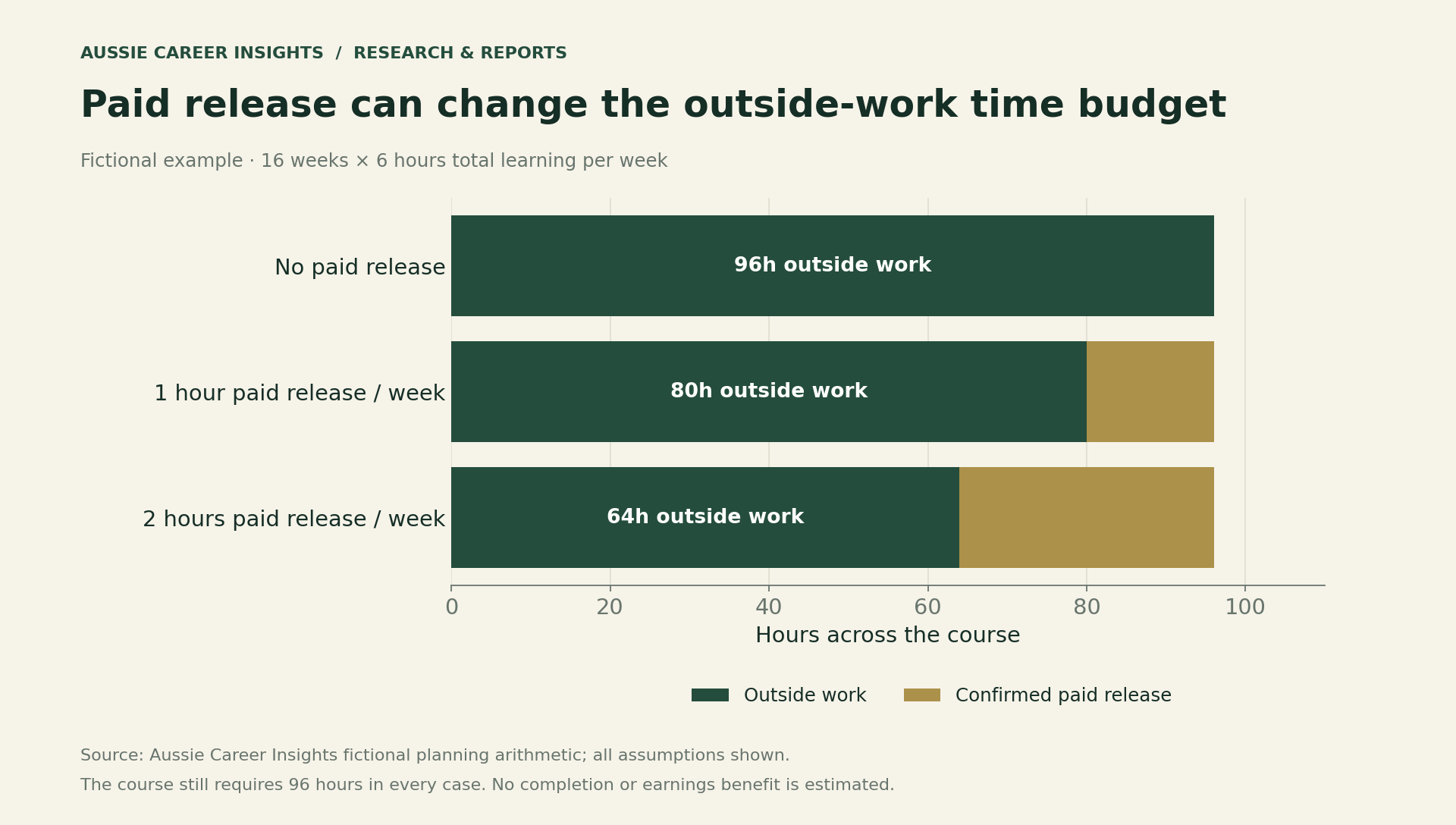
Start with a realistic week rather than an ideal one. Record work, travel, care, sleep and other commitments before assigning learning blocks. Next, test a week with an assessment deadline or an unusually heavy roster. If the plan depends on every evening going perfectly, it needs more flexibility or a smaller workload.
Paid release also needs a precise meaning. Ask whether it replaces normal duties, whether deadlines and workload will change, and who covers essential tasks. An agreement to “support your learning” does not establish that protected hours are available each week.
Count indirect costs and the timing of support
Tuition is only one cash requirement. Materials, software, transport and additional care can change whether a course is affordable. Lost paid hours may matter too. Keep those costs separate so you can see which assumptions drive the decision.
Our fictional cash budget, in Australian dollars, uses A$1,200 tuition, A$200 materials, A$20 weekly travel and A$40 weekly additional care over 16 weeks. That totals A$2,360 before support. A confirmed A$500 employer contribution reduces the final out-of-pocket cost to A$1,860. No tax benefit, subsidy or future pay rise is assumed.
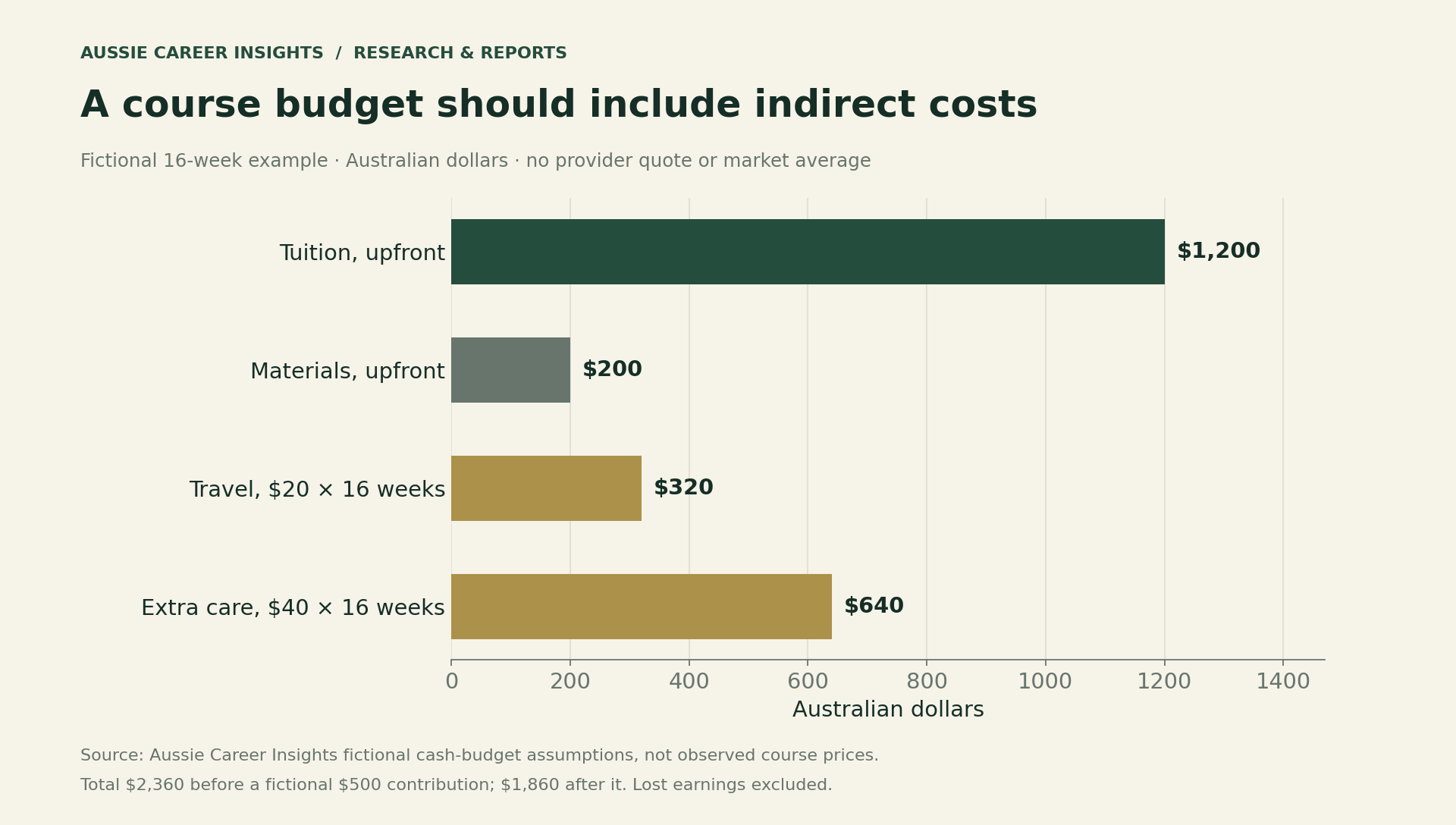
The payment date matters as much as the final total. Suppose tuition and materials are due at enrolment, while travel and care cost A$60 weekly. If the A$500 contribution arrives upfront, the learner initially funds A$900. If reimbursement arrives only after the course, the initial requirement is A$1,400, reaching A$2,360 before reimbursement.
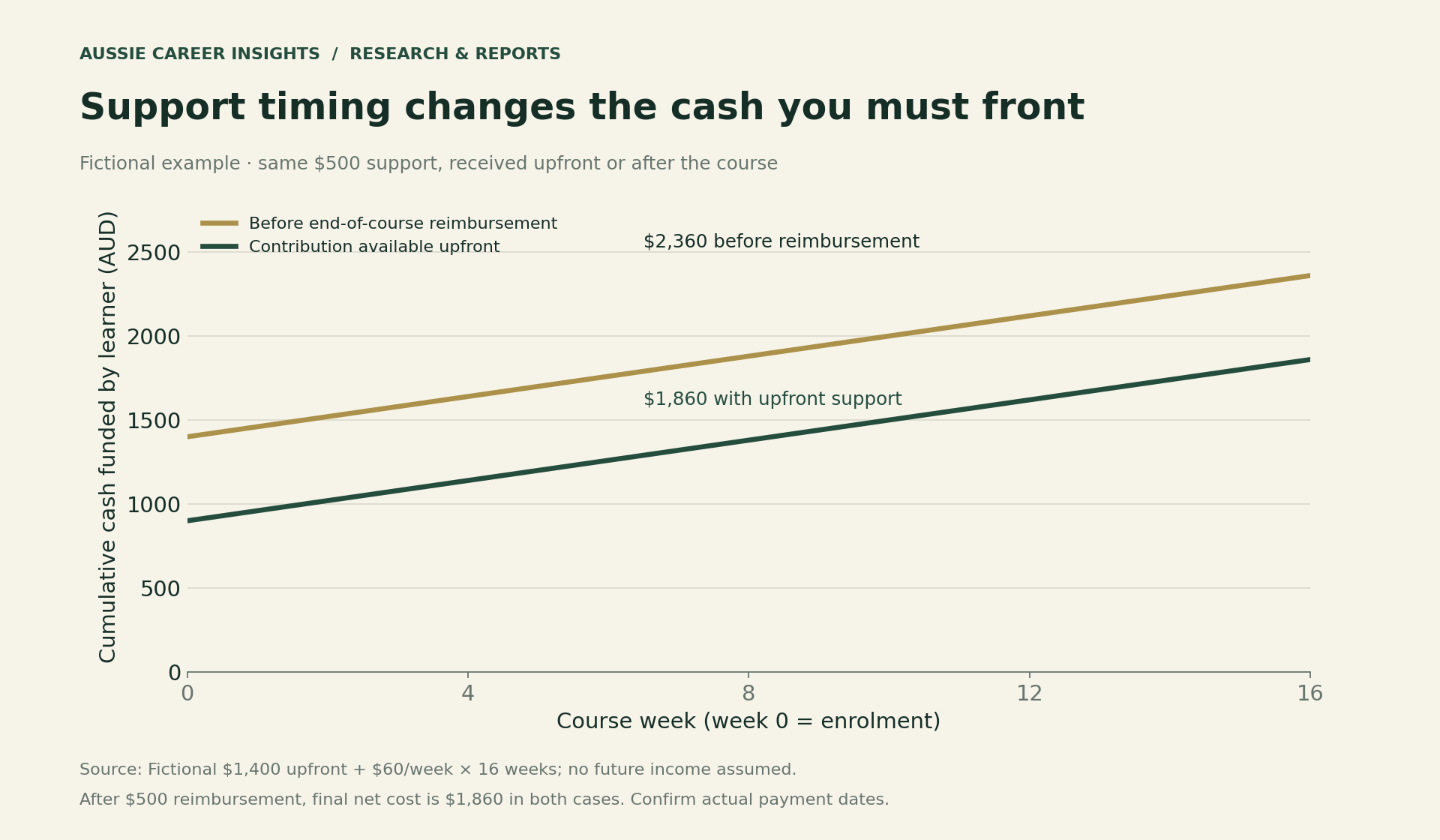
Neither example includes foregone wages, borrowing charges or household emergencies. As a result, a course can fit the final budget while still creating a difficult payment week. Compare actual due dates with reliable cash inflows and essential household spending. Do not count an unconfirmed reimbursement as money already available.
Four checks before committing to study
Use the infographic as a conversation guide with your employer, provider and household. Each condition should have an answer supported by an actual timetable, quote or written agreement. An unresolved condition is a reason to ask, adapt or defer, rather than assume the gap will disappear.
Your Personalized Career Strategy
Unlock your potential with tailored career consulting. Get clear, actionable steps designed for your success. Start now!
Get Started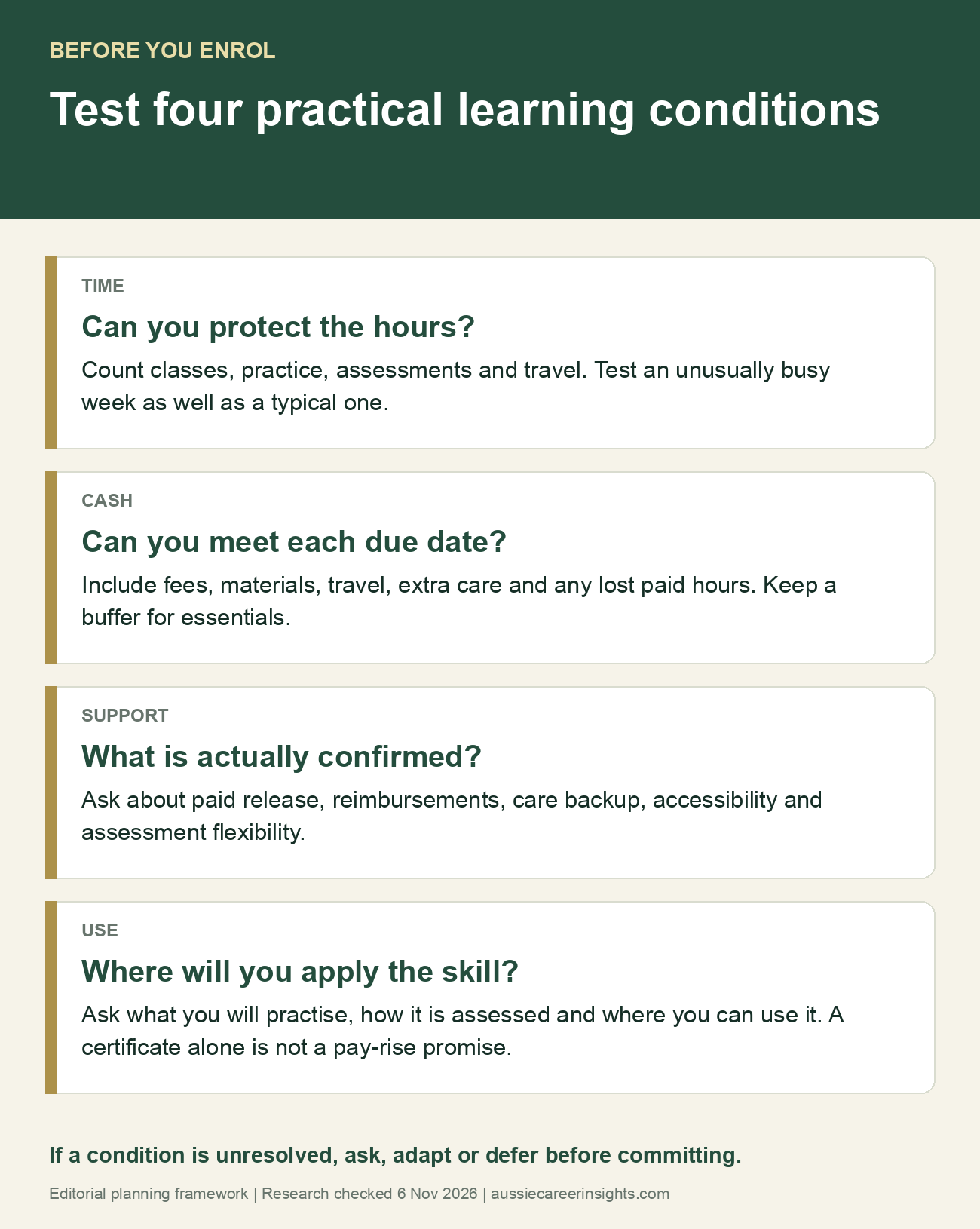
Ask the provider for concrete details
- What is the full workload in an ordinary week and an assessment week?
- Which activities have fixed times, attendance rules, placement hours or location requirements?
- What equipment, software and materials are required, and which fees are additional?
- What are the withdrawal, refund, deferral and assessment-extension rules?
- What accessibility support is available, and when must arrangements be requested?
Confirm employer and household support
Ask your employer whether paid release or funding is approved, when it starts and how it affects duties. Also check whether reimbursement depends on completion, continued employment or particular results. Keep any repayment conditions in the decision rather than discovering them after enrolment.
For care, agree who is available during fixed classes and what happens if the usual arrangement falls through. These conversations should reflect your household’s circumstances. The report identifies population patterns; it does not imply that all women, parents, casual workers or people with disability face the same barriers.
Identify where the skill will be used
A useful learning objective names a task you want to perform and the evidence that would show progress. For example, you might want to produce a work sample, meet a verified role requirement or improve an existing task. Then ask how the course teaches and assesses that capability.
If your aim is a public-sector move, our public-sector jobs research provides official recruitment starting points. Read actual role requirements before paying for a qualification on the assumption that every employer needs it. Participation alone does not guarantee a job, pay increase or return on course fees.
Download the study-feasibility tools
The time worksheet keeps required hours and realistic available hours separate. The cash worksheet records both the amount and timing of support. Blank fields are deliberate: complete them privately using verified course information. Neither file needs identity numbers, bank details or sensitive health information.
- JSA learner-cohort source table (CSV)
- Fictional time and cash assumptions (CSV)
- Blank 16-week study-time worksheet (CSV)
- Blank study cash and support worksheet (CSV)
Sources, method and limits
We checked the full JSA report and its publication page on 6 November 2026. Table 1 on printed page 5 supplies the cohort figures, while pages 6–7 and 10–11 explain unfulfilled demand, barriers and limitations. The underlying population analysis uses the ABS Work-related training and adult learning survey for 2024–25. This is the observation period, not a measurement of participation in November 2026.
The headline table does not provide sample counts or confidence intervals for the figures reproduced here. We have not estimated them, tested differences between groups or ranked individuals’ likelihood of completing a course.
JSA notes that informal learning is missing from this survey measure and that the evidence primarily reflects individuals’ perspectives. Other descriptive analysis in the report uses HILDA data with different definitions and periods; we have not combined those measures with the cohort totals. Observed associations between employment conditions and training are not proof of cause and effect.
Our original contribution is the transparent time, cash and payment-timing framework. All scenario calculations are retained in the downloads and labelled fictional in the charts. They are scheduling and budgeting arithmetic, not evidence that employer support causes completion or higher income.
Suggested citation: Aussie Career Insights (6 November 2026), “Adult Learning in Australia: Budget the Time Before Choosing a Course.” Underlying cohort data: Jobs and Skills Australia, Adult learner cohorts: Unpacking adult learning participation and demand, Table 1, © Commonwealth of Australia, CC BY 4.0. The branded charts are original redraws; they do not imply government endorsement.


