




A VET teaching job offer checklist should test workload, mentoring and learner-support arrangements before you accept. Ask who will help you, when that help is available and how the employer will document it. A job title and advertised pay cannot answer those questions on their own.
This guide uses NCVER’s newly released research as a starting point for practical offer questions. It includes five figures and four downloadable tools. Our worksheets help organise a conversation; they are not a validated employer-quality score or a guarantee that a new teaching role will work out.
What the new research can establish
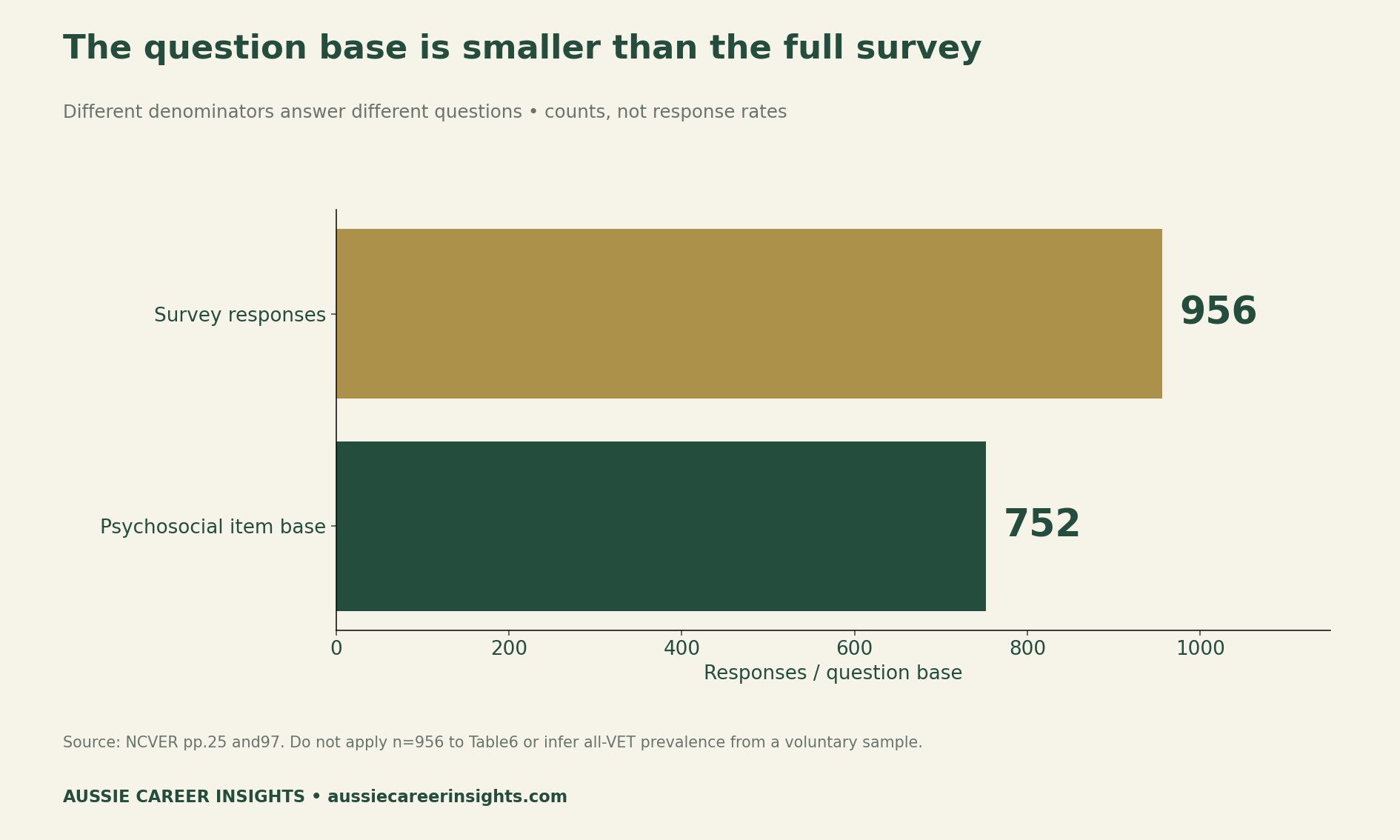
NCVER published Strengthening teaching practice and psychosocial support on 28 October 2026. Its survey ran from October 2025 to January 2026 and received 956 responses. Participation was voluntary, and the report explicitly warns that the findings are not representative of the whole VET teacher workforce.
The selected psychosocial-impact questions have a smaller base of 752. These are teachers’ reports about student behaviour arising from psychosocial needs, not independently observed classroom outcomes. Keep that population and question wording with every statistic.
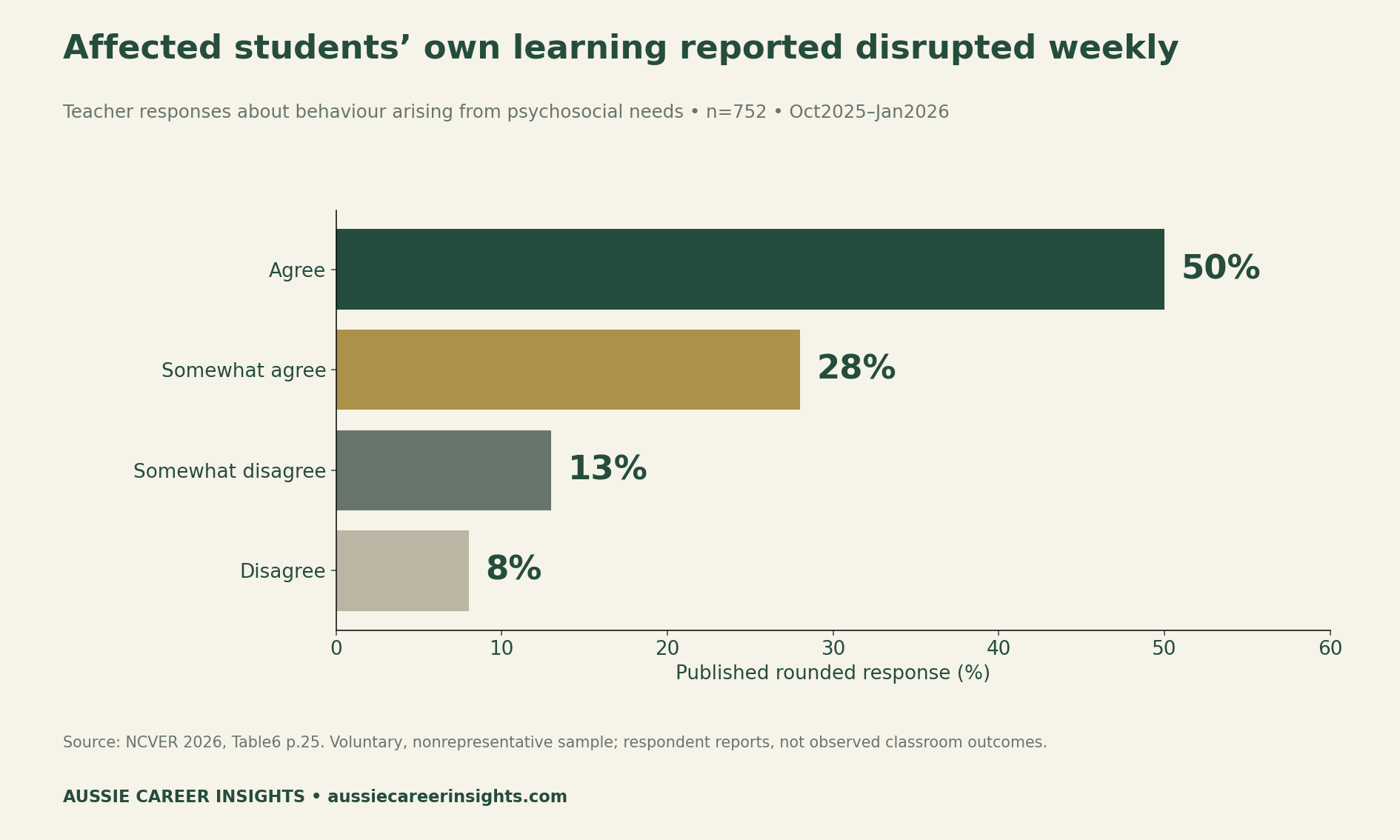
For the item about affected students’ own learning, 50% agreed and 28% somewhat agreed. This does not mean that 78% of all Australian learners experience a particular condition. It describes the responses to this item within this voluntary teacher sample.
Different questions describe different reported impacts
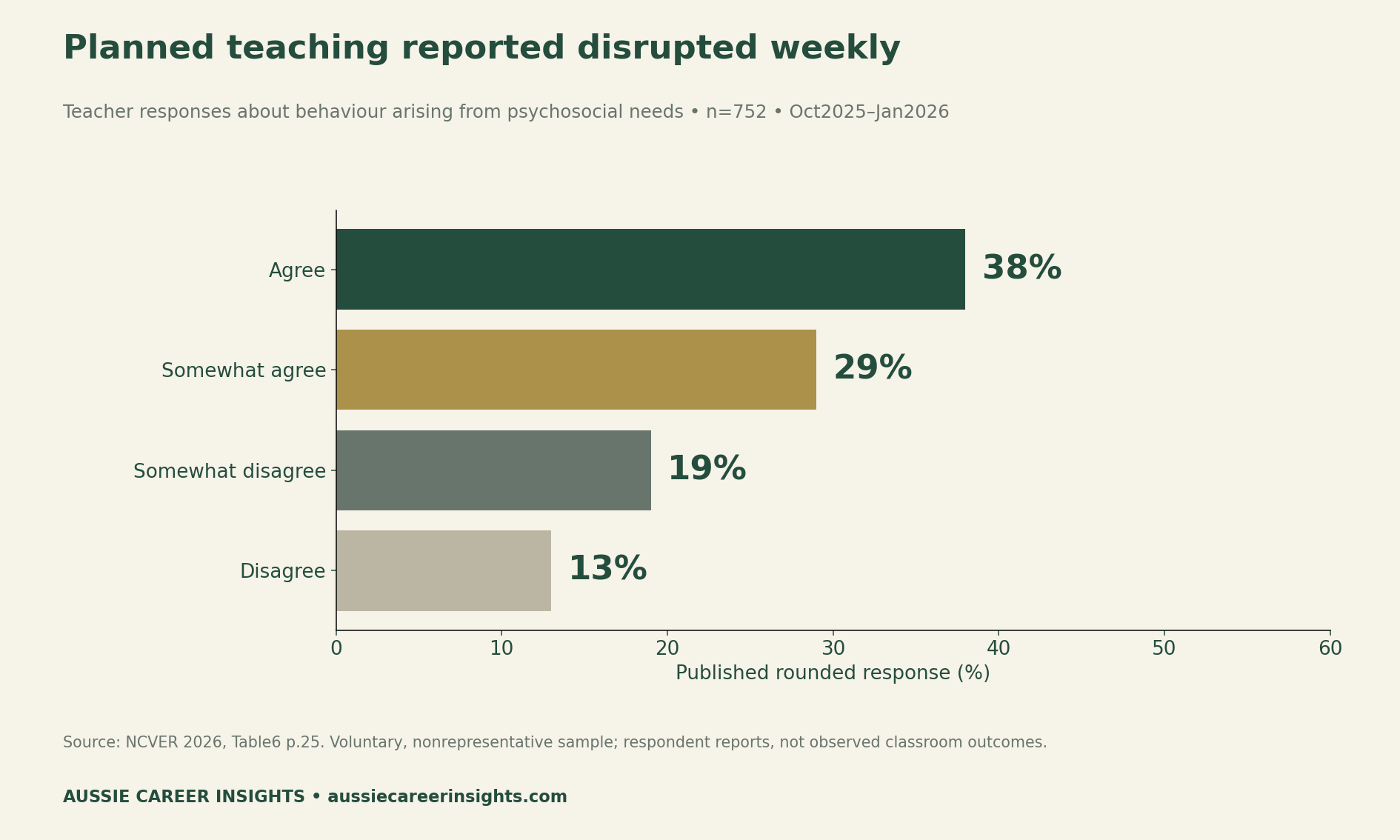
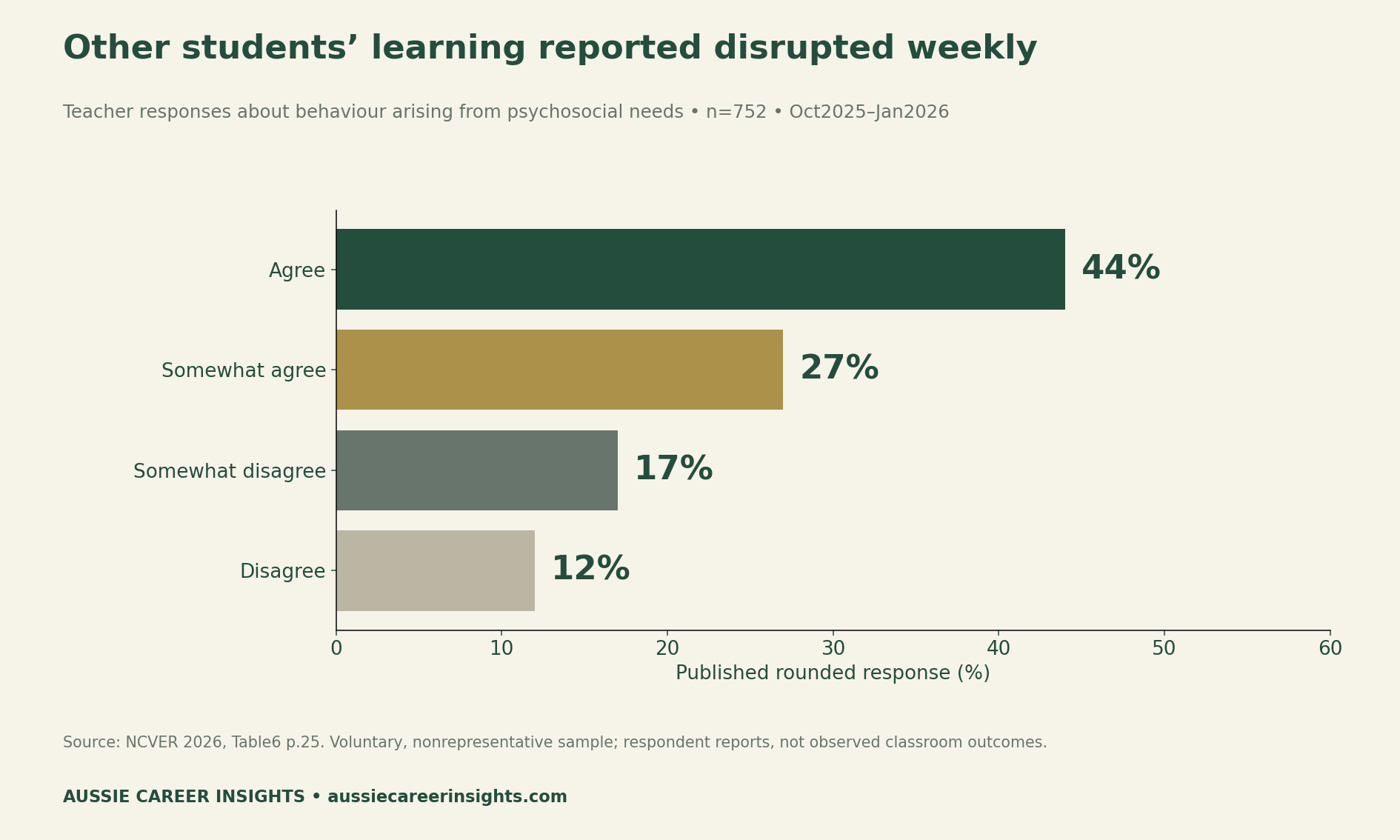
The full NCVER report provides the item wording and methodology. For an applicant, the findings make support a worthwhile interview topic. They do not establish that a named provider lacks support, nor do they tell you how a particular class will behave.
Use the VET teaching job offer checklist in the interview
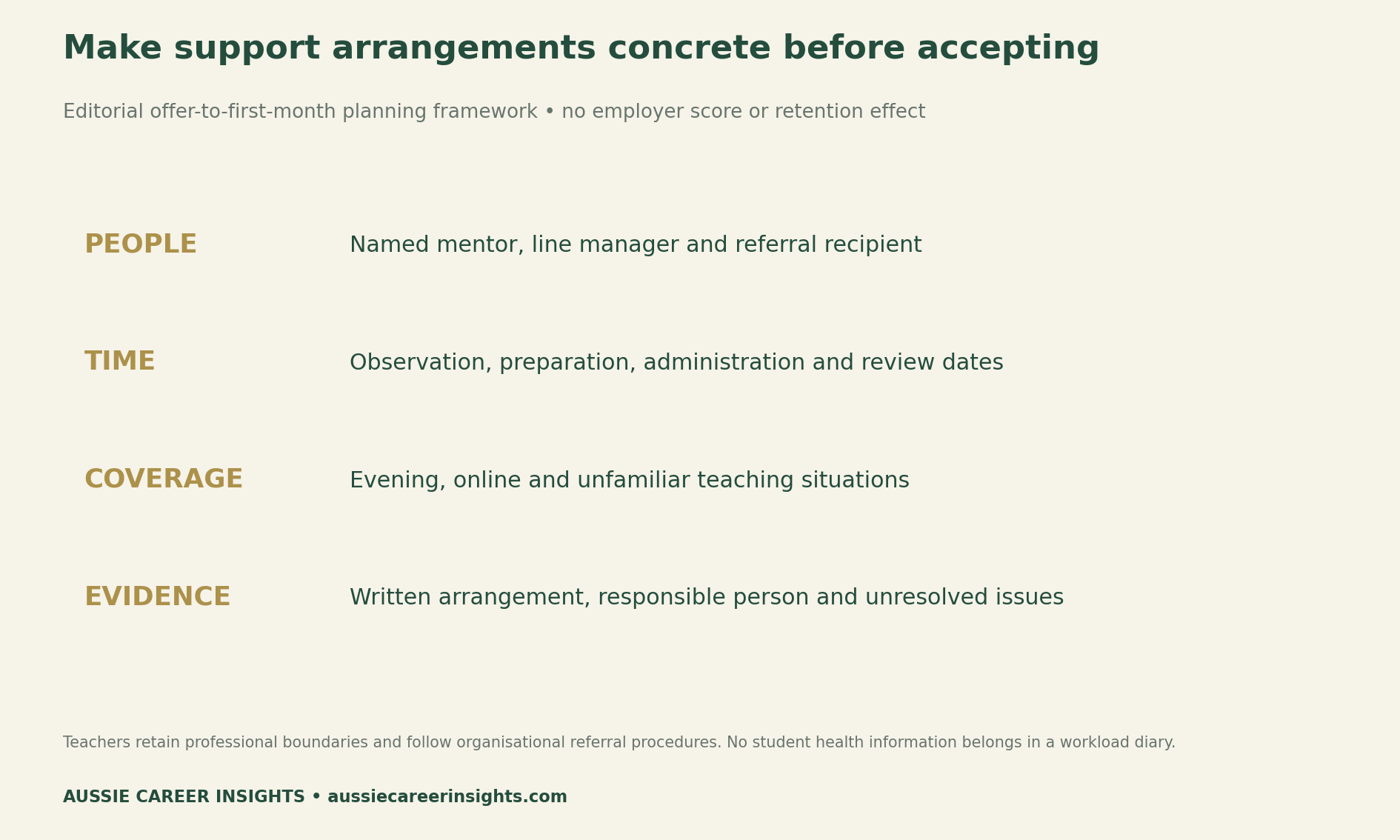
Begin with the people behind the offer. Ask for a named mentor and find out how often you can meet. Then ask who covers that role when the mentor is absent. A broad promise of an open-door culture becomes more useful when you know the person, the access route and the expected availability.
Next, ask about observation and feedback. Can a novice watch an experienced colleague before taking responsibility for an unfamiliar class? Will someone observe the new teacher and discuss practical questions afterwards? Record what the employer actually offers, including arrangements that remain undecided.
Also ask how preparation and administration fit around delivery. A timetable of contact hours alone may omit tasks you still need to plan. Request an example of how a new starter’s preparation, assessment administration and meetings fit within the proposed workload. This guide does not calculate contractual hours or a lawful pay rate.
Clarify the learner-support handover
Ask where a referral goes and who acknowledges it. A list of services is less useful if a new teacher does not know the handover process. Request the organisation’s current procedure and the role responsible for the next step, while respecting student privacy and professional boundaries.
Teachers should not be positioned as clinicians. In an interview, you can ask how staff recognise a concern and follow the organisation’s procedure without asking for access to students’ health histories. Keep questions about systems and responsibilities, rather than collecting examples that identify a learner.
Delivery mode matters too. Ask which support arrangements cover evening teaching, online delivery and locations away from the main campus. If the answer only describes office hours, record the remaining question. An unanswered item is unresolved information, not proof that the employer is poor.

Turn an assurance into a written arrangement
The offer worksheet uses five practical fields: your question, the employer’s answer, a document or example, a responsible person and the unresolved issue. For instance, a mentoring answer might point to a scheduled meeting and a named colleague. If no arrangement exists yet, note who will confirm it and by when.
Avoid converting those fields into an invented universal score. Your needs may differ from another applicant’s, and a document does not establish that a process works in practice. The aim is a more specific discussion with the employer, followed by a clear record of what both sides understand.
Before accepting, compare the written terms with the interview discussion. Check any qualification and experience requirements separately for the particular vacancy. An offer-support checklist cannot waive an employer’s requirements or establish that a course guarantees a teaching position.
Your Personalized Career Strategy
Unlock your potential with tailored career consulting. Get clear, actionable steps designed for your success. Start now!
Get StartedPlan the first month without inventing a workload study
Use the first-month sheet with a manager to propose orientation, mentor meetings, observation opportunities and a review date. Record who owns each activity and how its time will be accommodated. These are suggested planning fields, not a programme whose impact we have measured.
If useful after starting, keep a private workload diary of planned and actual minutes by activity. Choose categories such as preparation, delivery, assessment administration and meetings. Do not put identifiable student health information in the diary. You can discuss the pattern with a manager without building a private dossier on learners.
No reader diary or employer audit has been collected for this article. Therefore, we report no average preparation burden, improvement in retention or effect of using the worksheet. A future study would need a defined sample, consent and an appropriate design before making those claims.
Download the worksheets and source data
Teaching offer support worksheet (CSV). Capture answers, documents, responsible people and unresolved follow-ups.
First-month planning sheet (CSV). Set proposed orientation, observation and review arrangements with a manager.
Blank private workload diary (CSV). Compare planned and actual minutes without identifiable learner details.
NCVER Table6 chart data (CSV). Reproduce all four published categories for each of the three items, with sample size and source URL.
The tools are plain CSV files. Blank entries mean not yet recorded; do not treat them as zero time or absent support. Keep your completed versions private. For another practical offer comparison, our hospitality offer checklist shows how to separate a hiring headline from written conditions.
Method, attribution and limitations
We checked the publisher’s release date, Table6 and methodology on 30 October 2026. Our charts preserve the published rounded values. The survey base varies by question, and we do not reconstruct respondent counts from rounded percentages. The voluntary sample and respondent-report design limit generalisation.
Data attribution: Griffin, Wibrow, Andrahannadi, Ackehurst, Waugh and Schueler (2026), Strengthening teaching practice and psychosocial support, NCVER, Adelaide. Report text and data are offered under CC BY3.0 Australia, subject to the report’s exclusions. We redrew selected data and created our own editorial worksheets; no endorsement is implied.
Suggested citation: Aussie Career Insights, “VET Teaching Job Offer Checklist: Workload, Mentoring and Support,” 30 October 2026. Cite NCVER for the survey values and identify our offer tools as editorial planning aids. Corrections log: source values, denominators and rounding checked on this date.


