




Research checked: 6 November 2026. If you are comparing fixed term research contracts Australia offers, start with the contract date and the actual legal exception. A grant-funded job does not qualify simply because somebody calls it a research role.
From 1 November 2026, the additional medical and health research exception continues with a stricter funding condition for newly entered contracts. More than 50% of the position’s funding must come from the specified qualifying sources. Exactly 50% is not enough for that condition.
However, funding is only one test. Employer revenue, the kind of research, the funded project, elapsed time, previous service, award coverage and funding dates also matter. This guide turns the published rules into an evidence checklist, rather than an automatic eligibility calculator.
What changed in November 2026?
The Fair Work Ombudsman’s updated exceptions guidance explains the medical and health research pathway. We checked it against regulation 2.15 in the current Fair Work Regulations, compilation F2026C01141, effective 1 November 2026.
For contracts entered on or after that date, the position must be more than 50% funded by qualifying government or philanthropic funding, or a qualifying combination. The earlier funding rule differed. Do not apply this new percentage test retrospectively to an older contract without advice about the applicable provisions.
The October amending instrument commenced on 1 November. Its continuation of an exception does not create a general exemption for every research institution or remove all other employment rights.
Start with the employer and the work
The relevant employer entity must be a philanthropic entity, an entity it controls, a public-purpose body established under Commonwealth, state or territory law, or an entity that body controls. Its total annual revenue must be less than A$100 million.
An ACNC reporting group needs particular care. Where the group’s most recent available financial-year revenue reaches A$100 million, the regulation treats the entity as reaching that amount unless it provides contrary evidence sufficient to satisfy a reasonable person. A small department budget does not establish the employer’s revenue.
The work must primarily involve basic, pre-clinical, clinical or translational medical or health research. It must also relate to a specific funded program or project. A science job title, a laboratory location or a university affiliation alone answers neither question.
The funding boundary: 50% versus 52.5%
The qualifying sources include government funding and funding from a different philanthropic entity. Where the relevant entity is itself philanthropic, the regulation also covers funding provided for its charitable purpose, including a testamentary gift or contribution for that purpose.
Ask the employer to identify the qualifying sources, the position’s total funding and the evidence supporting the calculation. Do not substitute the whole institution’s grant income for the funding of the particular position.
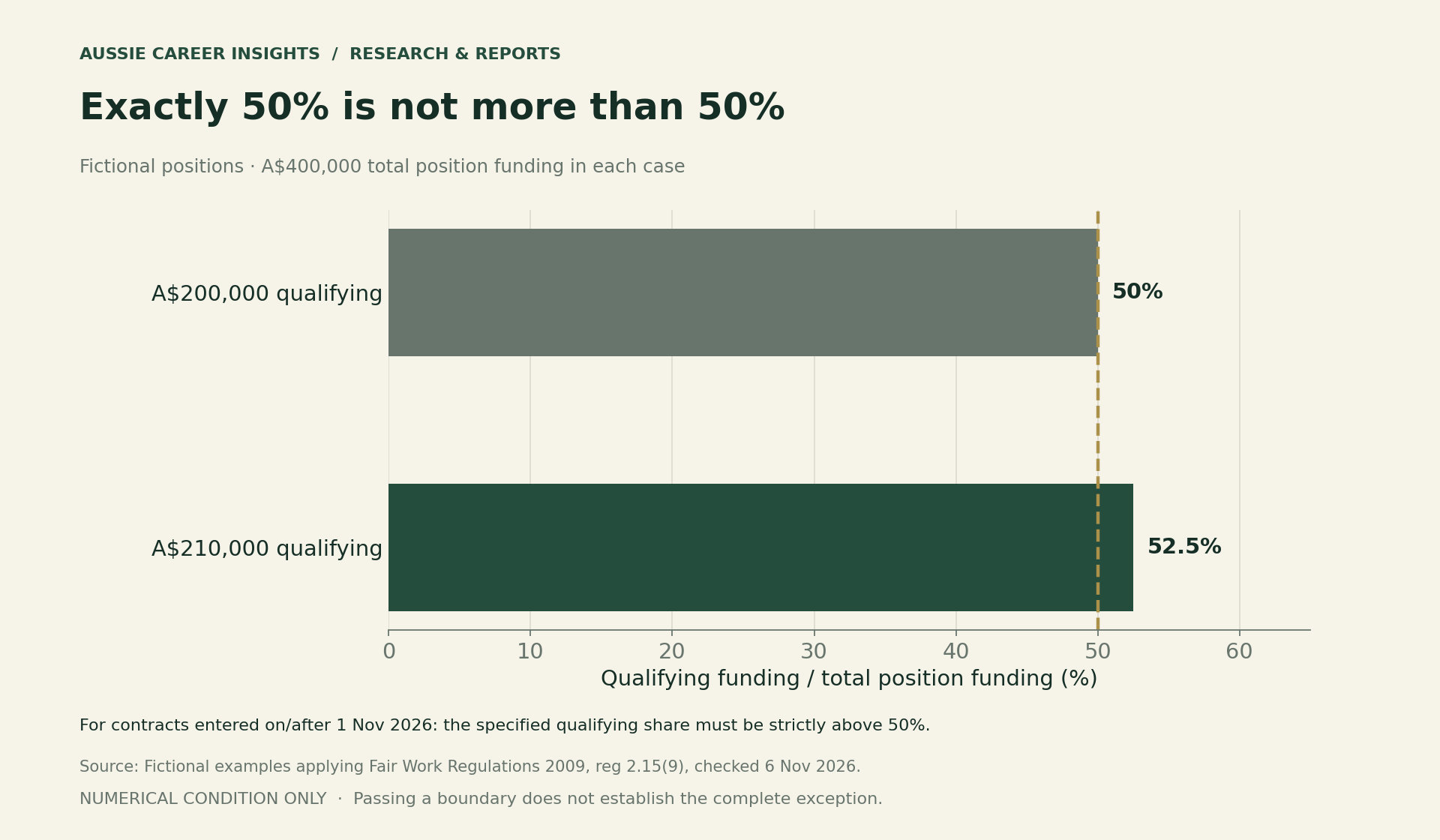
In the fictional example, A$210,000 ÷ A$400,000 × 100 equals 52.5%. Reducing qualifying funding to A$200,000 produces 50%, which does not meet “more than 50%”. Both examples leave every other legal condition unresolved.
Count the whole project, including elapsed time
The funded program or project must run for no more than five years in total, including time that has already elapsed. The contract’s identifiable end period must substantially match the project’s duration or its remaining duration.
For example, two elapsed project years plus three remaining years totals five. Two elapsed years plus four remaining years totals six. Calling the second offer a “four-year contract” does not remove the earlier two project years from this test.
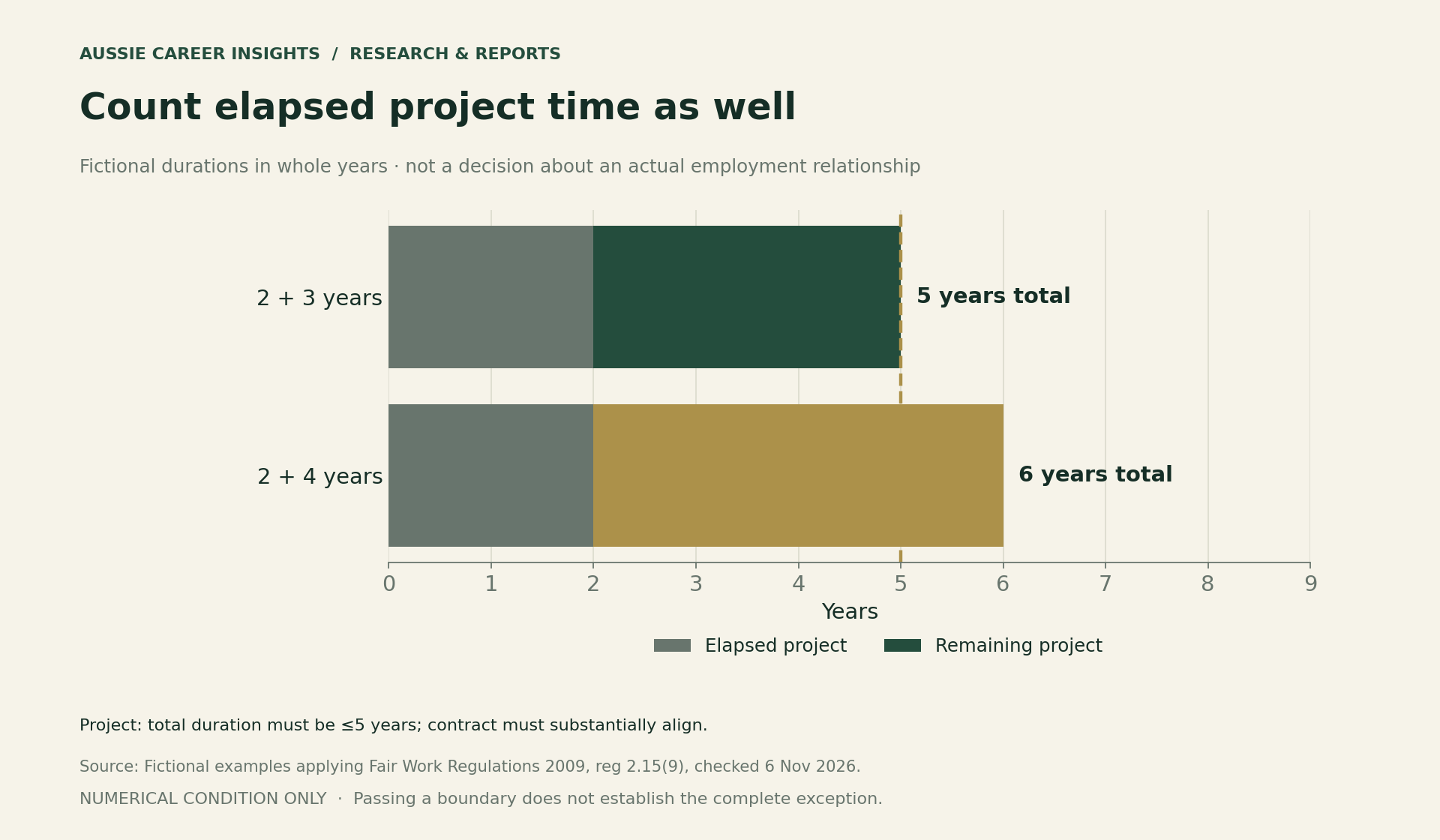
Ask for the project start date, funded end date and explanation of how the proposed contract period aligns. A funding extension may require a fresh assessment; this diagram cannot decide the legal effect of a changed project.
Your Personalized Career Strategy
Unlock your potential with tailored career consulting. Get clear, actionable steps designed for your success. Start now!
Get StartedPrevious service matters as well
For a current or former employee, the proposed contract must not result in continuity or substantial continuity of employment with that employer exceeding seven years. That requires a history of the employment relationship, not just the new offer’s length.
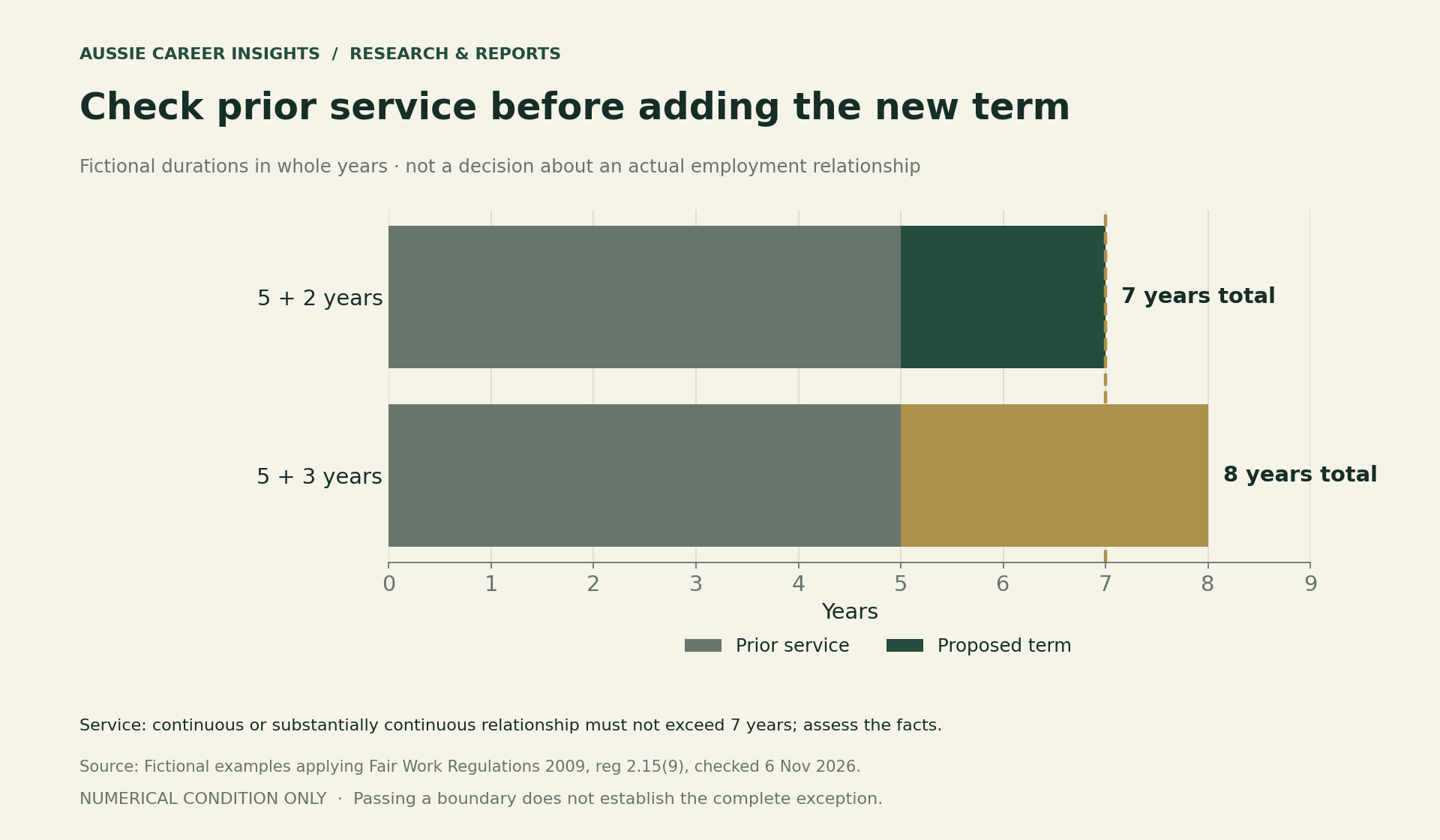
Record earlier contracts, relevant dates, breaks and any employer-entity changes. Do not assume that a short break resets the clock, or that every previous appointment must count in the same way. Ask an appropriately qualified adviser to assess continuity where it is unclear.
Revenue is a separate boundary
The revenue condition is less than A$100 million, rather than A$100 million or less. A hypothetical entity at A$99.9 million falls below that numerical boundary; one at exactly A$100 million does not.
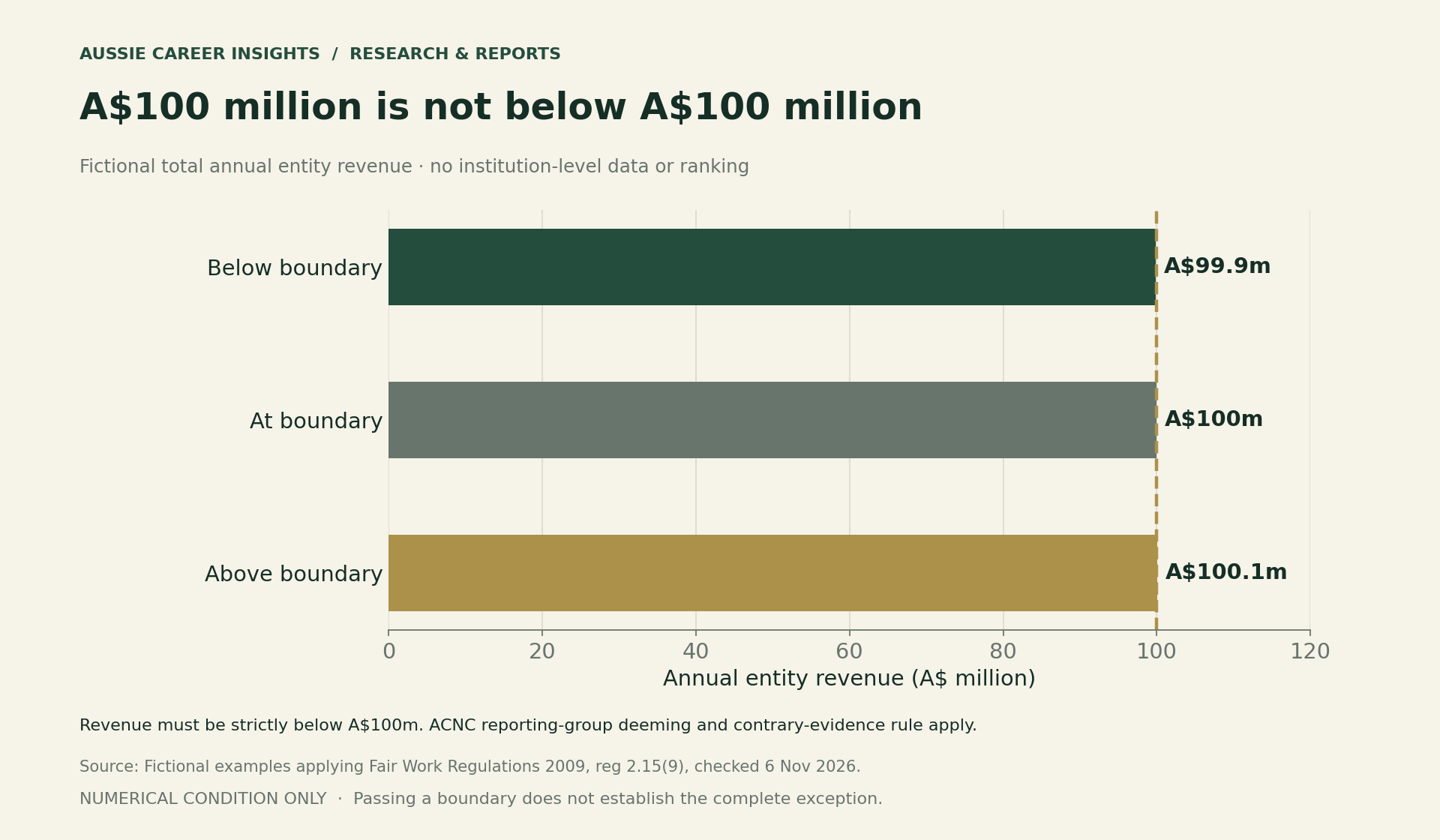
These are invented boundary values, not estimates of Australian institutions’ revenues. Neither employer size nor a contract’s funding share can substitute for the other conditions.
Fixed term research contracts Australia: build an evidence pack
At entry, the employee must not be covered by the Higher Education Industry—Academic Staff—Award 2020 or the Higher Education Industry—General Staff—Award 2020. Award coverage needs checking against the actual role and employer, rather than the wording of a job advertisement.
The qualifying funding arrangements must take effect on or after 1 November 2024. The relevant contract-date conditions also matter. Keep the funding agreement and contract dates separate in your notes.
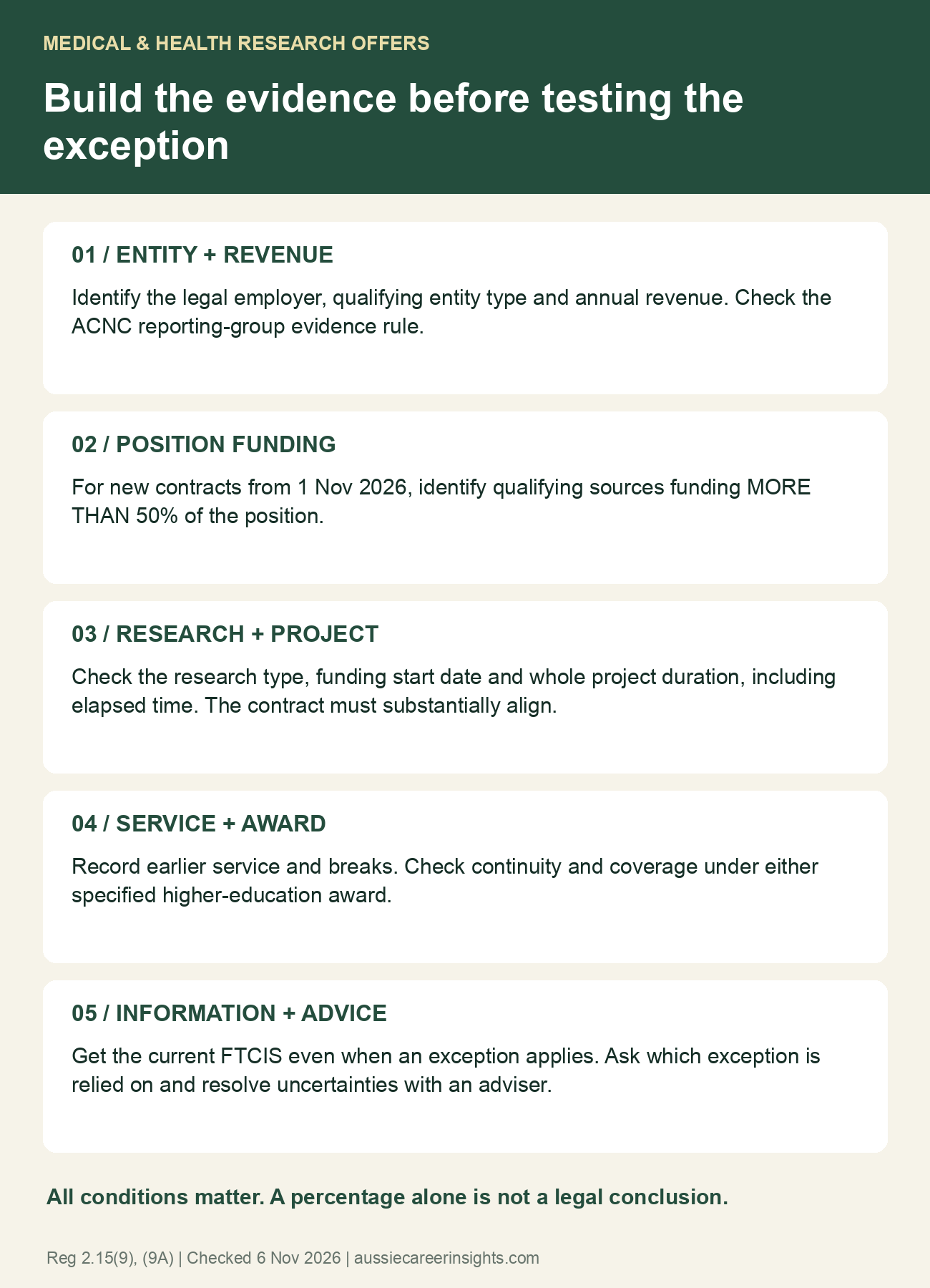
| Evidence area | Ask for | Why it matters |
|---|---|---|
| Employer | Legal entity, revenue evidence, reporting-group information | The entity and revenue rules apply independently of the job title |
| Funding | Position budget, sources, funding start date | Qualifying funding must exceed 50% for new contracts from 1 November 2026 |
| Project | Defined research scope, original start, funded end | Elapsed time counts; the contract must substantially align |
| Employment | Previous contracts, breaks, coverage assessment | Service and specified higher-education award conditions need checking |
| Information | Current FTCIS and explanation of the exception relied on | An exception does not remove the statement requirement |
Get the information statement too
Employers must give a new fixed-term employee the Fixed Term Contract Information Statement when entering the contract, or as soon as practicable afterwards. This includes employees engaged under an exception. The Commonwealth Gazette notice for the new statement records its publication on 1 November 2026; use the current statement rather than an older saved copy.
If an employer relies on another pathway, ask which one. Failing this particular research exception does not, by itself, prove that a contract is unlawful or automatically convert it into permanent employment. The general fixed-term contract rules and other exceptions require separate consideration.
Download the calculations and blank checks
Use the four boundary comparisons (CSV) to reproduce Figures 1–4. Each row states its fictional inputs and the limited numerical question it answers. There is no employer ranking or estimated probability of qualifying.
Download the source-linked conditions register (CSV), the blank offer-evidence worksheet (CSV) and the blank service-history worksheet (CSV). Keep personal employment details private; these files do not submit anything to us.
If an offer also requires new study, our adult-learning time and cash guide can help you budget that commitment. For a broader employer search, see where public-sector jobs grew. Those labour-market articles do not establish contract rights.
Methodology and limits
We checked the current official guidance and consolidated regulation on 6 November 2026. The four figures use fictional, deliberately simple boundary cases. Funding share is qualifying position funding divided by total position funding; duration examples add elapsed and remaining periods. No survey, grant sample or institution-level revenue dataset is used.
Four charts are appropriate here because they explain four distinct numerical tests. Adding a fifth would duplicate a legal condition rather than supply additional evidence. The non-chart infographic separately shows how those tests fit within the full checklist.
This is general research and a preparation tool, not a decision about an individual contract. Seek advice from Fair Work, your union or a qualified employment lawyer about your circumstances, including award coverage, continuity, other exceptions and any dispute.
Stand Out with a Resume That Gets Results
Your career is worth more than a generic template. Let us craft a resume and cover letter that showcase your unique strengths and help you secure that dream job.
Get Hired


