






Workplace AI consultation Australia gives workers and managers a reason to examine how work changes when new tools arrive. A fast first draft can be useful. However, it does not show whether the whole task takes less time or whether its final quality is acceptable.
The Department of Employment and Workplace Relations announced its consultation on 12 November 2026. The consultation hub records an opening date of 11 November and a closing time of 11:59 p.m. AEDT on 27 January 2027. Those dates describe the announcement and consultation timeline, respectively.
Workplace AI consultation Australia: start with the draft’s scope
We downloaded and read the 45-page draft best practice guide. Page 4 says it is voluntary, creates no new legal obligations and is not a work health and safety code of practice. Existing obligations still apply. The draft is therefore a discussion framework, not a new individual entitlement.
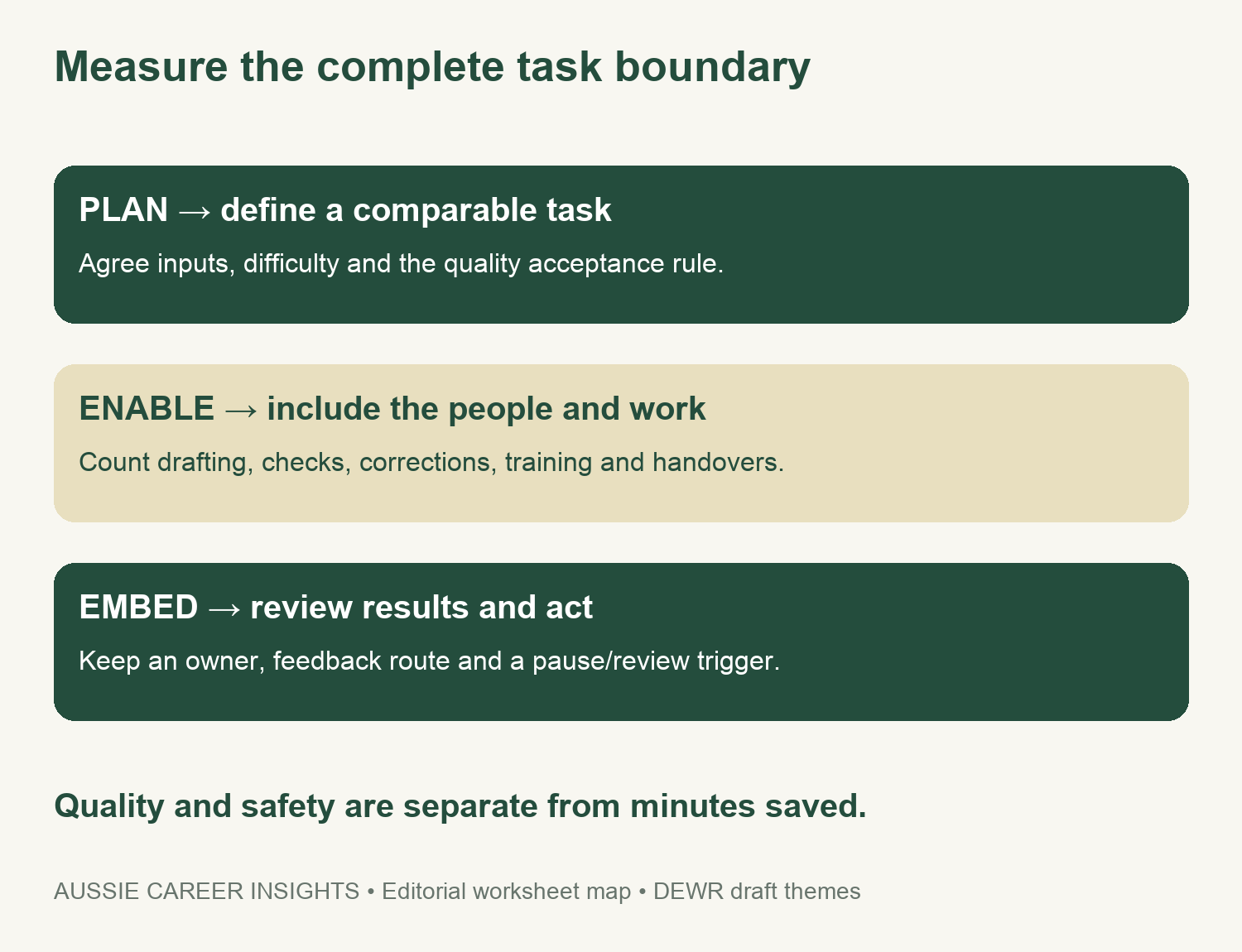
The guide has three themes: Plan, Enable and Embed. Its eight principles cover opportunities, readiness, worker engagement, job design, capability, workforce change, governance and risk. Our worksheets translate those themes into a private measurement exercise. They do not reproduce an official assessment or certify compliance.
Compare total work, not only the first draft
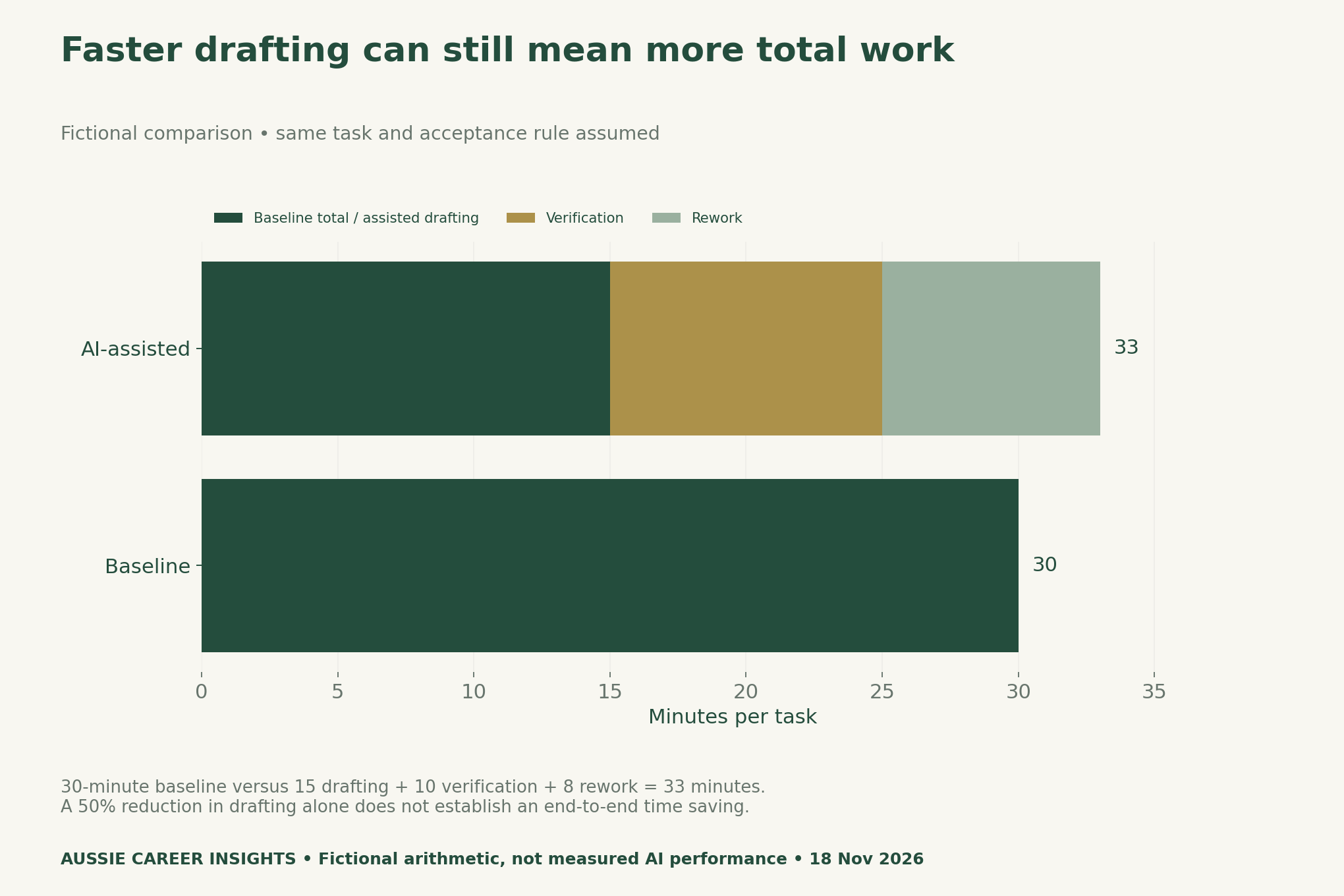
Consider a fictional task that takes 30 minutes using the existing process. A tool reduces drafting to 15 minutes, but verification takes ten minutes and rework takes eight. The assisted total is 33 minutes. Calling this a 50% time saving would count only drafting and omit the remaining work.
Under these assumptions, total time rises by 10%: three extra minutes divided by the 30-minute baseline. The calculation says nothing about typical workers, particular products or future performance. Change the assumptions and the result changes. We provide the fictional inputs so readers can reproduce the arithmetic.
First, define when a task begins and when an acceptable output is ready for the next person. Include necessary checking and corrections on both sides of the comparison. If one method needs a longer handover, record that time too. A consistent boundary makes the comparison useful.
Find the threshold, then test your own conditions
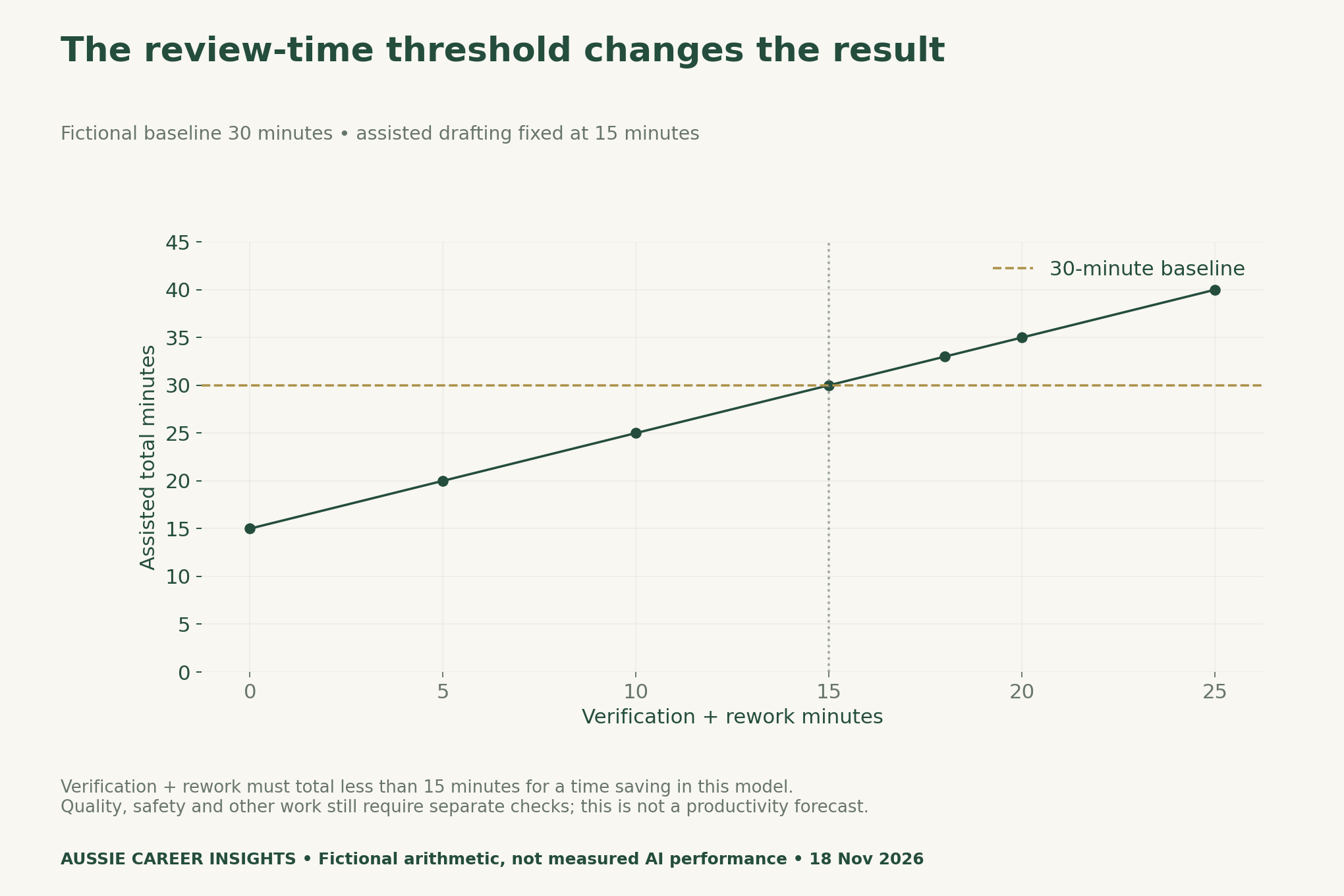
Next, consider the review burden. With drafting fixed at 15 minutes, another 15 minutes of checking and rework brings the total back to 30. Below that threshold, this model saves time; above it, the model adds time. This is a sensitivity calculation, not a recommended checking limit.
Do not reduce necessary verification merely to cross the threshold. A high-impact output may need specialist checks even when they take longer. Likewise, an error-free trial on simple material does not establish reliability for more complex tasks. Keep quality and risk decisions separate from the stopwatch.
Build a paired-task log that respects workers
Choose comparable tasks with similar difficulty, input quality and acceptance rules. Where feasible, vary the order of methods so learning does not always favour the second attempt. Record differences rather than treating unlike tasks as a clean experiment. A small convenience sample cannot establish a general causal effect.
Also record training and setup separately from repeated task time. A one-off learning session and an ongoing review duty have different implications. Note which costs fall on the worker, supervisor or another team. Otherwise, apparent savings may simply move work to someone outside the original measurement boundary.
Use neutral task references and approved material. Do not paste confidential documents, personal records or commercially sensitive information into a tool or our blank worksheet. The log is for private planning; it does not ask for employee names or rank people. Discuss an appropriate approach with the workplace before collecting observations.
Turn observations into useful, non-confidential feedback
The draft’s job-design discussion considers changes to tasks and workload. A useful contribution can therefore explain the problem, the task boundary, the acceptance rule and what happened to checking or handovers. Separate observed facts from interpretations, then identify what support or clarification would improve the process.
The hub says individual submissions may be published. Check its current terms before sending feedback through the official consultation page. Do not submit confidential workplace examples without appropriate authority. We have not submitted feedback on a reader’s behalf or presented the worksheets as government forms.
For related context, read our guide to interpreting Australian AI job-loss figures. A national estimate and a local task trial answer different questions. Neither should be presented as a promise about one person’s job or a specific tool’s performance.
Your Personalized Career Strategy
Unlock your potential with tailored career consulting. Get clear, actionable steps designed for your success. Start now!
Get StartedMethod and four downloadable CSV tools
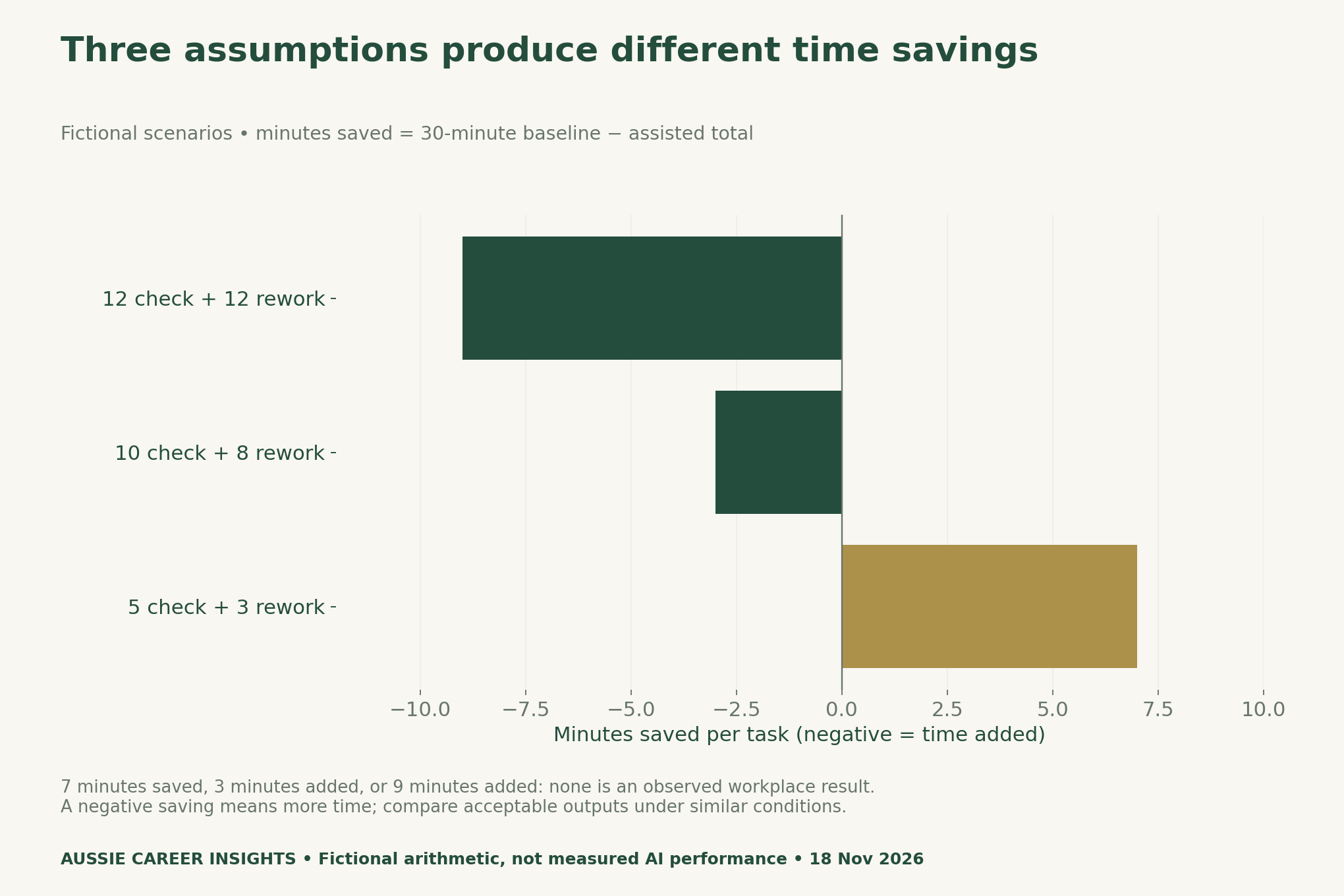
Sources were checked on 18 November 2026. We reconciled the announcement date with the hub’s opening date and read the draft’s scope, theme structure and job-design discussion. All three charts use fictional minutes, not survey data. Savings equal baseline total minus assisted total; percentage savings divide that difference by baseline time.
- Source register and consultation boundaries (CSV)
- Fictional complete-workflow calculations (CSV)
- Blank paired-task time and quality log (CSV)
- Plan, Enable and Embed question worksheet (CSV)
Suggested citation: Aussie Career Insights, “Workplace AI: Measure Total Work, Not Just Drafting Speed”, 18 November 2026. Primary sources: DEWR announcement, consultation hub and draft guide, especially pages 4, 7 and 26–29. Charts and private planning worksheets are this publication’s original work.


