







Private tutoring jobs in Australia can look attractive when a session fee fits around study or other work. However, the paid lesson may be only part of the commitment. Preparation, travel, messages and direct expenses can change the comparison substantially.
Jobs and Skills Australia’s October 2026 Vacancy Report, released on 18 November, spotlights Private Tutors and Teachers. It reports about 110 online ads, almost 60% above the 2019 monthly average, versus around 20% across occupations. The spotlight’s footnote identifies 12-month-average data. This is not a list of 110 jobs open today.
Private tutoring jobs Australia: read the demand signal correctly
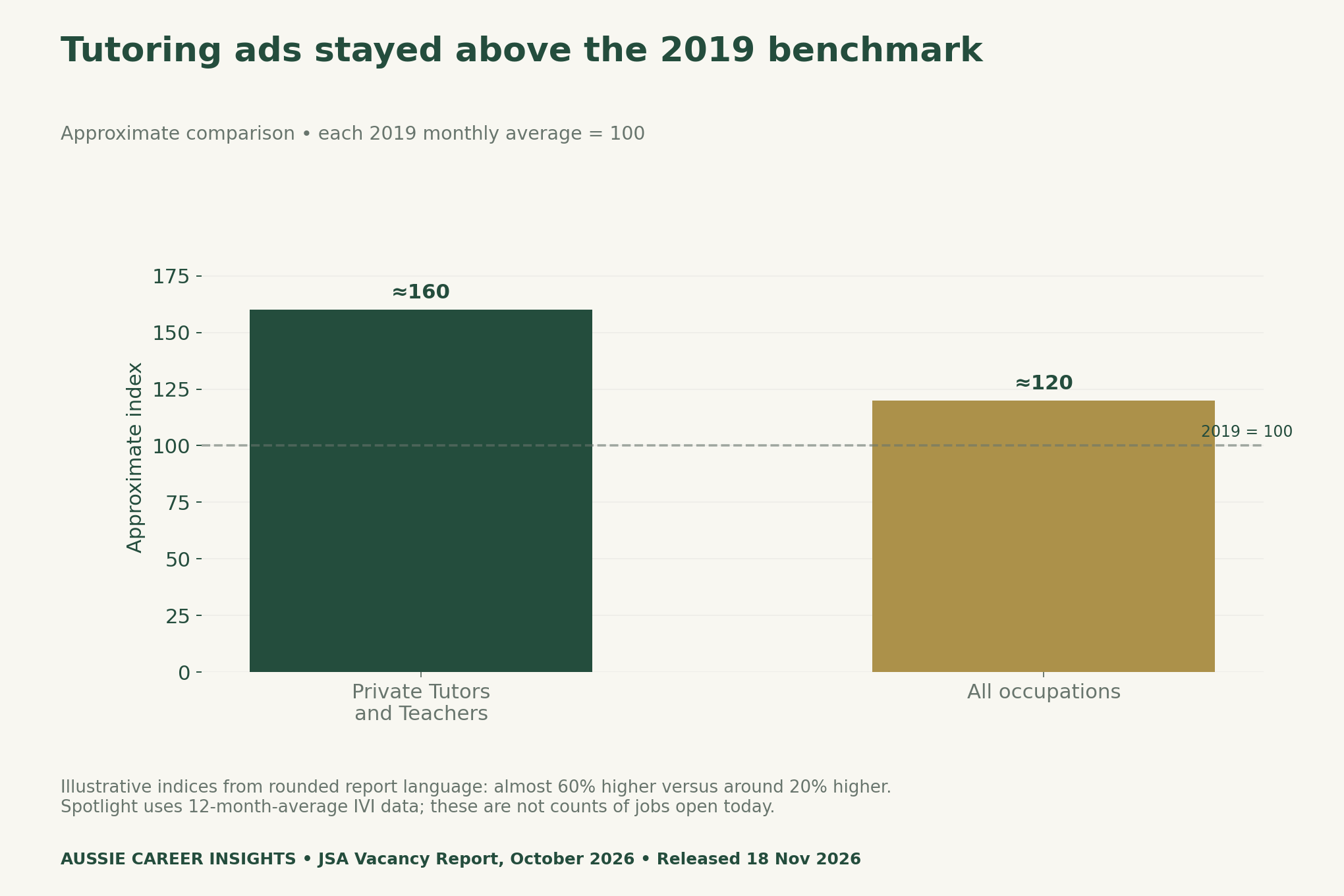
The occupation includes music, art, drama and dance teaching as well as broader private teaching. Online advertisements also miss informal recruitment. Therefore, a demand indicator cannot tell you whether a suitable academic tutoring role is available near your home or campus.
The report says Major Cities accounted for more than 80% of this occupation’s ads on average over five years, against around 70% overall. That is a historical location pattern, not proof that every city has vacancies. Likewise, older Census descriptions do not describe the people applying for today’s advertised roles.
Use every committed hour in the denominator
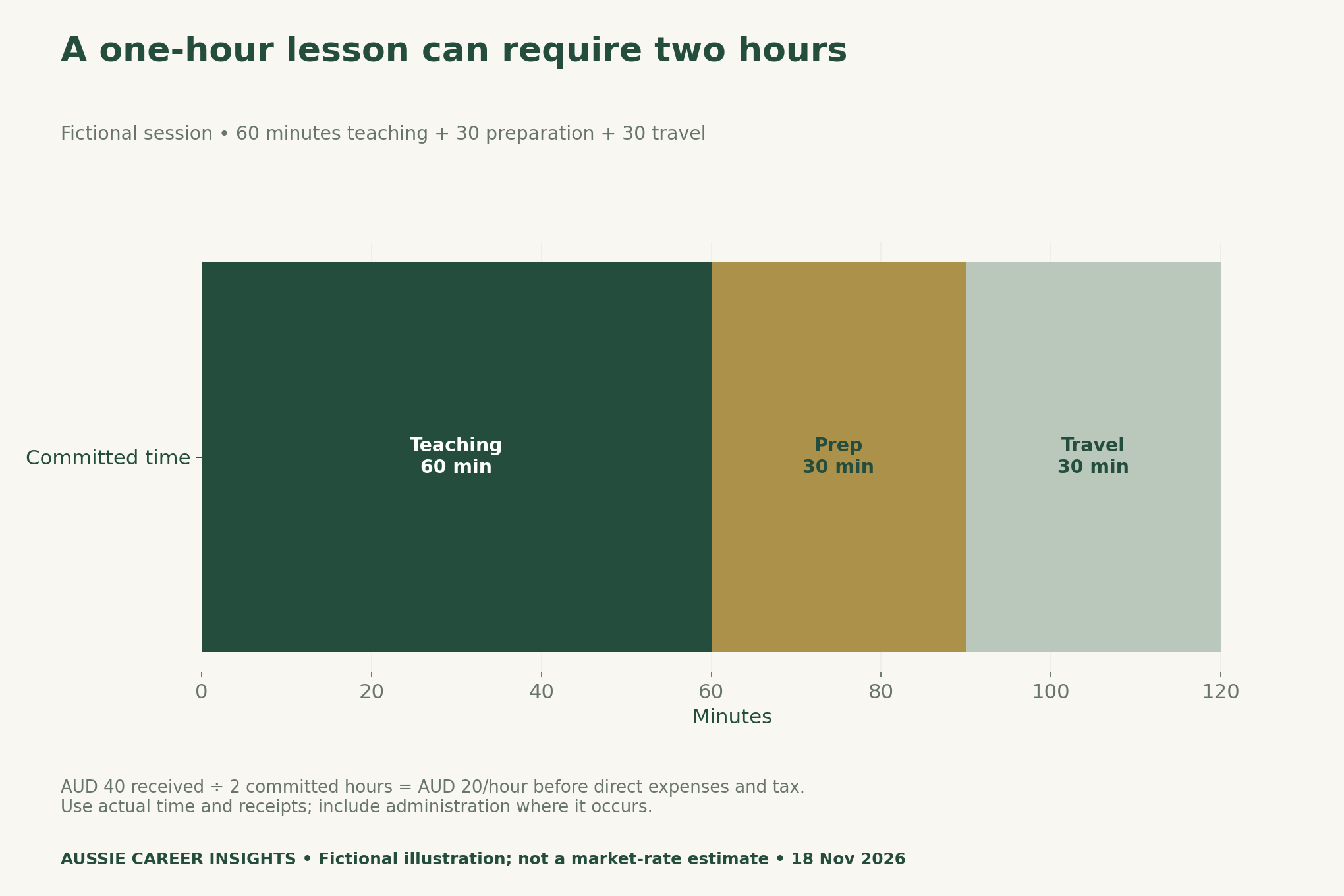
Consider a fictional A$40 receipt for a one-hour lesson. Add 30 minutes preparing and 30 minutes travelling, and the commitment becomes two hours. The effective return is A$20 per hour before expenses. If direct expenses are A$5, the calculation becomes A$35 divided by two hours, or A$17.50.
Here, “effective return” means receipts after identified direct expenses divided by time committed. It does not mean inflation-adjusted pay, an employee’s take-home wage or a legal minimum rate. Keep those concepts separate when comparing an employment offer with an independent tutoring arrangement.
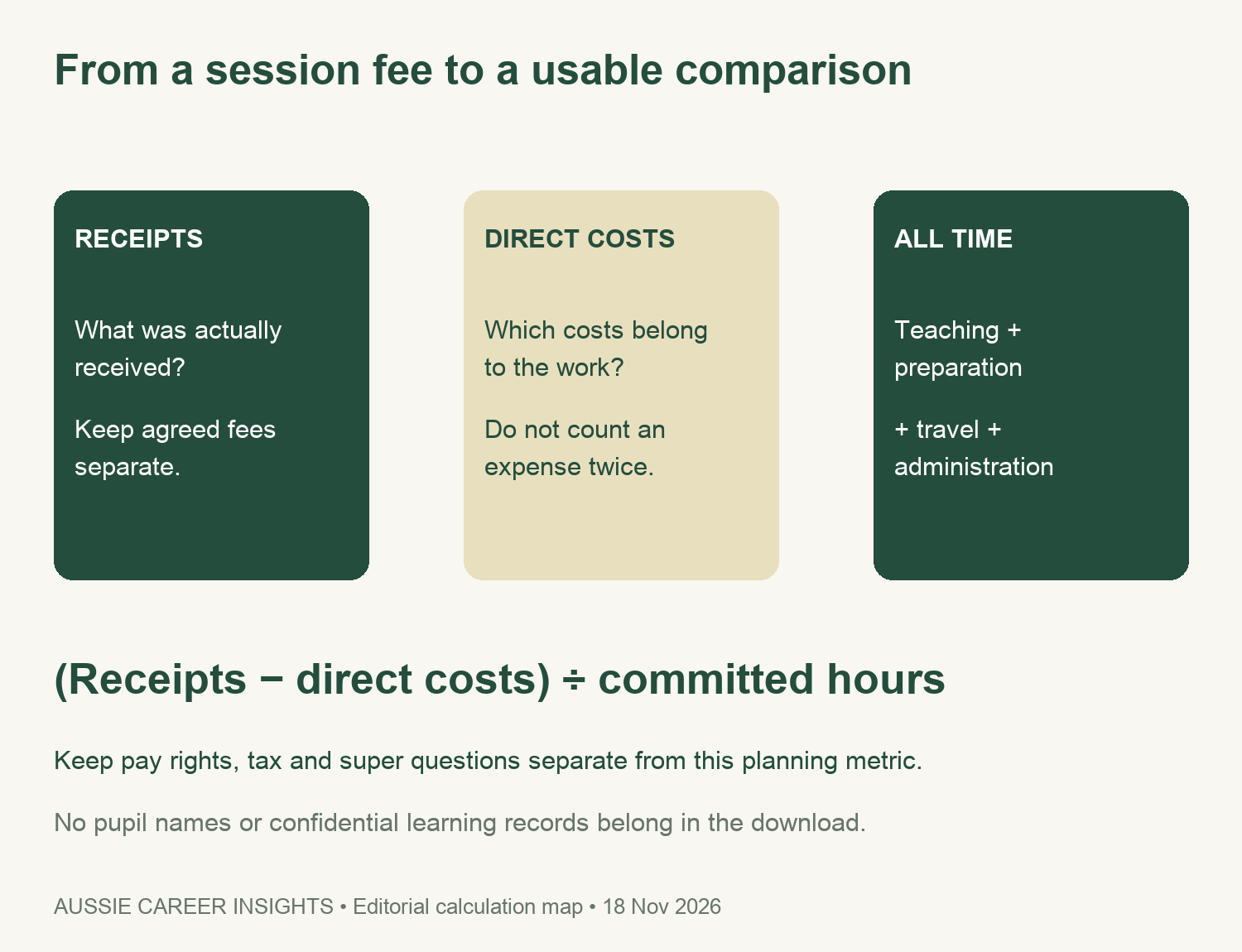
First, record the time the work actually takes. Include necessary messages, resource preparation and administration where they occur. Avoid counting the same shared journey twice across sessions. If you allocate a shared cost, write down the method so another reader can follow the arithmetic.
Compare plausible scenarios, then replace the assumptions
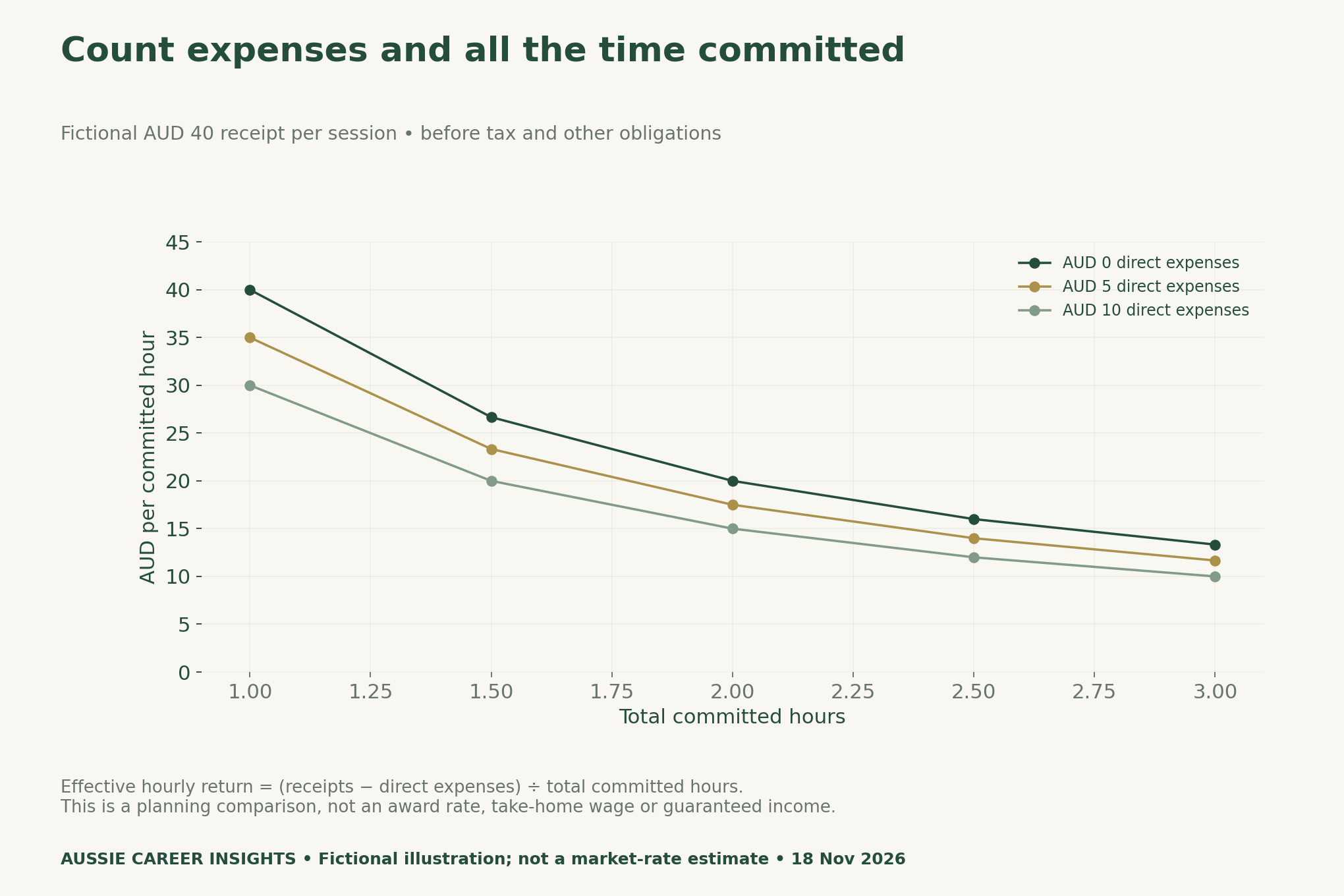
Next, test how a different commitment changes the result. At A$40 received with A$5 in direct expenses, one hour gives A$35 per hour, two hours gives A$17.50 and three hours gives about A$11.67. These differences come from the assumptions, not a claim about typical tutors.
Also, distinguish a booked lesson from money received. Record an unpaid cancellation separately rather than treating the agreed fee as income. Time already spent preparing or travelling still belongs in a retrospective account. Check the actual cancellation terms before relying on any expected payment.
For a weekly comparison, add receipts and costs across the relevant sessions, then divide by the total committed hours. Do not average hourly figures without considering their different time weights. A short, high-return session and a long, low-return session need their actual hours in the combined calculation.
Questions before accepting a tutoring arrangement
Ask which duties the quoted fee covers, when payment occurs and how cancellations work. Confirm who supplies resources, what training is required and whether the location is practical. Request clarification before treating a headline rate as payment for every hour involved.
In addition, ask whether the arrangement is employment or independent work and where to confirm the applicable conditions. This article does not classify an individual contract or decide which expenses an employer must reimburse. Our planning metric should not replace checks of legal pay entitlements.
When children are involved, check the provider’s safeguarding, privacy and escalation procedures and any relevant local requirements. The private log uses a neutral session reference. It asks for no pupil names, learning records, contact details or sensitive information about a child.
Finally, consider fit as well as arithmetic. A schedule that disrupts classes, caregiving or another job may be impractical even if the calculated return looks acceptable. For related context, see our coverage of online education work; verify each role’s actual duties and conditions.
Method and four reusable CSV tools
We retained and checked the official five-page report on 18 November 2026. The demand chart uses approximate indexed equivalents of its rounded language. We did not digitise its time-series line or treat historical demographics as current vacancy characteristics.
Your Personalized Career Strategy
Unlock your potential with tailored career consulting. Get clear, actionable steps designed for your success. Start now!
Get StartedThe remaining charts and calculation file use fictional assumptions. The blank log and question sheet support a private comparison; they predict no income. Keep gross receipts, expenses and committed time visible, and use consistent periods before comparing alternatives.
- Source benchmarks and measurement notes (CSV)
- Fictional session calculation worksheet (CSV)
- Blank private tutoring-session log (CSV)
- Tutoring arrangement question sheet (CSV)
Suggested citation: Aussie Career Insights, “Private Tutoring Jobs: Calculate Your Real Hourly Return”, 18 November 2026. Primary source: Jobs and Skills Australia, Vacancy Report October 2026, pages 2–3 and footnote 2. Original charts, fictional arithmetic and worksheets by this publication.


