







Battery manufacturing careers Australia may develop around specific components, rather than a single all-purpose “battery job”. For a career changer, the useful question is which task you can already demonstrate and what the target employer still needs you to learn. Start with the process, then test your evidence against a real role.
CSIRO’s 4 November 2026 announcement highlights aluminium cell cans and copper collector foil. Its research identifies technical opportunities for further study. It does not announce a factory recruiting today. This guide separates component measurements, possible evidence and verified vacancies, with two original charts and four downloadable tools.
What the new battery manufacturing research actually says
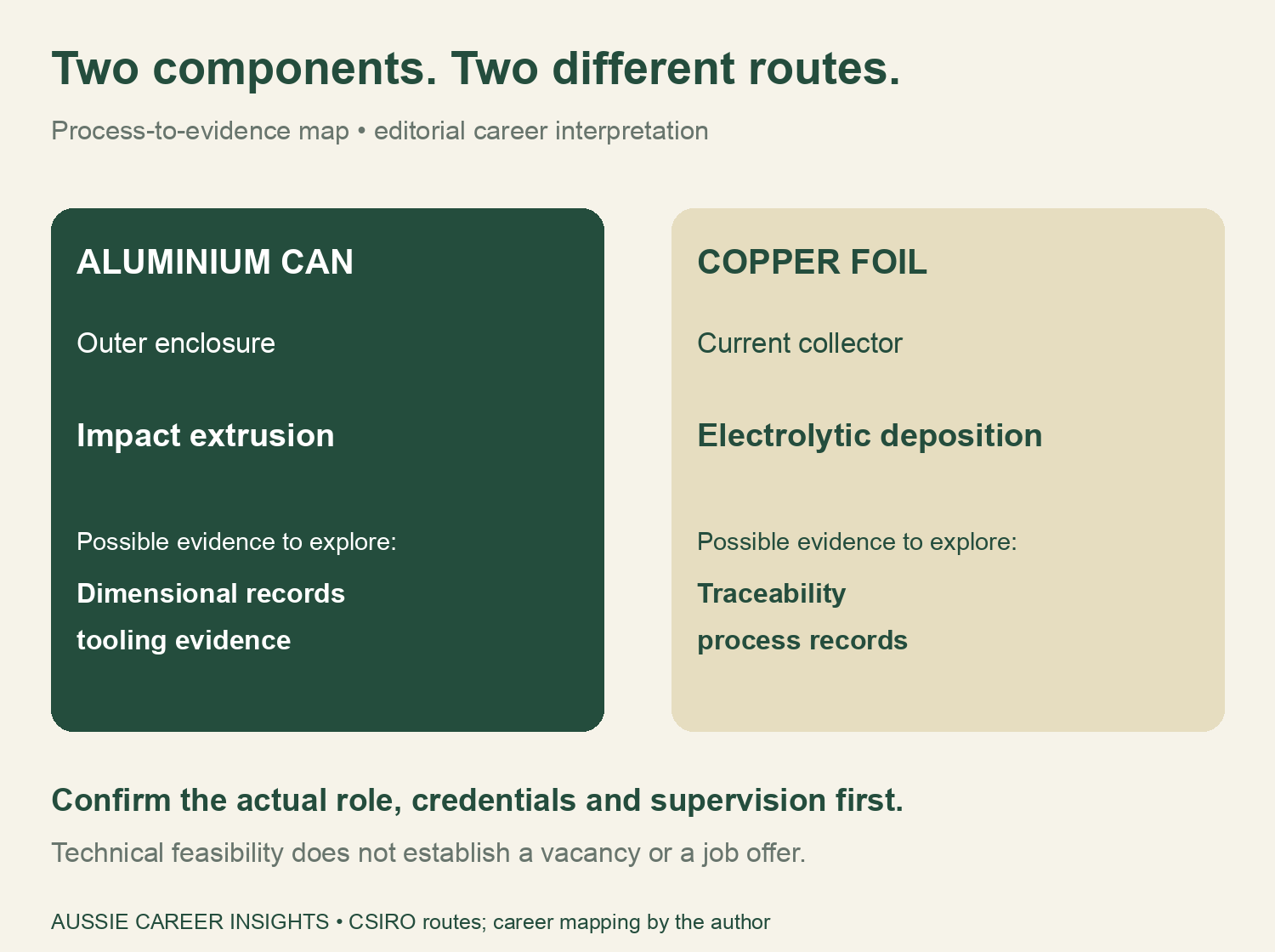
The CSIRO announcement points to impact extrusion for prismatic aluminium cans and electrolytic deposition for copper foil. The 26-page summary is dated September 2026 and draws on a longer report dated 25 May. Meanwhile, the landing page was updated on 28 October. These dates describe different publication stages, not a week of measured hiring growth.
A cell can is the outer enclosure; a collector foil supports electrode material and carries current. Therefore, a record of forming or inspecting an enclosure answers a different question from a record concerning foil. Keep the component, material and process together when explaining your own experience.
Battery manufacturing careers Australia: read the dimensions carefully
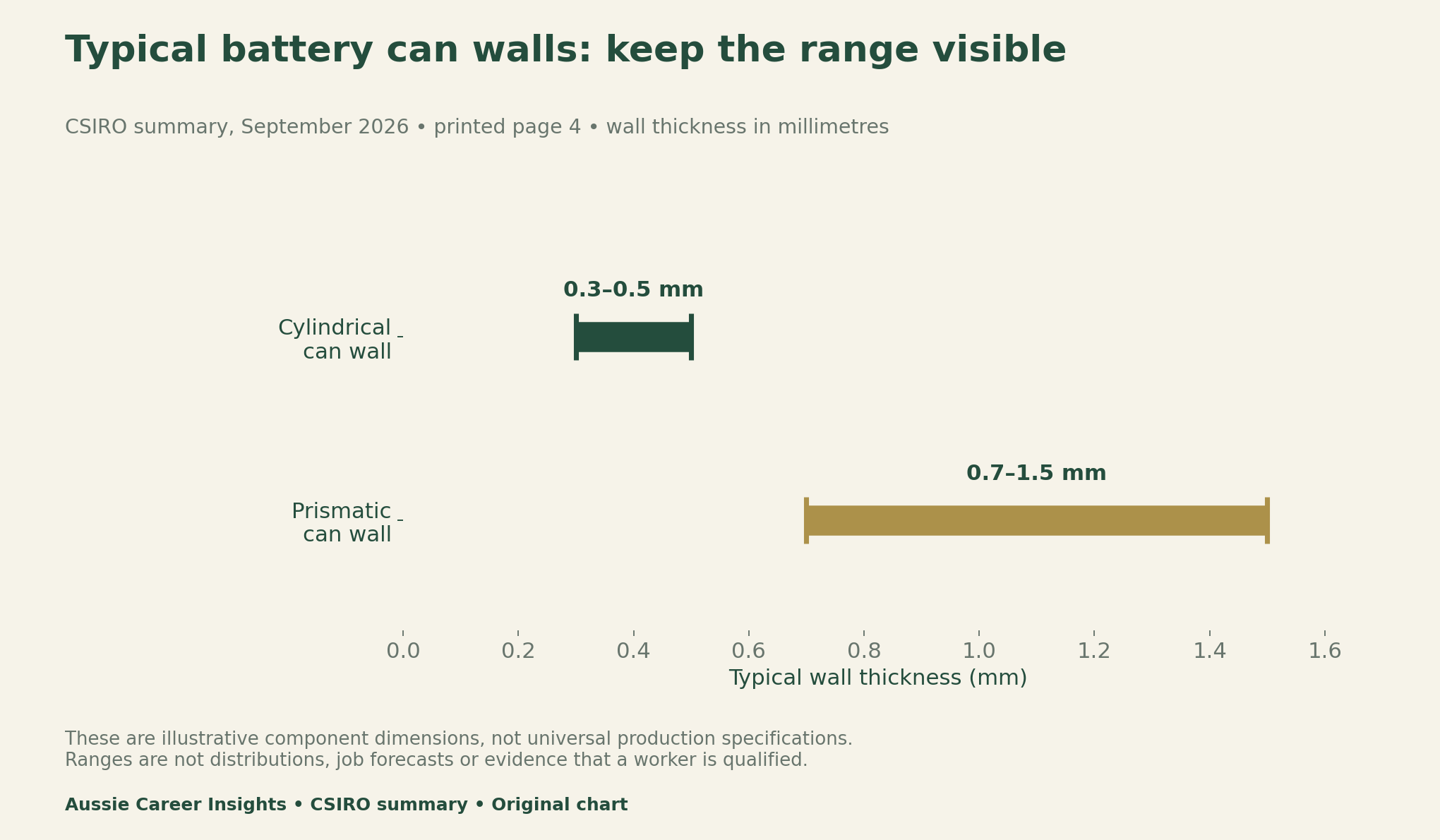
The summary gives typical cylindrical-can walls of 0.3–0.5 mm and prismatic-can walls of 0.7–1.5 mm. Those ranges describe components, rather than a specification to apply to every production line. The chart shows both endpoints. It does not imply that every value is equally common or that the ranges represent test results.
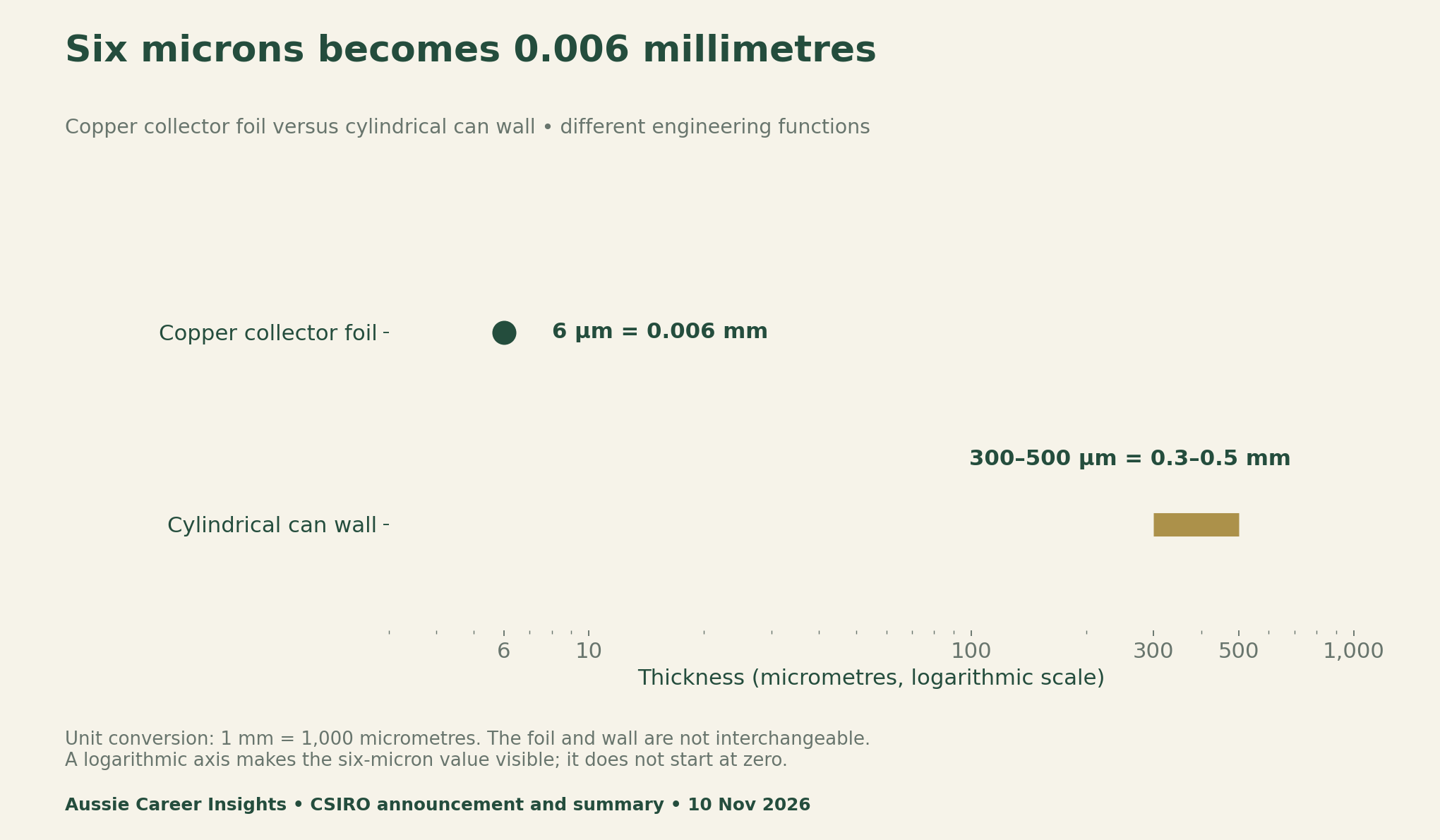
The announcement describes negative-electrode copper foil as typically six microns thick. Since 1 mm equals 1,000 micrometres, 6 ÷ 1,000 = 0.006 mm. Likewise, 0.3–0.5 mm becomes 300–500 micrometres. These are unit conversions, not a claim that foil and can walls perform the same job.
For an application, explain how you checked units and recorded a measurement in your own authorised work. Also state the instrument resolution when it matters. Reading a component dimension in a report does not establish that you can measure, manufacture or approve that component in a workplace.
Map a process to evidence an employer can assess
| Role family to explore | Evidence question | Boundary to confirm |
|---|---|---|
| Production or process operations | Can you explain a permitted work record and your own responsibilities? | Actual process, training and supervision |
| Tooling or maintenance | Can you show a sanitised inspection, handover or revision example? | Required trade credentials and authorisation |
| Quality inspection | Can you explain units, record control and how you escalated a discrepancy? | Employer procedure and release authority |
| Materials testing | Can you separate an observation from a conclusion that needed review? | Required qualification, method and oversight |
Choose one relevant example, rather than collecting an impressive pile of unrelated documents. Describe the task, what you personally did, who checked it and what changed after a problem arose. A clear boundary around your responsibility helps an employer assess the evidence honestly.
Use original practice work or material you have permission to share. Remove customer details, restricted drawings and confidential production data. Do not send employment records or identity documents to this website. The blank evidence map is for your private preparation and a later conversation with an employer or assessor.
Try a fictional quality-documentation exercise
Our practice CSV uses an invented interval of 1.00–1.05 mm. A fictional reading of 1.02 mm falls within it; 1.08 mm exceeds its upper bound. The instrument resolution is set at 0.01 mm solely for the exercise. None of these inputs is a battery specification or a recommended instrument choice.
First, identify the unit and the supplied interval. Next, record the reading without altering it to fit the interval. Finally, note who would need to review a discrepancy in the fictional setting. This tests documentation clarity. It does not teach a manufacturing operation, authorise an adjustment or establish vocational competence.
Verify investment and actual recruitment separately
A technical pathway needs different evidence from a job search. Keep an investment announcement in one record and a direct employer vacancy in another. For each vacancy, save the employer URL, location, advertised date, checked date, essential credentials and current status. If no advert is verified, leave the register blank.
No employer adverts were sampled for this article, so the downloadable vacancy register contains no claimed openings. Search a named employer’s own careers page and confirm that an advert remains live before making a commitment. A supplier’s general contact page is not a vacancy. A course promotion is not an employment offer.
For adjacent engineering work, our mechanical drafting research shows why employers can require different software and project evidence. Its dated occupation data are context, not proof of hiring for cell cans or foil. Similarly, an overseas qualification or Australian course needs role-specific assessment; no component opportunity establishes sponsorship or automatic recognition.
Free source data and private planning CSVs
The source file preserves the original unit, conversion, source location and limitation. The practice record contains only fictional values. Both blank registers remain reader-owned tools. You can cite the charts with their source and date intact; do not remove the distinction between a technical possibility and an observed job.
Your Personalized Career Strategy
Unlock your potential with tailored career consulting. Get clear, actionable steps designed for your success. Start now!
Get Started- Component dimensions and unit conversions (CSV)
- Blank private process-evidence map (CSV)
- Fictional quality-documentation exercise (CSV)
- Blank direct-employer vacancy register (CSV)
Method, limitations and update log
Research checked on 10 November 2026. We inspected the official summary and created original charts rather than copying its figures. Millimetres convert to micrometres by multiplying by 1,000. No salaries, vacancy totals, worker interviews or hiring outcomes were collected. We did not turn global market values into Australian employment forecasts.
Suggested citation: Aussie Career Insights, “Battery Manufacturing Careers Australia: Cans, Foils and Skills,” 10 November 2026. Cite CSIRO alongside the relevant chart or CSV. Recheck the direct advert, credential requirements and provider terms when you make a decision. Update a register entry when its status changes, while retaining the earlier checked date.


