




Mobile TAFE South Australia First Nations training plans could bring learning closer to home. However, a mobile classroom announcement does not settle where a learner will practise, receive clinical supervision or complete assessment. Confirm all four places before changing work, care or travel plans.
The 16 November joint ministerial announcement sets out two projects backed by a combined $3.58 million, with expected reach of up to 360 learners a year across 20 locations. Operation is expected by early 2029. These are future plans, not evidence that a particular mobile intake is open today.
Mobile TAFE South Australia First Nations training: two different projects
Tauondi Aboriginal College will lead the Distributed Digital Classroom Network for Aboriginal Workforce Development. Its announced scope includes foundation and digital skills, language, wellbeing, pre-employment learning and mentoring. AHCSA will lead RECONNECT, proposing telehealth-supported primary health training, professional development, clinical supervision and assessment.
The release says the projects were developed with community-controlled organisations, Traditional Owner groups and regional stakeholders. It does not publish a reader-specific offer, location timetable or equal seat allocation. We therefore do not divide the annual ceiling by 20 and call the result places available in each community.
Ask the relevant provider which project, course and intake your enquiry concerns. A foundation-skills conversation and a clinical qualification application can have different prerequisites and practical arrangements. Keep their answers in separate records rather than merging both projects into one generic mobile course.
What current AHCSA course pages actually say
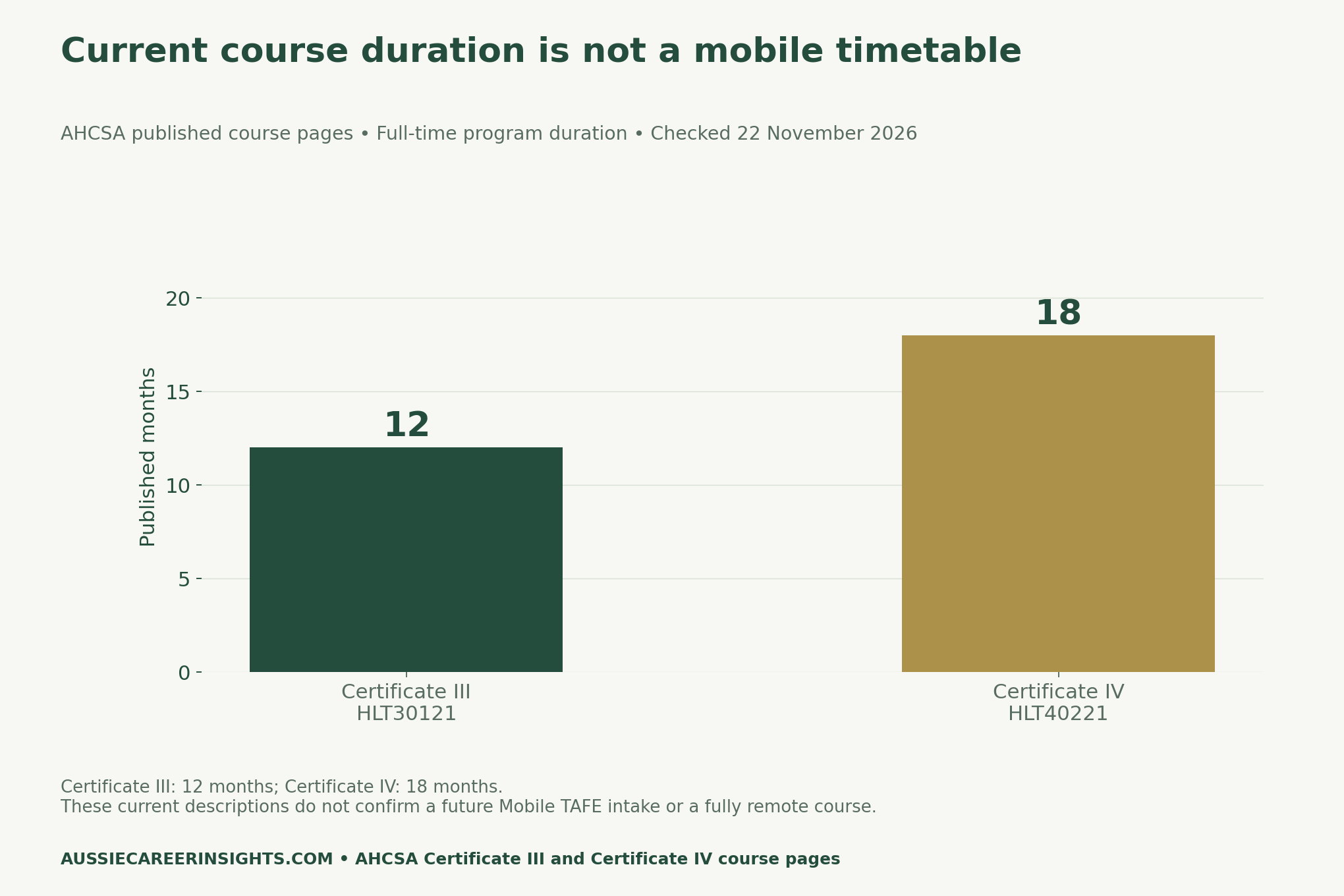
The current Certificate III page describes a twelve-month full-time program with eight weeks of face-to-face training, study between workshops and supervised primary-health practice. It specifies at least 250 placement hours for learners without relevant health-industry access. Confirm how the requirements apply to your circumstances and intake.
The current Certificate IV page describes eighteen months of full-time study combining workshops, independent work and workplace learning. It states a minimum 500 hours of clinical practice. It also describes eligibility to apply for practitioner registration after completion; that is not automatic registration or a promise attached to every mobile learning activity.
Hours and months answer different questions. Placement hours describe practical participation; program months describe elapsed course duration. We do not put those values on one numerical axis or treat the difference between the two qualifications as a faster route to the same role. The qualification code and scope matter.
Confirm four places, not just the classroom
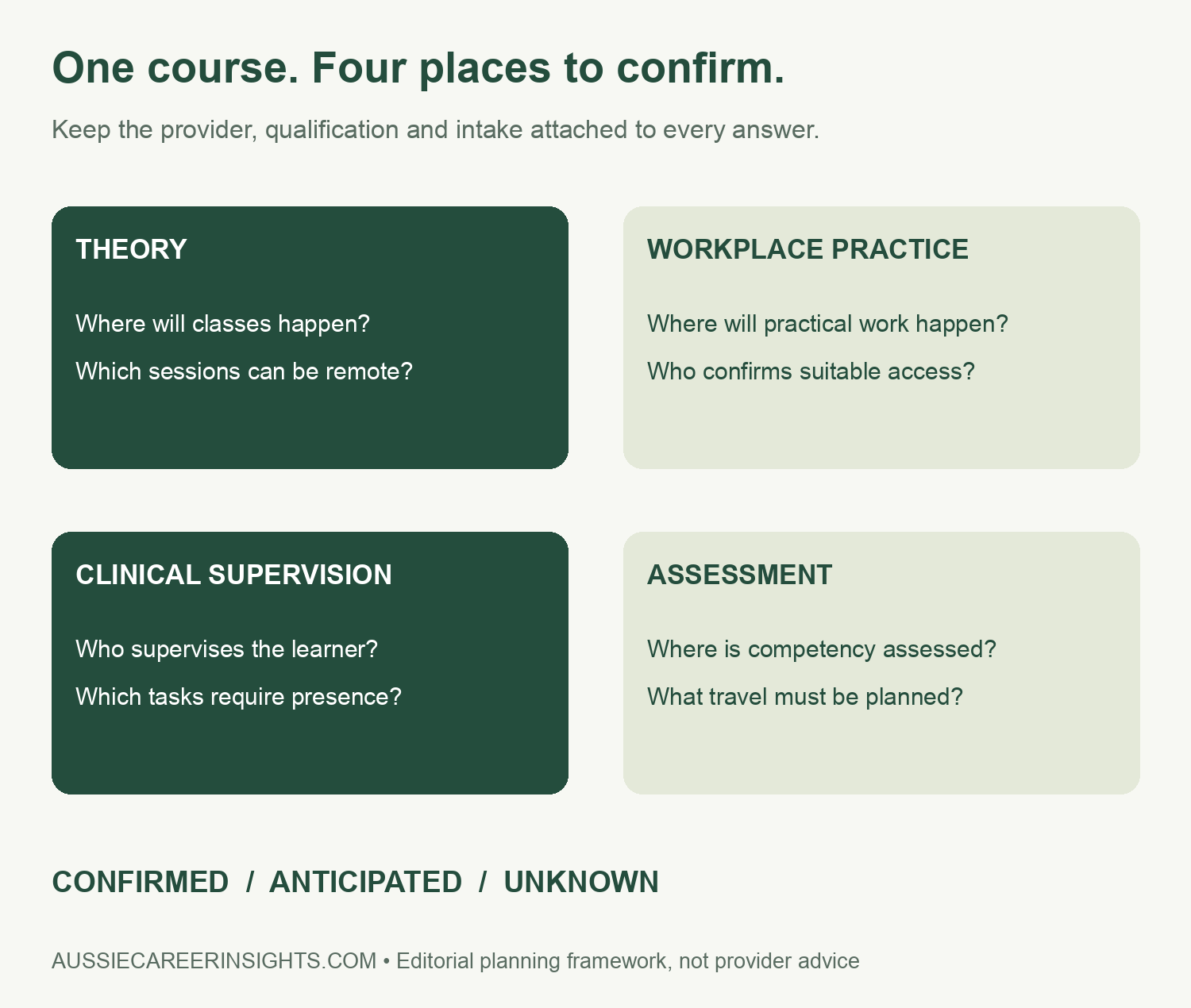
Start with theory. Record the actual location, the delivery mode and any sessions that require attendance. A digital link might support a class without replacing all face-to-face learning. Ask about internet and device needs, access to a quiet place and whom to contact when a connection fails.
Next, record workplace practice. Name the clinic or placement arrangement only when the provider has confirmed its suitability. Existing employment may help, but a job title alone does not establish access to the right tasks, patients or learning opportunities. Keep unresolved placement access visibly unknown.
Then identify clinical supervision. Ask who is responsible, how contact is arranged and which activities require a supervisor to be physically present. Do not assume telehealth makes every task remotely supervisable. The course provider and authorised clinical setting must settle those details within the learner’s scope.
Finally, confirm assessment. Ask which competencies need direct observation, where that happens and whether a separate examination venue is required. Record travel, time away and accessibility questions alongside the answer. A blank travel field means unresolved information, not a zero-dollar journey.
Two fictional learners expose different gaps
| Fictional scenario | Known assumption | Unresolved decision |
|---|---|---|
| A: already in a relevant clinic role | Workplace access exists in this invented example | Provider acceptance, supervisor and assessment venue still need confirmation |
| B: reliable home internet, no clinic role | A possible connection for theory exists | Placement, clinical supervision and assessment remain unresolved |
For learner A, the next useful call is about whether that workplace can support this exact qualification. The local classroom plan alone is not the bottleneck. For learner B, good internet solves a different problem: it does not create clinical access. Their worksheet should keep that distinction clear.
Use one status per answer: confirmed, anticipated or unknown. Attach the source and date, then write the next question. An anticipated community-room session can remain in the plan, but it should not be treated as a confirmed place or a reason to commit to non-refundable travel.
Ask the provider before you reorganise your life
AHCSA’s application guidance says acceptance is not guaranteed and lists course-readiness requirements. It directs people without current health employment to discuss placement options, while also requiring relevant clinical access and suitable supervision for participation. Read this alongside the specific course page and seek a direct answer where the wording differs.
Your Personalized Career Strategy
Unlock your potential with tailored career consulting. Get clear, actionable steps designed for your success. Start now!
Get StartedA useful enquiry states the qualification code, intended intake and current work or placement situation, then asks the four-place questions. Keep sensitive health, identity or employment documents within the provider’s official application process. The downloadable worksheet is for private planning, not a request to publish personal records.
This report has not established current vacancies, course fees, open application dates or a travel subsidy. It does not replace advice from an Aboriginal community-controlled training provider. We welcome corrections and community-educator perspectives, but do not claim consultation or endorsement that has not occurred.
Method, limitations and free planning files
We compared the dated government announcement with AHCSA’s current Certificate III, Certificate IV and application pages, checked 22 November 2026. The chart transcribes course durations. The infographic and two fictional scenarios are our editorial planning tools; they are not evaluations of either provider or evidence of delivery outcomes.
Keep future-project statements separate from current course descriptions. Recheck the provider’s intake-level advice before acting, especially if placement access, assessment arrangements or travel remain unknown. For a separate qualification-route example, see our Western Australian MEM50119 entry-route report; its trade rules do not transfer to clinical training.
- Announcement and current-course source register (CSV)
- Blank four-place provider confirmation worksheet (CSV)
- Two fictional learner comparisons (CSV)
- Confirmation status and interpretation dictionary (CSV)
Sources: Ministers’ Media Centre, 16 November 2026; AHCSA Certificate III, Certificate IV and application guidance. Suggested citation: Aussie Career Insights, “Mobile TAFE in South Australia: Plan the Assessment, Not Just the Class”, 22 November 2026. Published source values are attributed; tools are original editorial work.


