







Regional youth career pathways in Australia can look promising on paper while still being hard to reach. A course offer does not settle the last bus home, the placement location or the internet connection needed for assessment. Before you commit, turn the pathway into a dated access plan with a real provider and a fallback.
Jobs and Skills Australia released its Regional Roadmap on 10 November 2026. Its education measures show why the practical route matters. This report explains two different denominators, calculates a fictional travel example and provides four free CSVs for private planning. It does not rank young people, courses or towns.
What the regional youth pathway evidence measures
In the Roadmap’s Table 6, tertiary participation among people aged 15–24 is 20% in regional Australia and 36% in major cities for 2025. The difference is 36 − 20 = 16 percentage points. Calling it a 16% relative difference would use the wrong calculation.
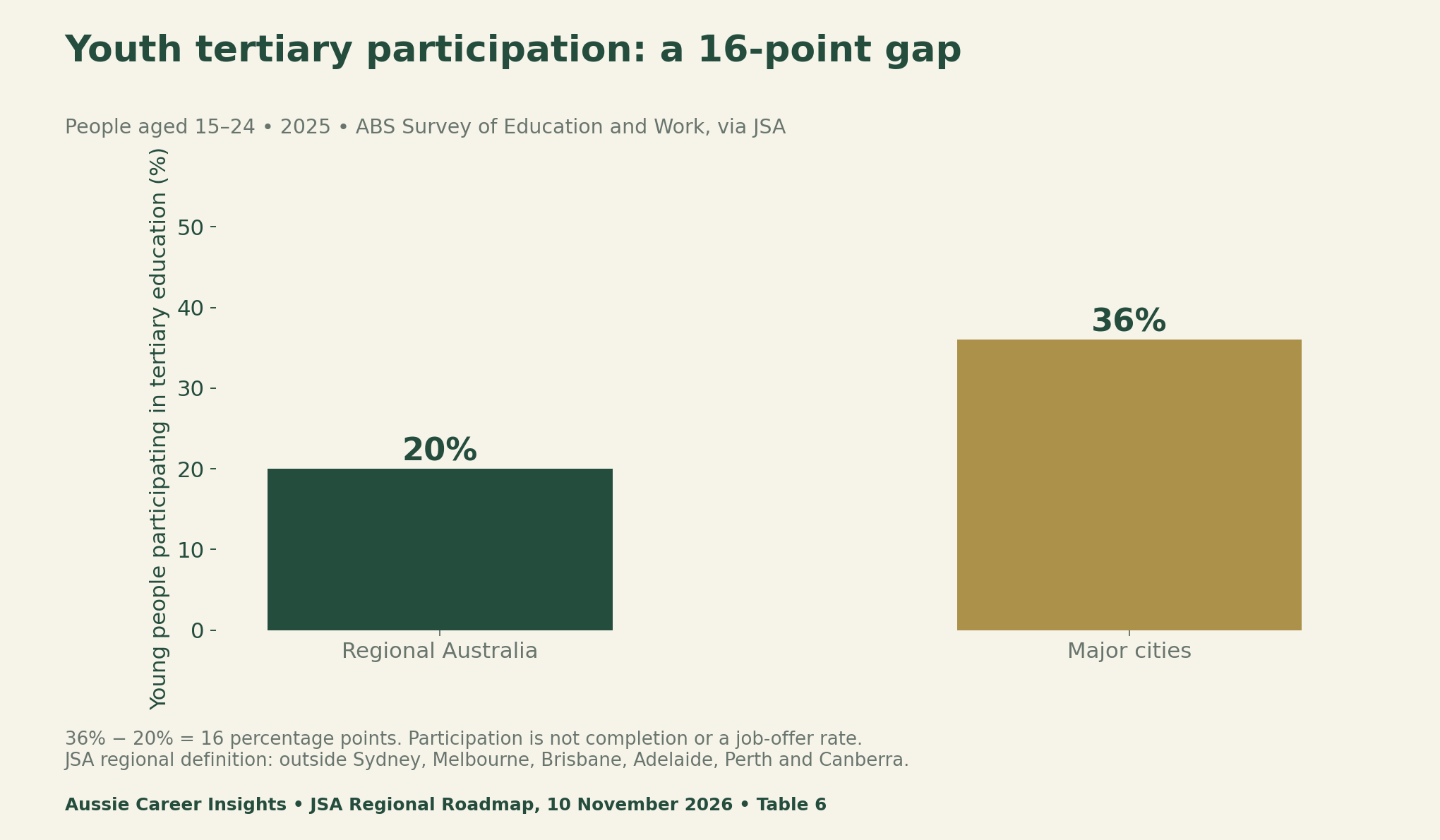
Here, regional Australia means areas outside Sydney, Melbourne, Brisbane, Adelaide, Perth and Canberra. The report draws on the ABS Survey of Education and Work series for 2015–25. People moving for study can affect the regional pattern. These rates cannot determine an individual’s motivation, ability or likely outcome.
Keep participation, completion and NEET separate
Participation asks who is studying at the reference time. Completion follows a starting cohort over a specified period. NEET describes being outside employment, education and training. Therefore, do not place these measures in a league table or treat one as the complement of another. None is a personal chance of success.
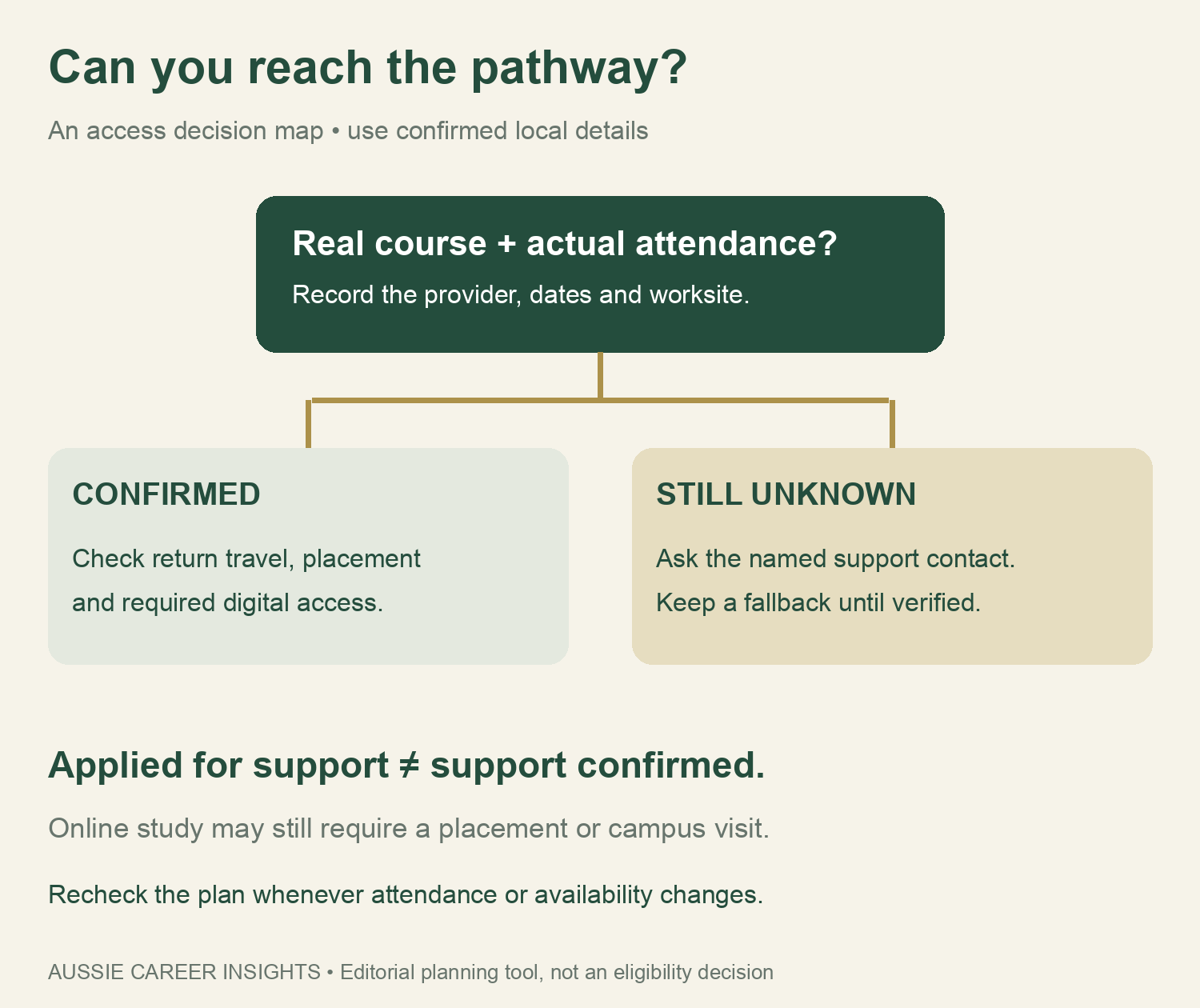
For a decision, ask what support the actual pathway offers when attendance becomes difficult. Name the person to contact before you miss a placement or assessment. A national rate cannot tell you whether a particular provider has an available place, flexible attendance or a suitable support arrangement.
Audit regional youth career pathways in Australia using real details
| Pathway to investigate | Question to confirm | Evidence to keep |
|---|---|---|
| School to TAFE | Which days and times require attendance, and where? | Current provider timetable and dated answer |
| Apprenticeship or traineeship | Where are the worksite and off-the-job training, and who supervises? | Employer and provider confirmations |
| Local or online university | Are there campus blocks, exams or placements away from home? | Course requirements and placement answer |
Write the exact attendance requirement, rather than a label such as “flexible” or “online”. Check the first arrival and last return journey for the required day. Include waiting, transfers and travel to a placement. If a timetable is not yet available, record that uncertainty and set a date to ask again.
For online study, confirm the equipment, software, connection and quiet space you need. Also check whether the course includes supervised assessment or an in-person block. A nearby study space may help with connectivity, but it does not automatically replace the course’s practical requirements or provide a placement.
Calculate the travel commitment before paying
Imagine three return journeys each week, with each return taking 90 minutes. The weekly total is 3 × 90 ÷ 60 = 4.5 hours. Over a 16-week term, it becomes 72 hours. These wholly fictional inputs illustrate the arithmetic; they are not measured regional travel times or a recommended travel limit.
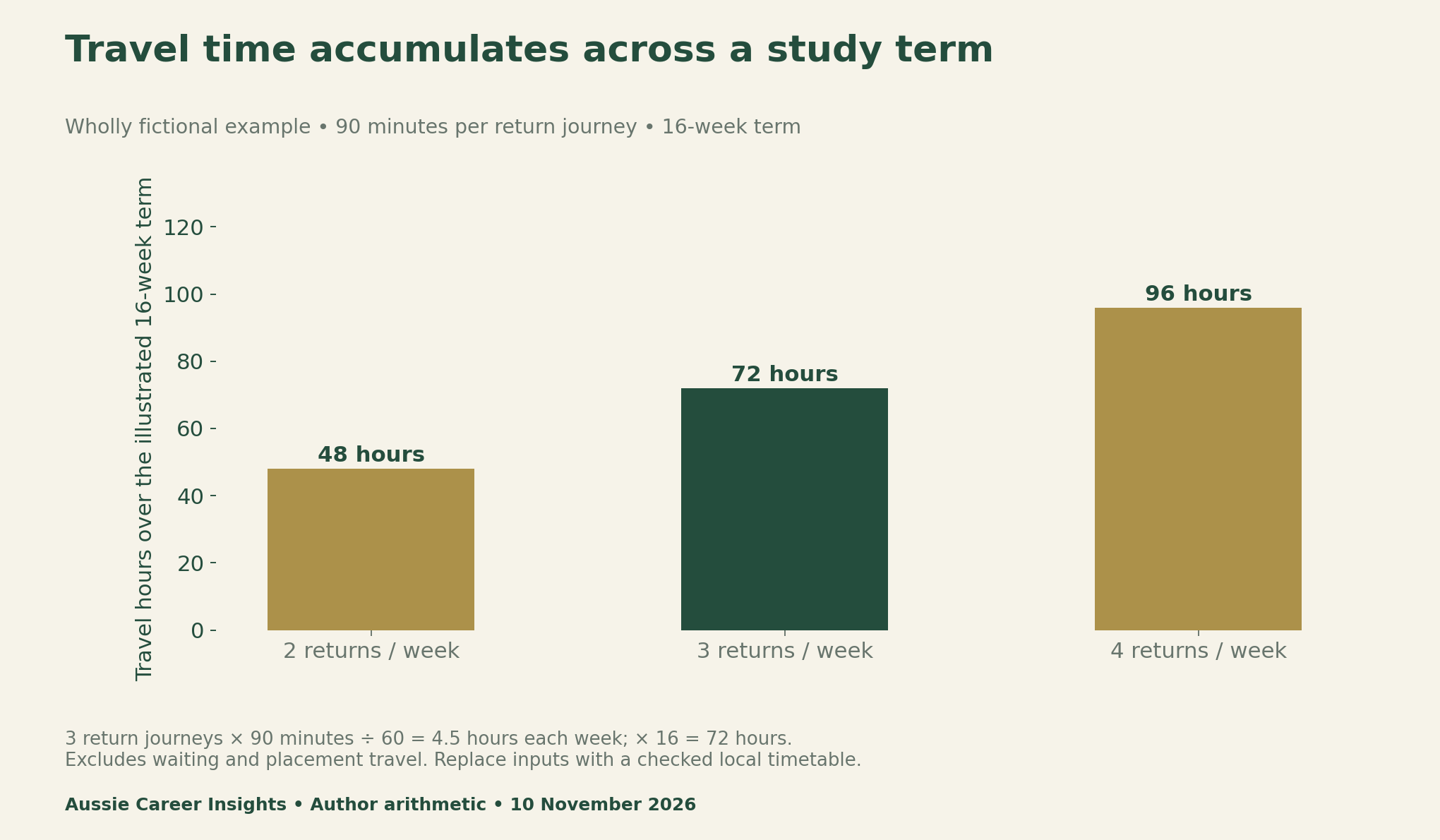
Now test a difficult week. What happens if the last bus does not run, a placement changes location or an assessment requires an extra visit? Name a practical alternative and its verified cost. If no workable alternative exists, take that question to the provider before assuming the pathway is available in practice.
Confirm help rather than budgeting for an application
The Department of Education’s University Study Hubs page provides a route to local facilities and registration information. Hubs provide study facilities and support; they are not education providers. Its current guidance describes free access for eligible domestic students enrolled with Australian university or VET providers. Check the particular hub’s registration and services.
The regional hubs FAQ explains that services vary locally. Ask about opening hours, equipment, accessibility and help during placements. For a newcomer, confirm domestic-student status and the particular service’s conditions rather than assuming that residence alone establishes eligibility. A hub listing does not confirm a course place or transport assistance.
For apprenticeships, the official Apprenticeship Support page explains the role of Apprentice Connect Australia Providers. Ask a named provider about your circumstances and the support route. Keep the status as unknown, applied for or confirmed. Only a confirmed amount and conditions should enter a cash plan as reliable assistance.
For broader context, our public-sector workforce report separates filled jobs from vacancies. The same distinction matters here: demand in a sector does not guarantee a course place, apprenticeship contract or local job. Verify each link in your own route.
Your Personalized Career Strategy
Unlock your potential with tailored career consulting. Get clear, actionable steps designed for your success. Start now!
Get StartedDownload the access audit and source CSVs
Keep these tools privately. Use course links and evidence references instead of identity documents or sensitive family details. The source file separates age group, geography, reference period and denominator. The travel file contains invented scenarios, while both blank worksheets need your own verified details.
- Participation and cohort source data (CSV)
- Blank course-to-work access audit (CSV)
- Fictional term-travel calculations (CSV)
- Blank support-confirmation register (CSV)
Methods, limitations and update log
Research checked on 10 November 2026. The official publication page confirms the release date. We used the report’s printed Table 6 and its source notes, without extracting invented point values from a chart. The access questions are our editorial framework, not a validated predictor of completion.
No local provider, timetable, assistance award or service availability was surveyed for this report. We have not attributed a participation gap to any single cause. Recheck official course and support conditions when they change. Suggested citation: Aussie Career Insights, “Regional Youth Career Pathways in Australia: Check Real Access,” 10 November 2026, with JSA’s original source and each measure’s period retained.


