




Overview of Electricians and Solar Installers: Roles and Responsibilities
This overview compares electricians and solar installers.
It outlines roles, responsibilities, and work conditions.
The content also describes career paths and professional development.
Role of Electricians
Electricians install electrical systems in residential, commercial, and industrial settings.
They maintain and repair those systems to ensure reliable operation.
Electricians follow safety regulations and electrical codes to prevent hazards.
They read blueprints and technical diagrams to connect wiring correctly.
Using multimeters, electricians test electrical components to diagnose faults.
Electricians collaborate with architects, engineers, and construction teams on projects.
They use conduit benders and wire strippers as part of daily work.
Electricians perform preventive maintenance to avoid potential electrical hazards.
Role of Solar Installers
Solar installers focus on setting up solar energy systems for homes and businesses.
They assess site conditions to determine optimal panel placement and orientation.
Installers assemble and mount panels on roofs or on ground mounts.
They connect panels to electrical systems and ensure proper wiring and grounding.
Your Personalized Career Strategy
Unlock your potential with tailored career consulting. Get clear, actionable steps designed for your success. Start now!
Get StartedInstallers commission systems and perform tests to verify efficiency.
They educate customers about operation and maintenance requirements.
Installers stay updated on photovoltaic technology and regulatory changes.
Their work supports Australia’s increasing push toward renewable and sustainable energy.
Key Responsibilities Compared
This comparison highlights how duties differ between electricians and solar installers.
Electricians cover broad electrical systems while installers specialise in photovoltaic setups.
Both roles maintain systems, but their technical focus and daily tasks vary.
- Installation: Electricians install varied electrical systems while solar installers specialise in solar panel setups.
- Maintenance: Both maintain systems, with electricians handling general repairs and installers focusing on panel upkeep.
- Technical Knowledge: Electricians require broad code knowledge while installers need photovoltaic technology expertise.
- Safety Focus: Each professional must follow strict safety standards to prevent hazards and ensure reliability.
- Client Interaction: Both communicate with clients to explain scope and system usage effectively.
Work Environment and Conditions
Electricians perform work indoors and outdoors and sometimes in cramped spaces.
Solar installers work outdoors on rooftops or open ground with weather exposure.
Both careers require physical fitness and comfort working at heights.
Teamwork and problem solving are essential in both trades.
Work hours vary by project and may include overtime or weekend shifts.
Career Path and Professional Development
Electricians often complete apprenticeships that last several years for certification.
Solar installers commonly begin as electricians or obtain specialised solar training certificates.
Stand Out with a Resume That Gets Results
Your career is worth more than a generic template. Let us craft a resume and cover letter that showcase your unique strengths and help you secure that dream job.
Get HiredContinuous education helps both trades adapt to evolving standards and technologies.
Many professionals advance to supervisory or consultancy positions within their fields.
Both careers offer high demand and opportunities across the growing energy sector.
Educational and Certification Requirements for Electricians vs Solar Installers in Australia
This page compares electrician and solar installer education and certification in Australia.
It focuses on training pathways and accreditation requirements.
Additionally, it highlights ongoing education and safety standards.
Training Pathways for Electricians
Electricians begin by undertaking a Certificate III in Electrotechnology Electrician.
Typically, this qualification requires an apprenticeship that lasts four years.
During the apprenticeship, apprentices gain hands-on experience and formal training.
They learn wiring practices, safety protocols, and Australian electrical standards.
Registered training organisations like TAFE Queensland and Holcim Institute deliver these courses.
Apprentices complete a combination of on-the-job and classroom training.
Licensing and Certification for Electricians
Electricians must hold a valid electrical license to work legally in Australia.
Licensing requirements differ by state but generally include completing the apprenticeship.
Transform Your LinkedIn for Maximum Impact
Elevate your professional brand with a LinkedIn profile that attracts recruiters, showcases your expertise, and maximizes opportunities. Stand out in your industry with a profile built for success.
Boost ProfileCandidates then pass a licensing exam covering electrical theory and safety regulations.
NSW Fair Trading manages electrician licensing in New South Wales.
Once licensed, electricians must renew certification regularly and maintain continuing education.
This renewal helps keep skills up to date with changing codes and technologies.
Training and Qualifications for Solar Installers
Solar installers typically complete a Certificate II or Certificate III in Renewable Energy.
Providers like GreenPower Training and Canberra Institute of Technology offer these qualifications.
The courses cover solar panel installation, maintenance, and system safety.
Trainees also learn about energy storage and system design fundamentals.
On-the-job training augments formal education to develop practical skills.
Some experienced electricians transition into solar installation after short additional courses.
Licensing and Industry Accreditation for Solar Installers
Solar installers must become Accredited Installers under the Clean Energy Council.
This accreditation signifies compliance with quality and safety standards.
Applicants provide evidence of relevant qualifications and practical experience.
They also pass an online assessment to verify their knowledge of solar systems.
CEC accreditation must be renewed every three years through continued learning.
Employers like SunBright Solar and EcoVantage Solutions seek accredited installers for projects.
Comparative Summary of Training and Accreditation
Electrician training generally spans four years through an apprenticeship.
By contrast, solar qualifications often consist of Certificate II or Certificate III courses.
Solar installers additionally require Clean Energy Council accreditation specific to photovoltaic systems.
Both professions require ongoing education and adherence to Australian safety standards.
Career progression frequently involves additional qualifications and continued professional development.
Employment Opportunities and Job Market Demand for Both Trades
Both trades offer steady employment across Australia’s construction and energy sectors.
Demand varies by industry drivers and regional uptake of new technologies.
Several companies actively recruit skilled workers in each trade across the country.
Overview of Employment Trends for Electricians
Electricians remain fundamental to Australia’s construction and maintenance sectors.
As a result, their employment opportunities continue to grow steadily across urban and regional areas.
Infrastructure projects frequently require licensed electricians, sustaining demand nationwide.
Companies like BrightSpark Electrical Services and Sydney Energy Solutions actively seek qualified electricians.
Growth of Solar Installer Careers
Solar installer careers grow alongside Australia’s renewable energy expansion.
Government incentives also increase demand for installation and maintenance jobs.
Companies such as GreenSun Energy and SolarWave Australia recruit skilled technicians.
Demand rises faster in states like Queensland and Victoria than in other areas.
Comparison of Job Market Demand
Both trades experience high demand driven by different factors.
Electricians serve diverse sectors including repairs, upgrades, and new construction.
Solar installers concentrate on clean energy infrastructure and environmentally minded clients.
Thus electricians often have broader versatility, which supports steady employment.
Meanwhile solar installers see rapid growth linked to policy and climate initiatives.
Regional Employment Variations
Electricians find steady work in both metropolitan and rural Australian locations.
Regional mining and agricultural facilities often require dedicated electrical specialists.
Solar installer demand concentrates in sun-rich regions and areas with high solar uptake.
Examples include the Northern Territory, South Australia, and coastal regions with adoption.
Job seekers should weigh regional strengths when choosing between these careers.
Future Outlook and Job Stability
Electricians benefit from ongoing demand for essential infrastructure and technology upgrades.
They also adapt to emerging areas like electric vehicle charging and smart homes.
Solar installers have promising prospects driven by sustained renewable energy targets.
Consequently skills in solar installation remain highly sought after by employers.
Both trades offer stability and potential advancement for workers across Australia.
Explore Further: How Mechanics Keep Vehicles and Machines Running Efficiently
Typical Work Environments and Job Settings for Electricians and Solar Installers
This content describes work environments and job settings for electricians and solar installers.
Both trades perform physically demanding tasks across varied locations.
Safety standards and adaptability shape daily tasks for workers in both fields.
Work Environments of Electricians
Electricians often work in settings ranging from residential homes to industrial sites.
They spend time indoors and outdoors depending on the project.
Additionally, electricians frequently enter construction zones, commercial buildings, and maintenance facilities.
Experienced electricians like Marcus Green from Stellar Electric typically adapt quickly to changing environments.
They use a variety of specialized tools and equipment that ensure safety on site.
Onsite conditions may include confined spaces, elevated platforms, or underground work.
Consequently, electricians must be physically fit and ready for hands-on tasks.
Solar Installers Typical Job Settings
Solar installers primarily work on rooftops and open land for utility-scale solar projects.
They commonly install photovoltaic panels on residential, commercial, and industrial properties.
Installers often face weather exposure, requiring adaptability to sun, rain, and wind.
Companies like SunBright Solutions employ teams to operate in urban and remote locations.
The work involves assembling mounting structures, electrical wiring, and system configuration.
Installers use ladders, scaffolding, and sometimes cranes to reach installation sites safely.
Planners coordinate with electricians, engineers, and inspectors to ensure compliance and efficiency.
Technicians must follow Australian standards for renewable energy and electrical safety.
Solar installation blends outdoor physical labor with technical assembly tasks.
Comparing Job Settings and Environmental Factors
Both electricians and solar installers work in physically demanding environments.
However, electricians may experience more variety indoors and underground than solar installers.
Conversely, solar installers often face greater exposure to weather and elevated heights.
Electricians usually interact closely with household wiring, machinery, and infrastructure systems.
Solar installers focus on renewable energy components and system integration at new and existing sites.
Team dynamics differ because electricians often work solo or with small crews.
Solar projects typically require collaborative teams with site managers and technical specialists.
Both careers require strict adherence to codes and safety protocols to protect workers and clients.
These work environments reflect each trade’s unique skills and project demands.
Discover More: The Role of Roofers in Building Durable Homes Across Australia
Salary Comparisons and Potential Earnings in Both Careers
Electricians in Australia earn competitive wages across various states.
Solar installers enjoy growing demand amidst Australia’s renewable energy boom.
Location heavily affects salary potential for electricians and solar installers.
Average Salaries for Electricians in Australia
The average annual salary typically ranges between AUD 65,000 and AUD 90,000.
Additionally, experienced electricians often earn hourly rates from AUD 35 to AUD 50.
Moreover, electricians working for established firms like Electra Services earn steadily above average.
Average Salaries for Solar Installers in Australia
Their average annual salaries range from AUD 55,000 to AUD 80,000.
Entry-level professionals usually start at lower wages but quickly improve.
Workers at companies such as BrightSun Solar often access performance bonuses.
Factors Influencing Earnings in Both Trades
For example, workers in Sydney and Melbourne tend to earn more than regional areas.
Experience remains a critical factor; seasoned professionals command premium rates.
Certifications and additional qualifications enhance earnings in both fields.
Long-Term Earning Potential and Career Advancement
Electricians can advance into supervisory or electrical engineering support roles.
Leading electricians like Matthew King at Apex Electrical report lucrative income growth.
Similarly, solar installers may progress to project management or technical consultancy positions.
Continuing education and skill diversification broaden prospects for raises.
Additional Benefits and Incentives Provided
Both electricians and solar installers often receive benefits beyond base salary.
These can include vehicle allowances, health insurance, and performance bonuses.
Solar firms like SunWave Energy provide training subsidies and flexible working conditions.
Ultimately, these benefits contribute positively to the overall compensation package.
Discover More: The Life of an Electrician: Powering Homes and Industries
Career Growth Prospects and Advancement Opportunities
This section explores career growth prospects and advancement opportunities for electricians and solar installers.
Additionally, it highlights training pathways, certification, and industry demand influencing progression.
Throughout, the content emphasizes skills development and workplace mobility.
Growth Potential for Electricians
Electricians in Australia experience steady demand across residential and commercial sectors.
As the economy grows, infrastructure upgrades create more job openings.
Additionally, technological advances require electricians to update their skills regularly.
Consequently, electricians can move into specialized roles, such as industrial electrical technicians.
Furthermore, some choose to become electrical contractors or start their own businesses.
Companies like VoltEdge Electrical Services encourage staff development through training programs.
Advancement Paths for Solar Installers
Solar installers benefit from the expanding renewable energy market in Australia.
Government incentives boost residential and commercial solar panel installations.
Therefore, solar installers are increasingly crucial to sustainable energy projects.
Many installers progress to design and system integration roles within solar companies.
Others advance to project management or sales positions at firms like SunBright Energy Solutions.
Continuing education in emerging technologies improves career prospects significantly.
Comparing Training and Certification Opportunities
Electricians typically require a formal apprenticeship and licensing through state authorities.
This training equips them with comprehensive electrical knowledge and safety standards.
On the other hand, solar installers often complete specialized certificate courses or on-the-job training.
Registered Training Organisations such as GreenTech Academy offer solar installation certifications.
Further education can open doors to broader electrical or renewable energy qualifications.
Thus, both trades can benefit from lifelong learning and certifications to enhance careers.
Industry Demand and Job Security
Electricians enjoy consistent demand due to ongoing maintenance and new construction needs.
Moreover, they often face less seasonal fluctuation compared to other trades.
Solar installers see rapid growth but must adapt to evolving technology and policy changes.
This dynamic environment offers opportunities, but it also requires flexibility and skill upgrades.
Employers like Horizon Electrical Solutions value electricians with renewable energy expertise.
Similarly, solar companies prefer installers with strong knowledge of electrical systems.
Find Out More: How HVAC Technicians Keep Australia Cool and Comfortable
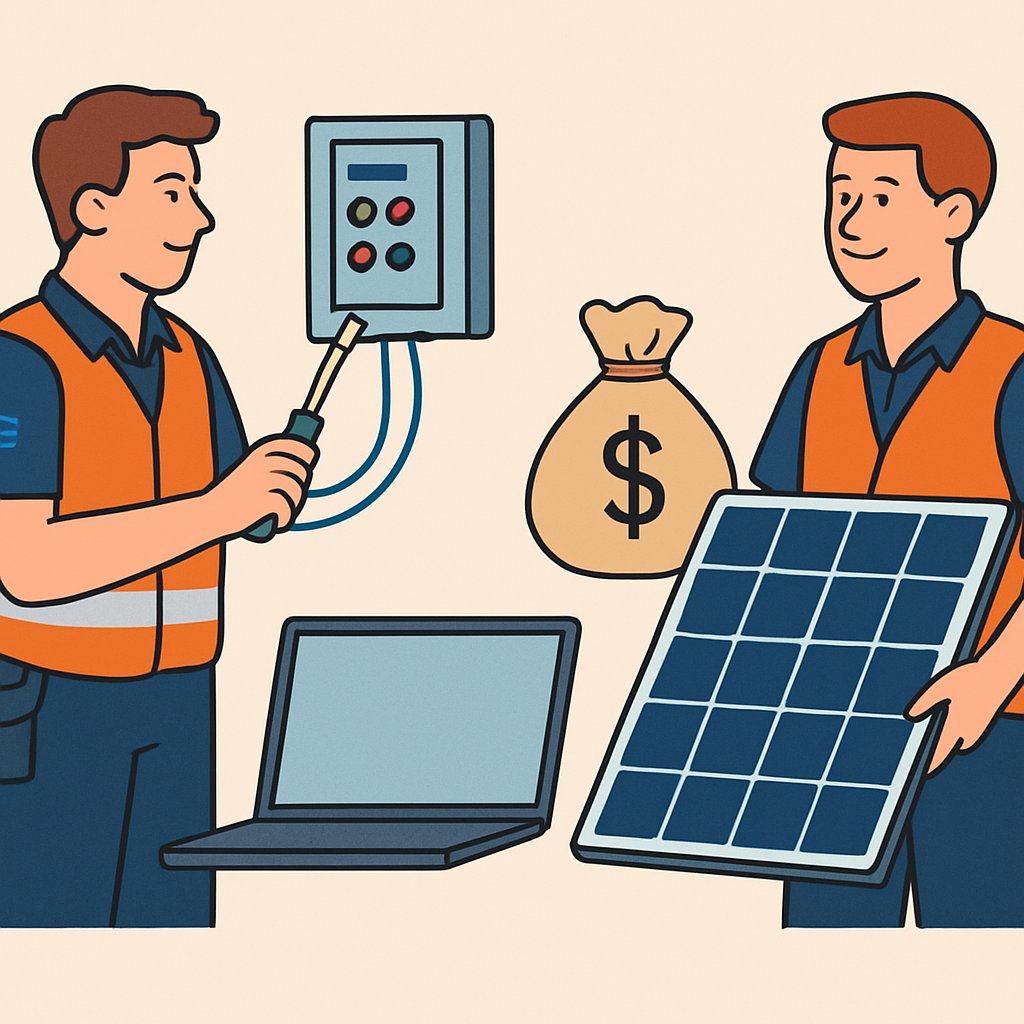
Challenges and Physical Demands Unique to Each Trade
This section outlines physical challenges specific to each trade.
It highlights hazards that affect daily tasks and safety.
Understanding these demands supports better career decisions and planning.
Physical Challenges Faced by Electricians
Electricians often work in tight or confined spaces.
They frequently climb ladders to access wiring and fixtures.
Working above ground increases the risk of falls and injuries.
Electricians handle heavy tools and equipment throughout their shifts.
Additionally, they must maintain precise hand-eye coordination for wiring tasks.
Their work environments sometimes include exposure to dust, fumes, and noise.
Moreover, electricians must stay alert to avoid electrical hazards.
Physical Challenges Faced by Solar Installers
Solar installers regularly lift and carry large solar panels.
They work outdoors in varying weather conditions, including intense sun.
Installation sites often require climbing roofs with steep angles.
Balancing on roofs demands physical agility and steadiness.
Installers spend extended periods kneeling or bending during assembly.
Furthermore, they frequently work at heights that require safety harnesses.
Prolonged exposure to outdoor elements can lead to fatigue and dehydration.
Unique Safety Concerns for Both Trades
Both trades face distinct and shared safety concerns on the job.
Awareness and training reduce incident risks for all workers.
Employers and workers must follow protective procedures and use personal protective equipment.
- Electricians manage the risk of electric shocks and burns.
- Solar installers face potential falls from heights during roof work.
- Both must use personal protective equipment, such as gloves and helmets.
- Proper training in safety protocols minimizes workplace accidents.
- Awareness and adherence to industry regulations protect workers and clients.
Work Environment Differences Influencing Physical Demands
Electricians frequently alternate between indoor and outdoor job sites.
Industrial and residential buildings present distinct physical challenges.
In contrast, solar installers primarily work outside on rooftops or solar farms.
Weather variability greatly impacts solar installers’ work pace and safety.
Electricians may encounter confined spaces that limit movement and comfort.
Conversely, solar installers rely on teamwork for panel transportation and positioning.
Impact of Physical Demands on Career Longevity
Both trades require sustained physical fitness for long-term career success.
Wear and tear on joints and muscles can affect electricians and installers.
Regular exercise and proper ergonomics help reduce injury risks.
Employers like Brisbane Electrical Services and SolarWorks Group promote worker health.
They encourage frequent breaks and rotation of physically demanding tasks.
Ultimately, understanding these demands guides individuals in career choice and planning.
Impact of Renewable Energy Trends on Solar Installer Demand
Australia has increased investment in renewable energy.
Solar power is one of the fastest-growing energy sectors.
This expansion raises demand for skilled solar installers.
Growth of Renewable Energy in Australia
Investment growth has supported a rise in solar projects.
Residential and commercial adoption of solar has accelerated.
GreenSun Solutions reports a steady rise in installation projects.
Consequently, market activity expands opportunities for installers.
Government Policies and Incentives
The Australian government supports renewable energy through various programs.
These incentives reduce the cost of installing solar panels.
As a result, more homeowners and businesses opt for solar energy solutions.
CleanWave Installers cites rebate schemes as key to increased demand.
Technological Advancements and Market Innovation
Advances in solar technology have improved panel efficiency and reduced prices.
Innovations such as battery storage create more complex installation needs.
Therefore, solar installers must update skills to match new technologies.
EcoVolt Systems invests heavily in training its workforce accordingly.
Continuous innovation sustains long term employment opportunities in the sector.
Environmental Awareness and Consumer Preferences
Australian consumers increasingly prefer sustainable and clean energy sources.
Public concern about climate change raises demand for renewable installations.
As a result, more households seek solar installations to lower their carbon footprint.
Solar Bright Australia experiences growing business due to these trends.
The role of solar installers gains importance nationwide.
Challenges and Opportunities for Solar Installers
Rising demand creates considerable job openings in the solar installation industry.
However, installers face challenges such as navigating complex regulations.
Training and certification programs become essential for maintaining workforce quality.
RadiantSun Solar focuses on professional development to address this need.
Solar installers hold promising career prospects amid renewable energy growth.
Regional Availability and Industry Hotspots Across Australia
Electricians enjoy widespread demand throughout Australia’s metropolitan hubs.
Solar installers thrive in areas with high solar adoption rates.
Both career paths benefit from increased infrastructure modernization plans.
Electricians’ Presence in Metropolitan and Regional Areas
Sydney, Melbourne, and Brisbane feature strong markets for skilled electricians.
Moreover, regional centers like Geelong and Newcastle consistently require electrical expertise.
According to Claire Whitman of Southern Electrical Services, urban residential projects drive steady work.
Meanwhile, mining towns such as Kalgoorlie create intermittent spikes in electrical jobs.
Thus, electricians benefit from flexible employment opportunities in both city and regional settings.
Emergence of Solar Installers in Growing Renewable Clusters
Queensland’s Sunshine Coast and Northern Rivers in New South Wales are prime examples.
These regions prioritize sustainable energy, increasing installer demand dramatically.
Michael Zhao from Green Horizons Solar notes growing new home developments favor solar installation.
The government’s push for renewable energy in South Australia also boosts installer roles.
Hence, solar installers find promising career prospects in eco-conscious communities.
Cross-Regional Comparisons of Trade Opportunities
Electricians maintain consistent opportunities across a broad geographic range.
In contrast, solar installers tend to concentrate around renewable energy hotspots.
Western Australia displays a balanced mix, with mining commissions and solar farms growing alike.
Trade companies such as Murray Electrical and Sunshine Solar remain active in these markets.
Transport infrastructure investments further fuel electrician demand in regional towns.
Furthermore, solar panel rebates and incentives drive installation projects near coastal regions.
Future Trends and Workforce Mobility
However, electricians may enjoy greater workforce mobility given broader project types.
Solar installers might need to relocate to capitalize on emerging solar precincts.
Industry experts anticipate ongoing growth in renewable sectors to expand installer reach.
Jennifer Liu of VoltPro Electrical suggests cross-skilling enhances job prospects for tradespeople.
Therefore, regional adaptability plays a key role in trade career success across Australia.
Apprenticeship Pathways and Training Duration Differences
Electrical apprenticeships provide a structured pathway into the electrical trade.
Most apprenticeships typically last four years across Australia.
Trainees work under licensed electricians to gain practical experience.
Electrical Apprenticeship Journey
Apprentices complete formal training through Registered Training Organisations.
TAFE Queensland offers Certificate III in Electrotechnology Electrician courses.
Apprentices combine on-the-job learning with classroom study for skill development.
Solar Installer Training Pathway
Solar installers often complete shorter and more focused training than electricians.
Many programs last between six months and one year.
For example, EnviroTech Solar Training provides accredited solar installation courses.
These courses teach panel mounting and electrical system integration skills.
Also, trainees learn solar system design and applicable safety standards.
Some programs combine classroom learning with on-site work for practical experience.
States may require additional licensing or accreditation for installers.
Comparative Training Duration and Career Impact
A longer apprenticeship period reflects the electrical trade’s complexity.
Consequently, electricians develop broader competencies for varied industries.
In contrast, solar installers often qualify faster to meet renewable energy demand.
Thus, shorter training suits people seeking quick workplace entry.
Electricians can add solar installation skills with supplementary training.
Employers value tradespeople who hold multiple practical skills.
Ultimately, career goals determine the preferred training pathway.


