






The Australian Teacher Standards review is an opportunity to turn classroom experience into specific feedback. A useful contribution identifies the wording, explains the context and shows the practical effect. You can prepare that evidence without sharing identifiable student or colleague information.
This guide provides two charts, a before-and-after infographic and four CSV tools for organising your own response. Research was checked on 14 November 2026. The consultation is live at the time of writing, and the existing Teacher Standards remain unchanged. Recheck the official status before acting.
Australian Teacher Standards review: deadline and current status
AITSL’s official review page says the online survey and written submissions close at 10pm AEDT on 20 November 2026. Use that stated time zone rather than assuming your local clock matches it. The page also confirms that the current standards remain in use during the review.
The fresh news hook is the 13 November AARE commentary encouraging teachers and education researchers to contribute. It is commentary about the live review, not evidence that the consultation research was collected this week. We have not established the discussion paper’s first publication day.
For the timeline, distinguish AITSL’s website milestone of review completion in February 2027 from the discussion paper’s final-report-to-ministers milestone in March 2027. Neither milestone is a confirmed commencement date for revised standards. The paper describes further decisions and drafting after ministerial consideration.
Understand the evidence streams before comparing the numbers
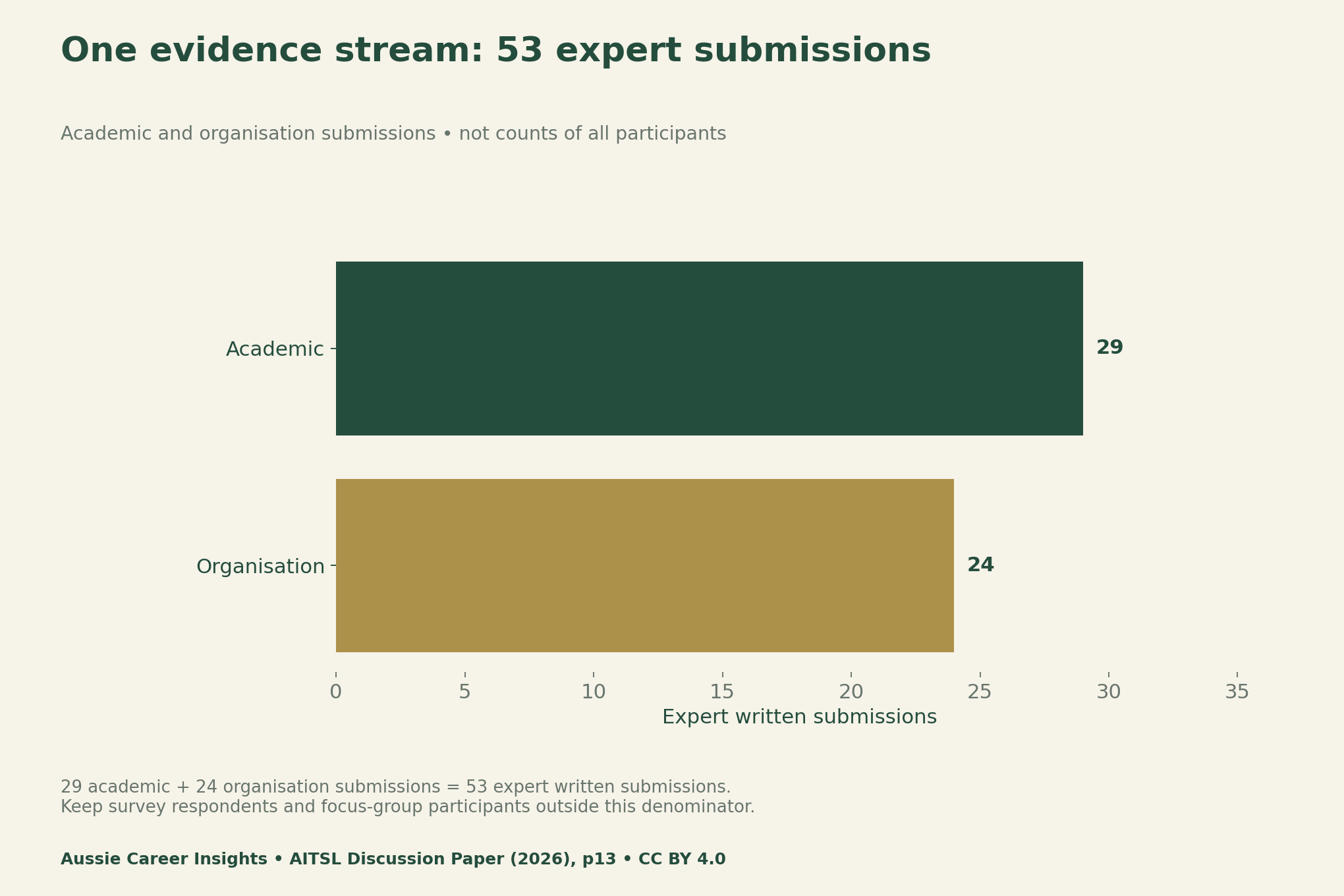
The AITSL discussion paper, printed pages 11–13, describes several evidence inputs. Its survey received 3,930 responses, with more than 70% from education practitioners. Separately, 93 participants attended 21 targeted focus groups. There were 53 expert written submissions: 29 academic and 24 organisation submissions.
Do not add these numbers into a single sample size. They count different units and can answer different questions. A written submission is not a survey respondent. A focus group is not one participant. The paper’s consultation evidence does not establish a nationally representative prevalence estimate or a measured improvement in classroom outcomes.
Australian Teacher Standards review: understanding and interpretation differ
On printed page 56, agreement that the structure is easy to understand ranges from 75% to 82% across respondent groups. Agreement that it supports consistent interpretation ranges from 51% to 58%. Those are published ranges, not a pooled percentage or a statistical confidence interval.
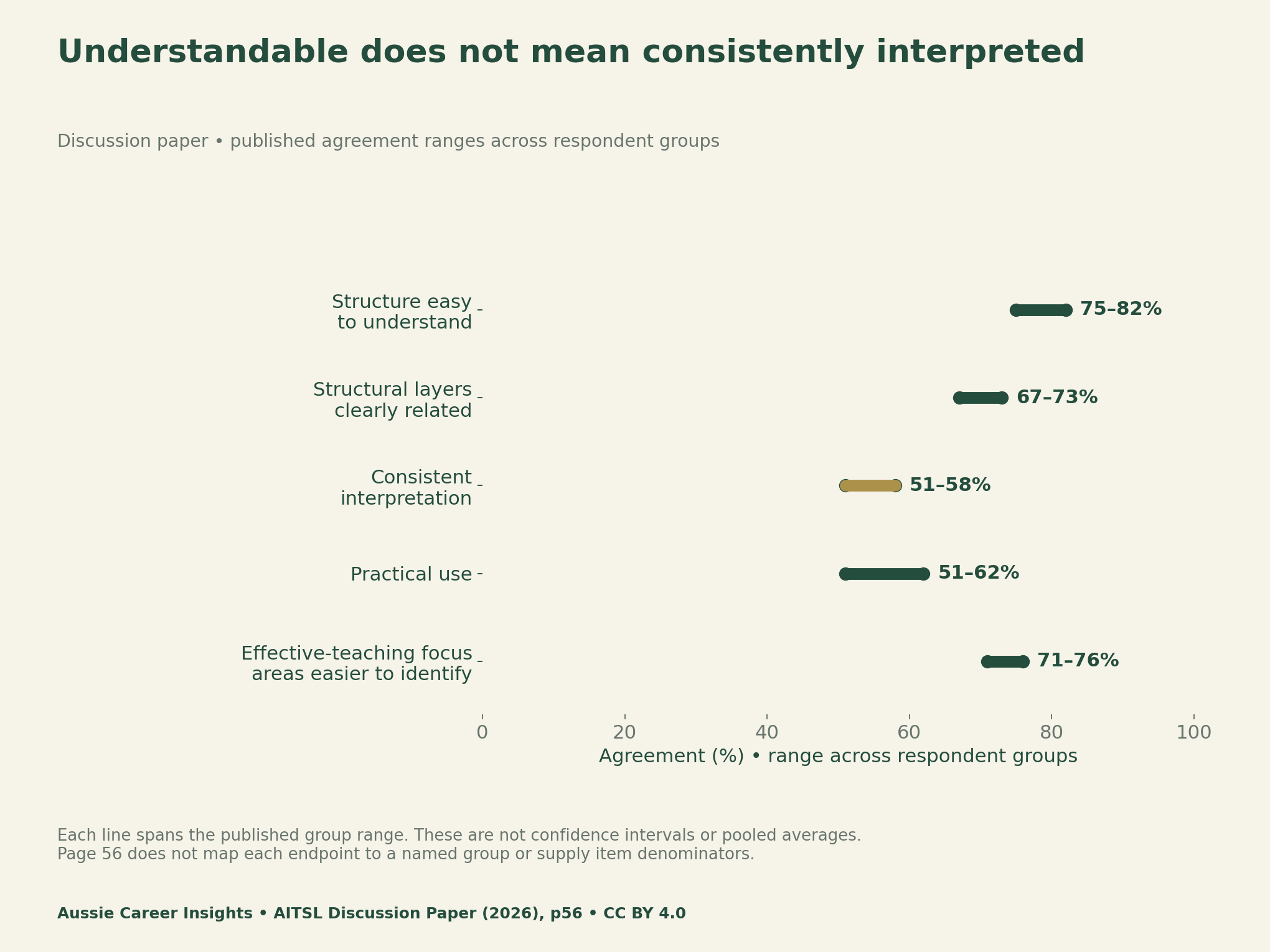
For your response, that distinction suggests a useful question: what wording produces more than one plausible reading in practice? A description can feel familiar while still leaving different people unsure about how to apply it. Your example should explain the specific problem rather than claiming that the chart proves your own experience is universal.
Prepare one precise, anonymised example
Begin with the relevant standard, focus area or descriptor and the context in which you used it. State whether you are discussing a school, early-childhood or teacher-education setting, using only the detail needed to understand the issue. Describe what the wording led you to do or what remained unclear.
Next, separate the wording from the interpretation. If two readings were possible, explain them in plain language. Then describe the practical consequence: an evidence requirement that needed clarification, a planning decision that became harder to explain or an example that did not fit the setting. Do not invent a student outcome to make the point sound stronger.
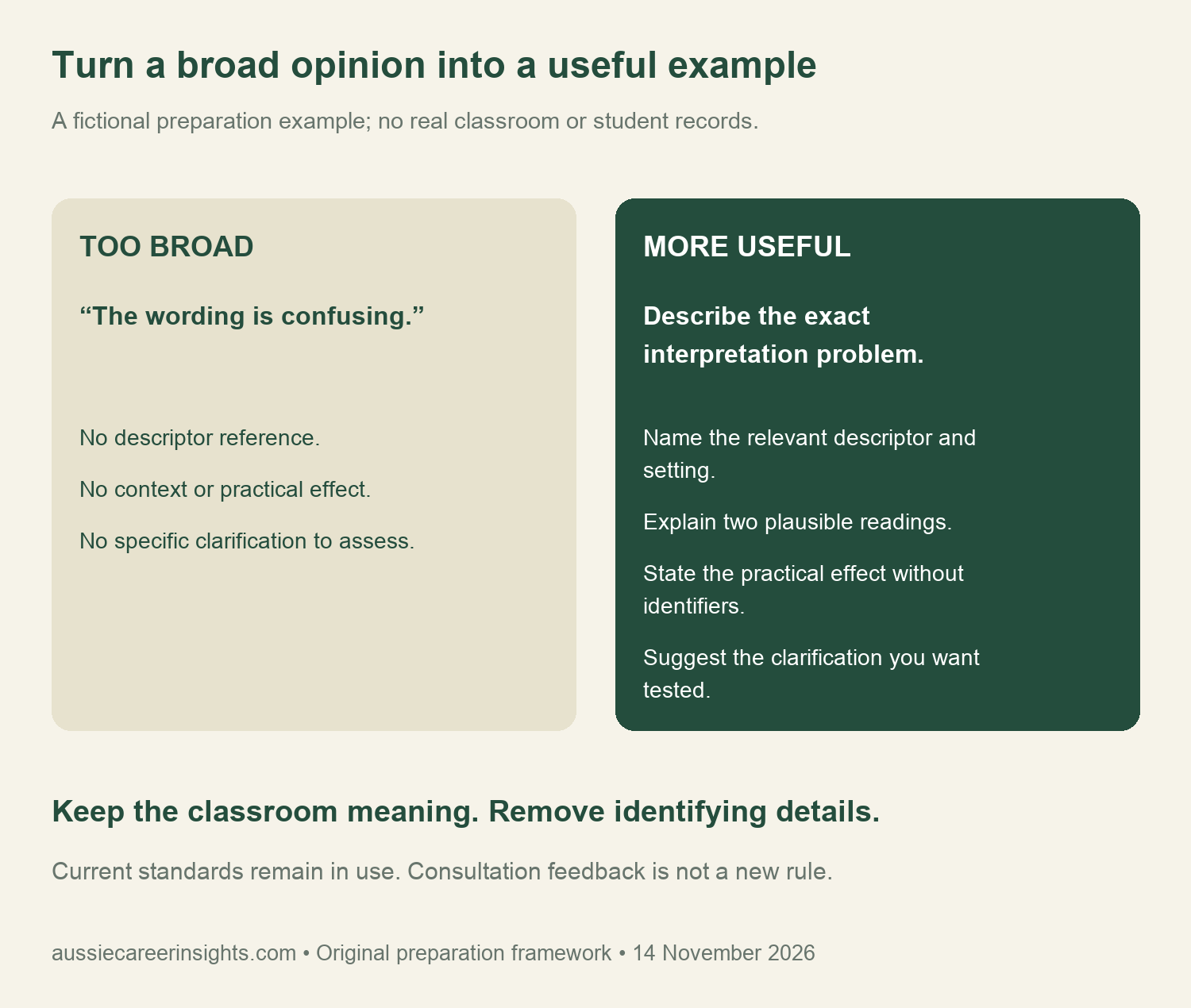
Finally, suggest what would help. You might ask for a worked example, a clearer distinction between terms or guidance about applying a descriptor in a particular setting. Also identify what you think should be retained. This makes your contribution more useful than a general request to replace everything or leave everything untouched.
Remove identifying details without removing the meaning
An example does not need a child’s name, school identifier, precise incident date or confidential record to explain an interpretation problem. Check combinations of details as well as obvious names. A rare event, small setting and exact date can identify a person even after their name is removed.
Use a generalised account where possible and retain only necessary professional context. Do not attach screenshots, student work, assessment records, staff correspondence or photographs unless you have a lawful and appropriate basis to share them. Where permission is unclear, leave the material out and describe the issue without it.
Use the planner to organise, then review your own contribution
The blank example planner includes fields for the descriptor, setting, interpretation problem, practical effect and suggested clarification. It also asks what should be retained and whether privacy has been checked. Complete one row for each distinct example rather than squeezing several unrelated concerns into a single paragraph.
Your Personalized Career Strategy
Unlock your potential with tailored career consulting. Get clear, actionable steps designed for your success. Start now!
Get StartedOur public-data portfolio guide illustrates how definitions and provenance support a clear explanation. The task-to-evidence guide explains how to describe relevant experience without taking confidential material. Their general evidence habits are useful here, although the subject and official process differ.
Download the Australian Teacher Standards review preparation tools
Use the source tables to check what the charts count, and the two planning files to prepare a private draft. These files do not send information to AITSL or to this website. The reader decides whether to respond through the official route and remains responsible for the content they choose to send.
- Published agreement ranges and limits (CSV)
- Evidence-stream counts and units (CSV)
- Blank anonymised example planner (CSV)
- Privacy and current-status checklist (CSV)
Methods, limits and the official response route
We checked the live review page, the 13 November commentary and the original 61-page discussion paper. The charts transcribe printed pages 13 and 56. They preserve counts and ranges without combining evidence streams, estimating missing group values or calculating a national average. The infographic and worksheets are original editorial preparation tools, not validated measures of teaching quality.
To act, return to AITSL’s official review page, read the participant information and use the appropriate survey or written-submission route yourself. This article does not submit a response on anyone’s behalf. After consultation closes, the deadline-led guidance should be treated as historical, and any later use should begin with a fresh status check.
Source attribution: AITSL (Australian Institute for Teaching and School Leadership) (2026), Discussion Paper, Review of the Teacher Standards, AITSL, Melbourne, CC BY 4.0. Charts are selected redrawn summaries; labels are shortened and limitations added. Suggested citation for the original tools: Aussie Career Insights, 14 November 2026, “Teacher Standards Review 2026: Turn Classroom Experience Into Useful Evidence”.


