






Owner-driver fuel cost recovery in November 2026 starts with a confirmed date and careful records. The Fair Work Ombudsman says fuel-cost recovery obligations restart on 23 November for affected parties. Before treating an adjustment as money available to spend, separate the extra cost, the contract or invoice and the cash actually received.
This guide helps you organise those records. It includes two clearly fictional arithmetic charts, a dated timeline and four free private CSV tools. It does not decide whether your contract is covered, calculate a statutory entitlement or supply a legal demand. Those questions need the current order and advice about the actual arrangement.
What the 23 November restart notice confirms
The Ombudsman’s page, updated 9 November, confirms that affected parties must adjust or set rates from 23 November to ensure recovery of increased fuel costs. The notice also says detailed information is being updated. Therefore, do not treat older text further down the page as a complete account of the amended requirements.
The Commission’s 9 November announcement identifies changes to its road transport contractual chain order. We read that official announcement in Chrome. Access to the consolidated PDF was interrupted, so this article does not offer a legal trigger tracker, a final coverage checklist or a compliance calculator. Follow the current official documents for those details.
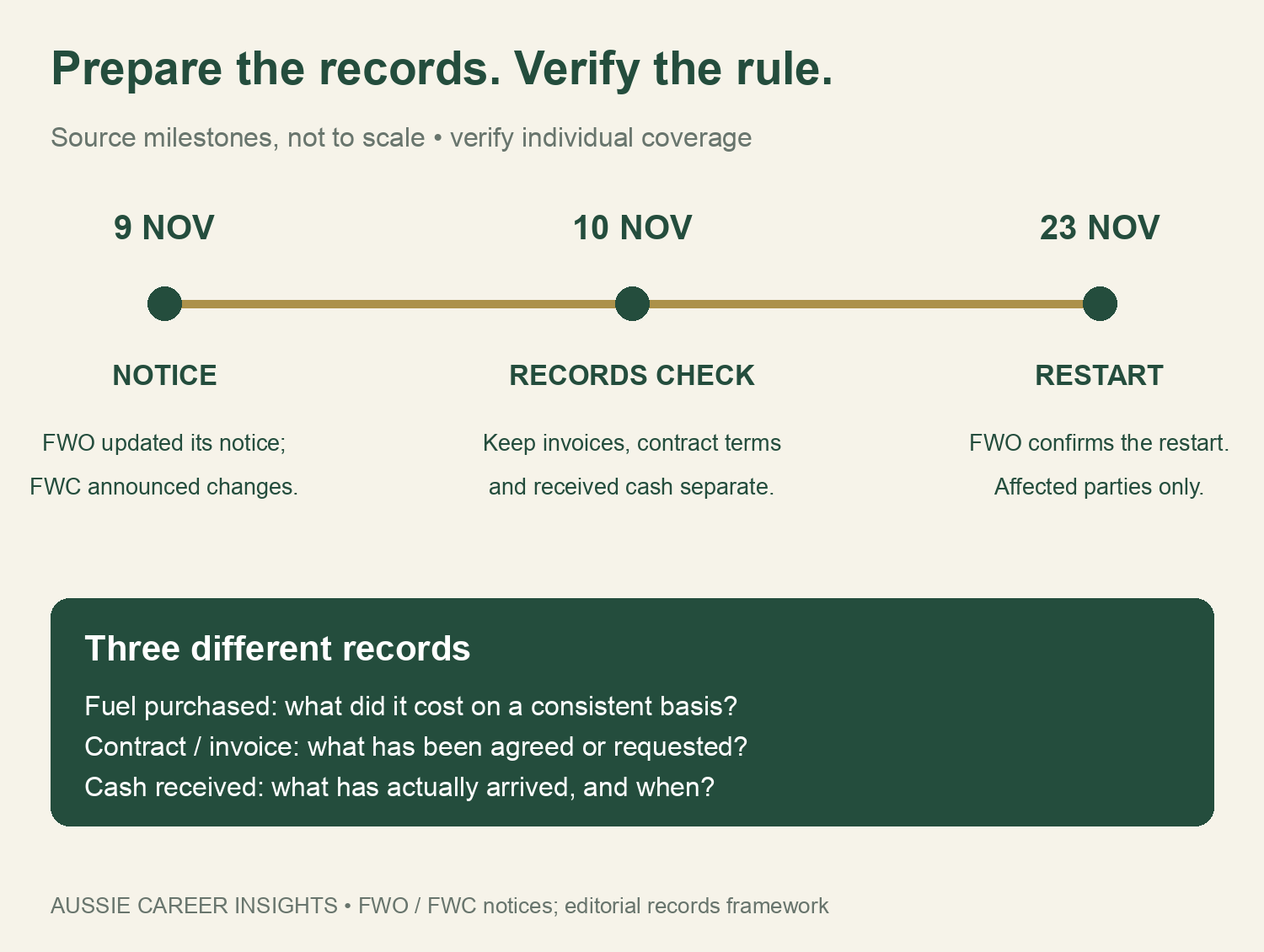
Owner-driver fuel cost recovery: separate status and records
An employee’s wages and an owner-driver’s business receipts answer different questions. Start by identifying the arrangement you actually have. Keep the contracting parties, work description and relevant agreement together. If the status or chain is unclear, record a question for a qualified adviser rather than guessing from a job title.
Next, locate any existing fuel adjustment, levy or surcharge wording. Save its version and date. Keep correspondence about changes with the relevant contract reference. A planning worksheet cannot determine how that term interacts with the amended order. Similarly, a discussion about a future adjustment is not proof that money has been received.
For someone new to Australian transport contracting, an ordinary fuel receipt does not establish legal coverage. Ask an adviser about the particular contract and current instrument. Do not assume a visa, occupation label, truck type or general industry description settles that question. No personal documents need to be uploaded to this website.
If your question instead concerns employee wages, our underpayment evidence guide organises payslips and hours by pay period. It addresses a different records problem. Do not transfer its employee-pay structure into an owner-driver contract claim without checking the arrangement.
Why an extra cost is different from additional profit
Consider a wholly fictional period with 3,000 litres and an assumed increase of A$0.25 per litre. The additional expenditure is 3,000 × A$0.25 = A$750. If the operator has received A$500 in that illustration, the difference is A$750 − A$500 = A$250.
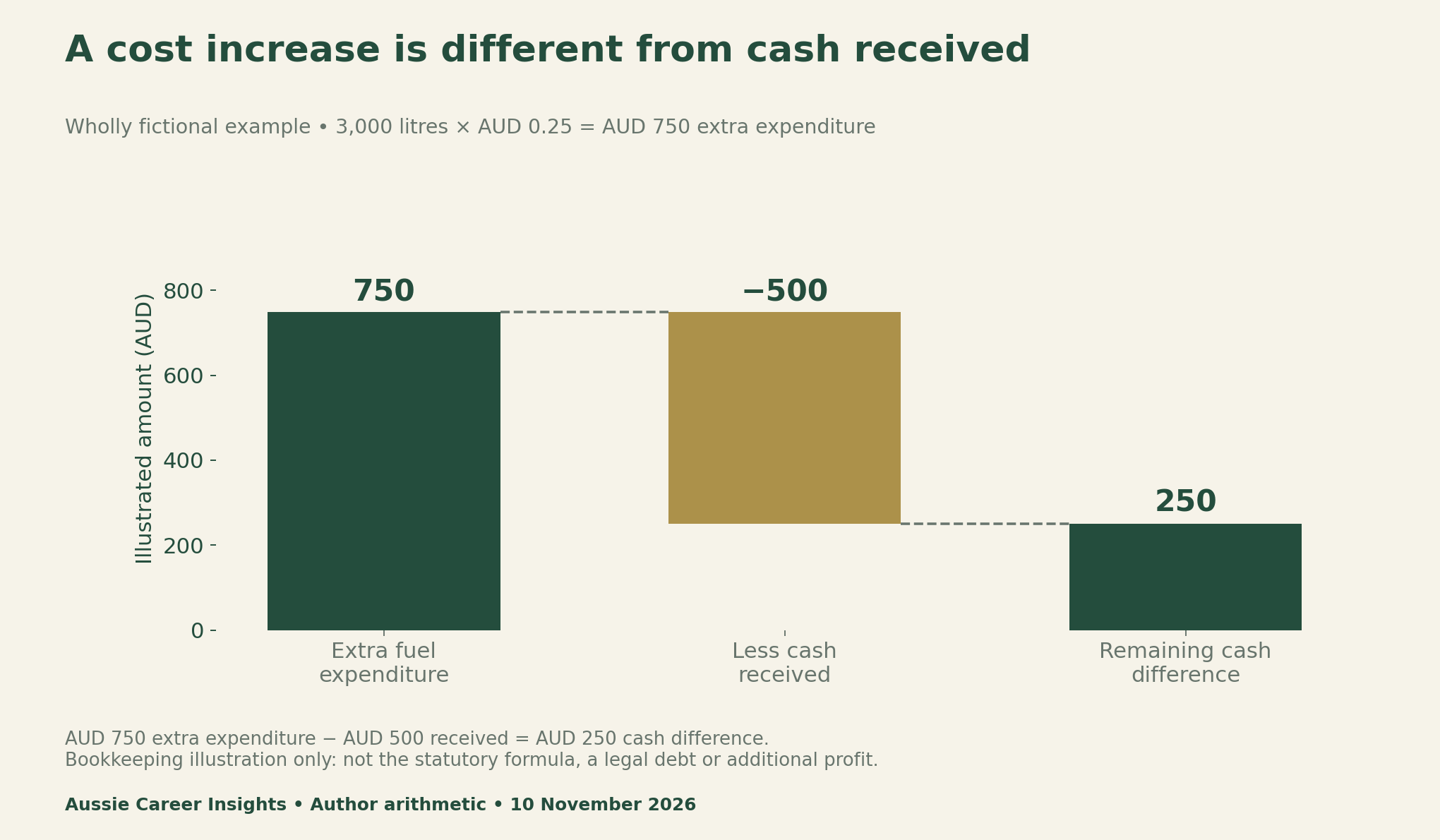
The example deliberately leaves legal liability unresolved. It also excludes other operating costs and timing differences. Recovering an extra cost does not, by itself, measure net business profit. Likewise, invoicing an amount does not mean the customer has accepted it, paid it or accepted the same tax treatment.
Keep the litre quantity, unit price, period and tax basis consistent before comparing records. Do not compare a tax-inclusive price with a tax-exclusive figure and call the result a fuel increase. If you are unsure which basis belongs in your accounts, ask your bookkeeper or tax adviser before relying on the difference.
Test the assumptions without calling them the legal formula
At the same fictional 3,000 litres, an assumed extra A$0.15 per litre produces A$450 additional expenditure. A$0.35 produces A$1,050. These scenarios show sensitivity to one input. They do not set the order’s baseline, determine an allowed rate or forecast future fuel prices.
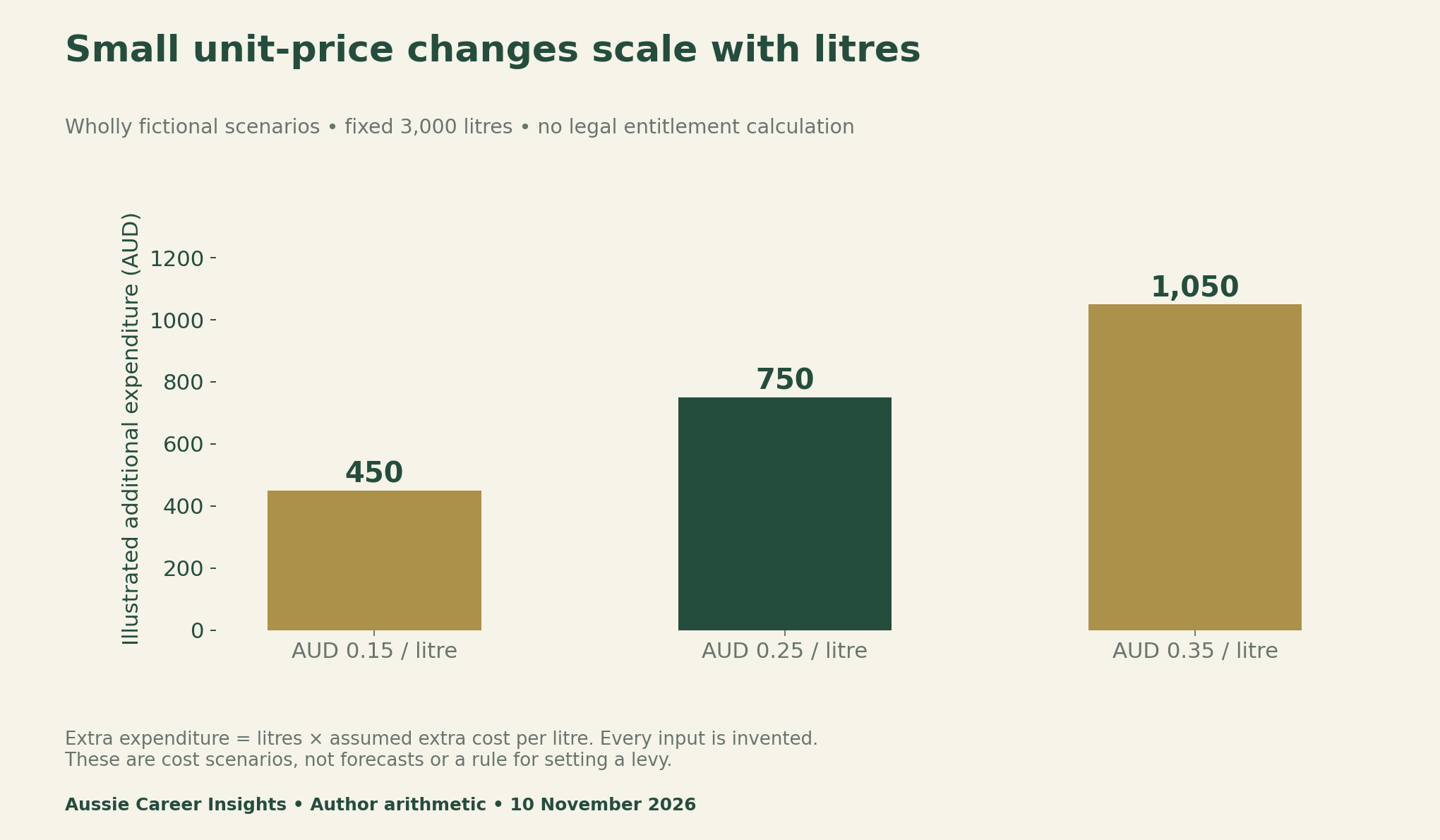
A retail pump price and a national terminal-gate series are different measures. Do not substitute one for a legal trigger or calculate a consecutive-week condition from an unrelated price. We have not built that tracker because the exact amended provision and measurement requirements need document-level verification.
Reconcile invoices and received cash on different dates
| Record | Question it answers | Useful private reference |
|---|---|---|
| Fuel purchase | What quantity and price were recorded for this period? | Receipt or invoice reference and tax basis |
| Contract or adjustment | What was agreed, requested or invoiced? | Contract version, correspondence and invoice date |
| Received cash | What arrived, and when? | Payment reference and received date |
| Unresolved question | Which part still needs a reliable answer? | Responsible adviser, status and next check date |
Use an expected payment date for planning, but retain the actual received date separately. If a payment covers several items, reconcile it before assigning all of it to fuel. Keep an unexplained difference visible until it is resolved. Avoid counting the same receipt in two periods or treating an estimate as a confirmed amount.
Also keep records when nothing has been agreed. A blank adjustment field is more informative than an invented surcharge. Record who you asked, what remains unknown and when you will follow up. This creates a useful adviser conversation without turning a private estimate into an asserted legal demand.
Your Personalized Career Strategy
Unlock your potential with tailored career consulting. Get clear, actionable steps designed for your success. Start now!
Get StartedWhere to check the rule and get appropriate help
Use the Commission’s current consolidated order and its linked decision and fact sheet. Then ask a suitably qualified Australian transport or employment-law adviser about your arrangement before using any compliance formula, making a coverage conclusion or sending a legal demand. This guide supplies none of those outputs.
The Ombudsman says it can provide general advice but cannot tailor advice to every complex contractual chain. Its legal-help page explains routes including unions, industry associations and legal centres. Keep free official information visible alongside any commercial service you consider. No paid provider was assessed or endorsed for this article.
Download the private records worksheets
The source register retains the notice date, restart date and access limitation. The arithmetic CSV contains only invented inputs. Use private references in both blank tools; avoid names, account numbers or confidential contract text. We do not collect completed worksheets, receipts or transport contracts.
- Restart notice and source-status register (CSV)
- Fictional fuel-cost and cash scenarios (CSV)
- Blank private fuel and received-cash ledger (CSV)
- Blank contract-questions register (CSV)
Method and update log
Research checked on 10 November 2026. The restart date comes from the current Ombudsman notice and is consistent with the Commission announcement. Both charts use author-created fictional arithmetic. No operator survey, observed cost estimate, payment entitlement or business-profit forecast is presented. The consolidated order was not inspected, so document-dependent legal tools remain outside this article.
Suggested citation: Aussie Career Insights, “Owner-Driver Fuel Cost Recovery: Prepare Records for 23 November,” 10 November 2026. Cite the official notice for the restart date and label the chart inputs as fictional. Recheck the official position before relying on a future change; preserve the earlier record rather than silently replacing its date.


