







Regional employer sponsorship Australia research works best when it starts with one occupation and a clear evidence trail. Historical visa grants can suggest questions worth asking. They cannot tell you which employer has a vacancy today or whether you qualify for a visa.
This guide turns newly published historical data into a practical search method. Two charts, an evidence-ladder infographic and four CSV files help you distinguish past activity, current recruitment and individual requirements. The research was checked on 14 November 2026; no live vacancies or sponsoring employers were audited.
Regional employer sponsorship Australia: what the new report measures
Jobs and Skills Australia published Australian Labour Market for Migrants, October 2026 on 13 November. The relevant tables cover financial years 2021–22 to 2025–26. Their measure is primary employer-sponsored visa grants, excluding family members. These are historical administrative aggregates, not advertisements or a forecast of demand.
Keep the report’s remote and very remote grouping intact. It is not a substitute for the designated-area rules of a particular visa. A grant location also should not be treated as proof of a person’s later work location. Read the original report and appendix tables alongside the downloadable extraction files.
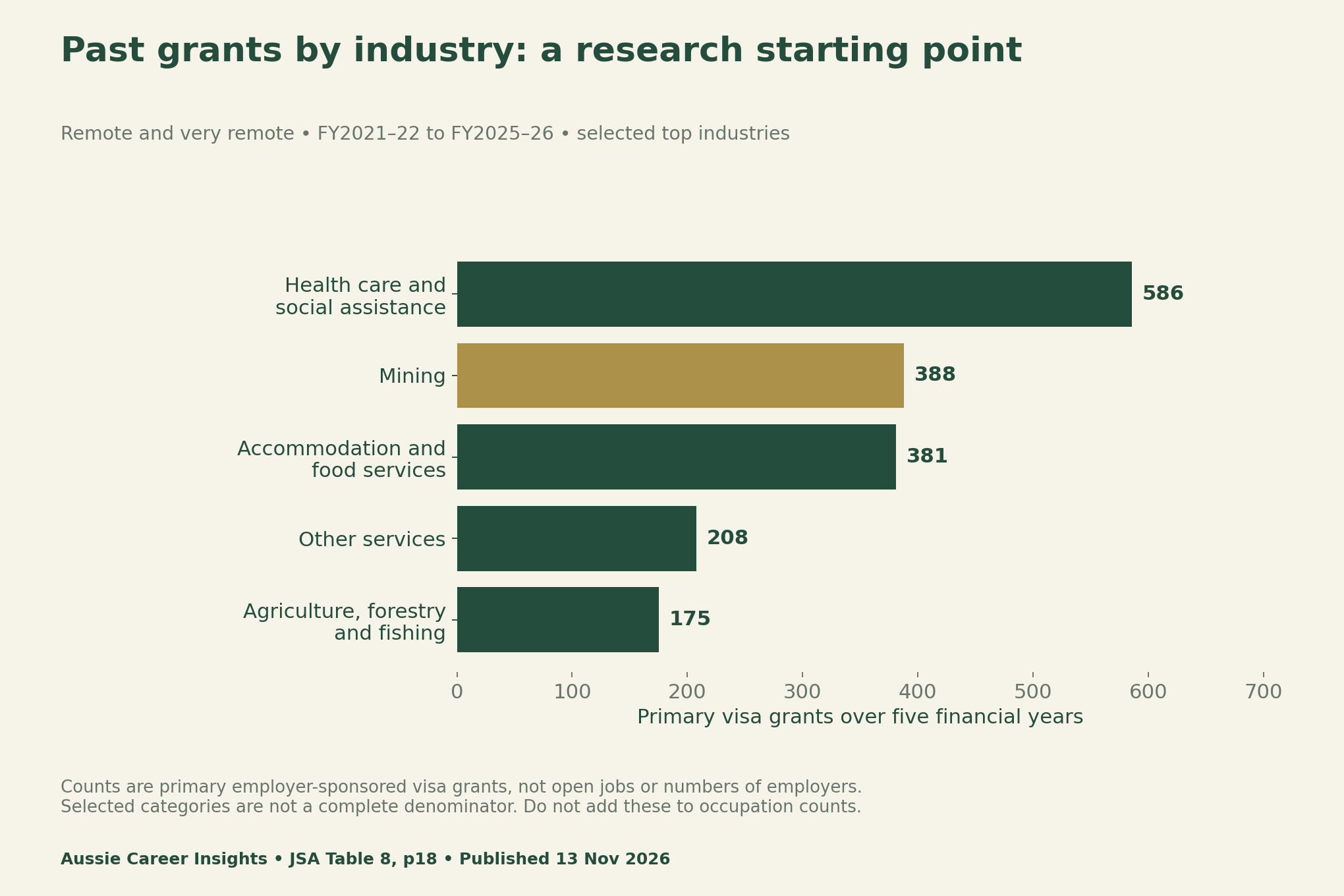
Read occupation counts separately from industry counts
Table 4 groups occupations across industries. It reports 185 medical registered nurses, 184 diesel motor mechanics and 166 chefs. The narrower health-industry discussion reports 184 medical registered nurses. That different scope explains why the occupation chart retains 185. Industry and occupation counts classify the same activity differently; adding them would double-count.
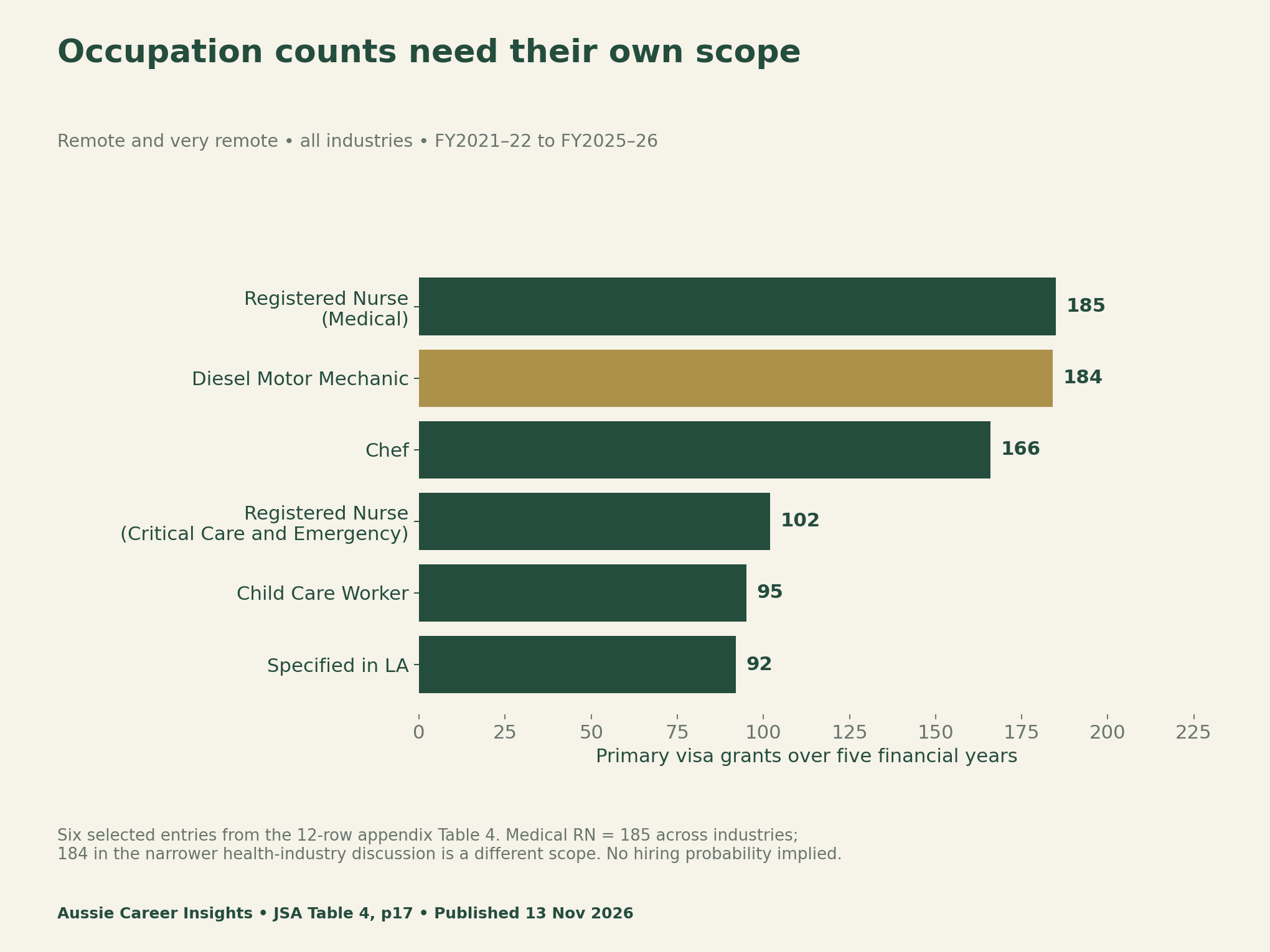
The useful next question is specific: where could someone with my actual skills look for suitable work? A broad sector label will not answer that. Start by describing your tasks, recognised qualifications and the locations you can realistically consider. Keep sensitive identity and migration documents out of a general search worksheet.
Build one occupation-specific search, not a list of promises
Choose an occupation that matches the work you can substantiate. Then select a manageable geographic area and search for current roles using both the occupation title and common task descriptions. Record the original employer advertisement where available. A reposted vacancy may remain visible after an employer has closed applications.
Next, write down the date checked, location, employer name and exact sponsorship wording. If no wording is present, mark it unknown. Silence does not mean either approval or rejection. Avoid turning a keyword in a job board filter into a statement that the employer will sponsor this particular position.
| Evidence in hand | A useful next check | Conclusion to avoid |
|---|---|---|
| A historical occupation count | Locate a current original advertisement | This many jobs are available now |
| An advertisement mentions sponsorship | Ask whether it applies to this position and applicant circumstances | Everyone meeting the job title is eligible |
| An employer gives a positive answer | Check the actual offer, registration and current visa requirements | The employer can guarantee a visa |
| A required qualification is listed | Check the responsible regulator’s recognition process | Overseas qualification names are automatically equivalent |
Use an evidence ladder before making a stronger claim
A spreadsheet becomes more useful when every conclusion points to its evidence. Use separate columns for a published statistic, a dated advertisement, a direct employer answer and an official requirement. The infographic shows why one cannot stand in for the next. A historical count cannot verify a currently advertised vacancy.
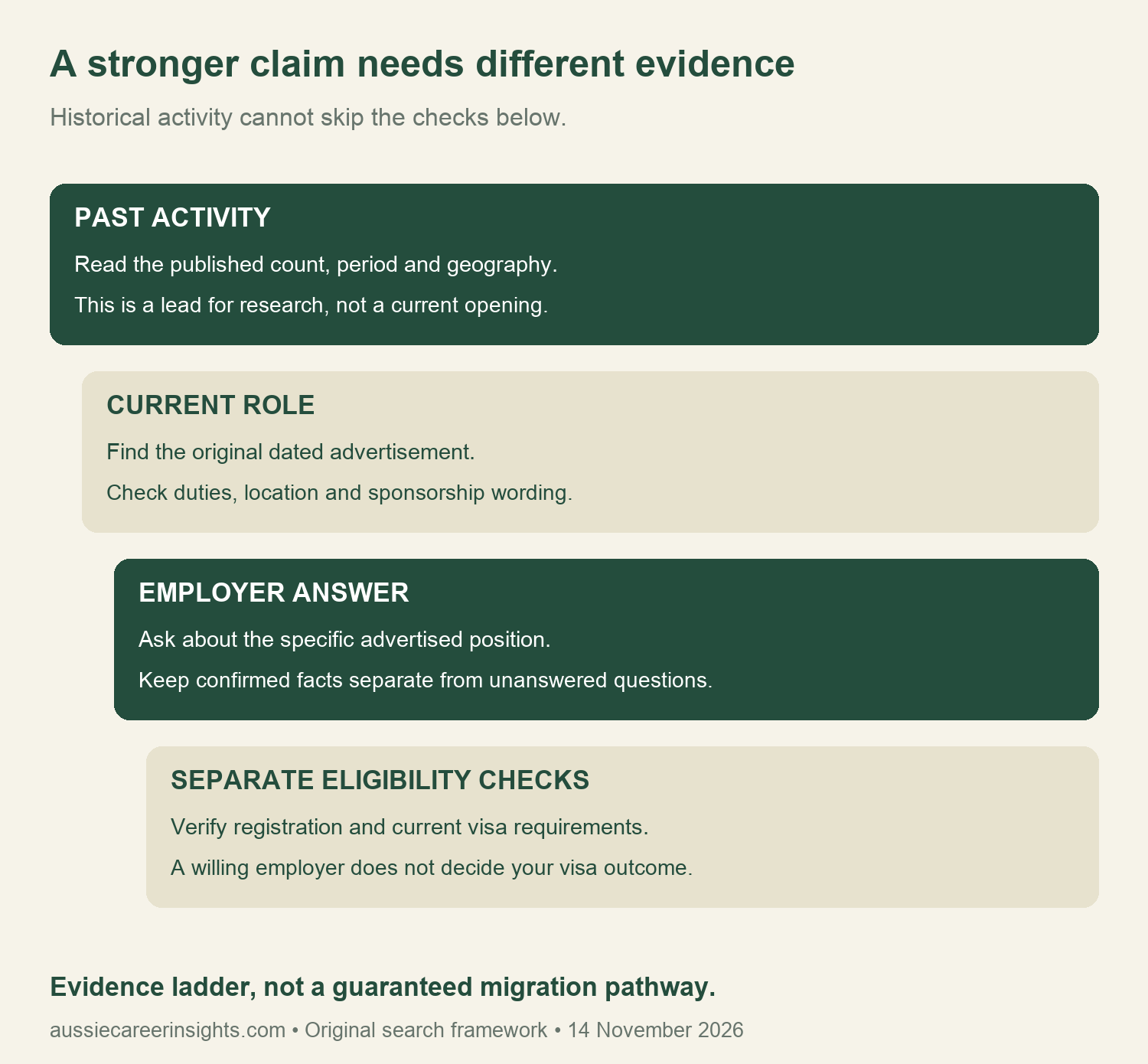
For an enquiry, ask a narrow question about the actual position. Does the stated sponsorship wording apply to this vacancy? Which tasks and qualifications are mandatory? Who can clarify the process and outstanding conditions? Retain the dated answer and identify what remains unresolved. Do not describe an informal conversation as an offer.
Verify regional employer sponsorship in Australia: separate eligibility checks
A job search, professional recognition and a visa assessment are related but different activities. The Department of Home Affairs subclass 494 page provides the official starting point for that specific regional employer-sponsored visa. Follow the relevant stream and current conditions rather than using a historical occupation count as an eligibility test.
This article does not reproduce age, salary, fee or processing-time rules. Those details can depend on the route and circumstances. Check the applicable official material when you act, and use appropriately qualified advice for an individual migration decision. Likewise, confirm occupational requirements directly with the responsible professional regulator.
If you already live in Australia, keep your current work conditions and any restrictions separate from the possibility of a future role. Do not assume that a conversation about sponsorship changes your existing permission to work. A worksheet can organise questions; it cannot decide a legal entitlement or authorise employment.
Compare the work and practical terms before the location label
Once a real position is identified, examine duties, roster, location, transport, housing implications and written conditions. Two advertisements with similar titles can require different tasks. Regional work can also involve practical commitments that a national industry count cannot measure. Leave cost estimates blank until you have a dated source.
Our task-to-evidence guide explains how to document transferable experience without taking confidential material. The Australian job-offer checklist demonstrates questions about written hours and conditions. Apply their general checking habits while recognising that each article has a different context.
Your Personalized Career Strategy
Unlock your potential with tailored career consulting. Get clear, actionable steps designed for your success. Start now!
Get StartedDownload the regional employer sponsorship Australia research files
Begin with the blank vacancy screen. Add one real advertisement at a time, retain its source and update the checked date. Use the evidence dictionary to label unknowns consistently. The two extraction tables preserve the historical counts and their source locations so another reader can check the published aggregates.
- Selected remote-industry grants and provenance (CSV)
- All 12 remote-occupation appendix entries and codes (CSV)
- Blank occupation-specific vacancy screen (CSV)
- Search evidence dictionary and verification prompts (CSV)
Methods, limitations and responsible reuse
We visually checked appendix Tables 4 and 8 against the original PDF. The charts preserve the published geography and five-year period. The industry chart shows five listed categories; the occupation chart selects six of the 12 transcribed rows for readability. We did not calculate shares from an incomplete denominator or combine the two classification systems.
The underlying individual administrative records are not supplied with the report. Reproduction here means checking the published aggregates, not rebuilding the source database. The data do not identify current employers, vacancies, unsuccessful applications or a personal sponsorship probability. The original worksheet has not been validated as an employment intervention.
Suggested citation: Aussie Career Insights (14 November 2026), “Regional Employer Sponsorship in Australia: Build an Occupation-Specific Search”, analysis of JSA published aggregates with original vacancy-screening tools. Preserve the reference period, geography and distinction between historical grants and current opportunities when citing a figure.


