







Qantas restructuring redeployment preparation starts with evidence you can control. Document the tasks you perform, the results you can safely describe and the skills a real alternative role needs. Keep that work separate from any assumption about your individual outcome.
The November announcement is a reason to prepare, rather than a personal redundancy notice. This guide separates the employer’s published figures from an original fictional example. Two charts, a four-status infographic and four CSV tools support a careful, private evidence pack. Research checked on 14 November 2026.
Qantas restructuring redeployment: read the announcement carefully
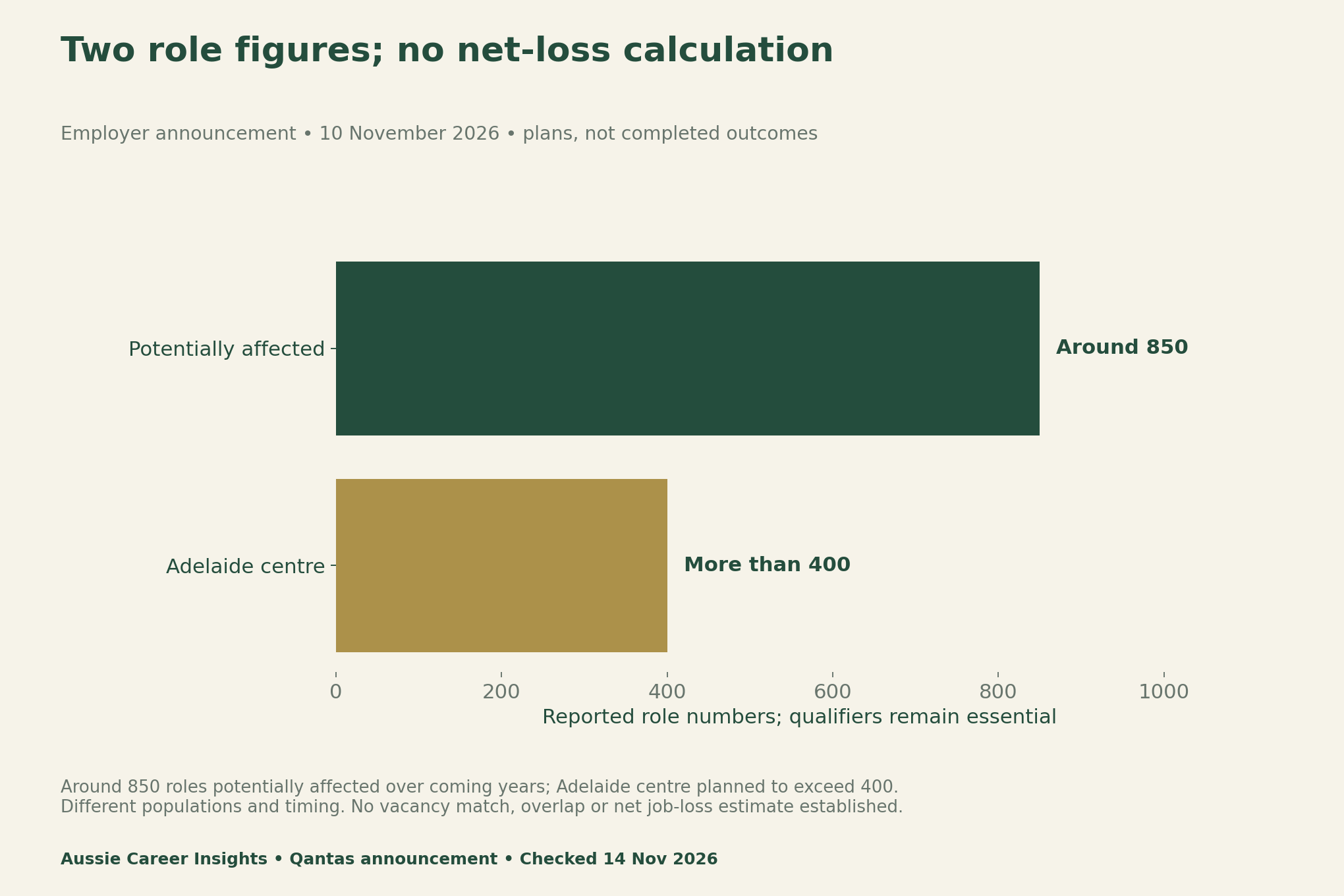
In its 10 November technology partnership announcement, Qantas says approximately 850 roles may be affected over the coming years, with the first changes expected by mid-2027. It describes consultation before individual outcomes, alongside possible redeployment and retraining support. These remain employer plans, not a verified count of completed redundancies or jobs lost solely to AI.
The same release describes more than 1,000 legacy applications and an Adelaide centre planned to exceed 400 roles. Applications are not workers. Nor are the Adelaide roles established matches for the potentially affected group. Subtracting 400 from 850 would therefore create an unsupported net employment result.
Keep the four statuses in separate columns
Use precise labels in your notes. A potentially affected role is within a proposed change. A possible alternative is an option that still needs checking. An actual offer provides details for a decision. A confirmed outcome records what has happened to the individual. Movement between these labels is not automatic.
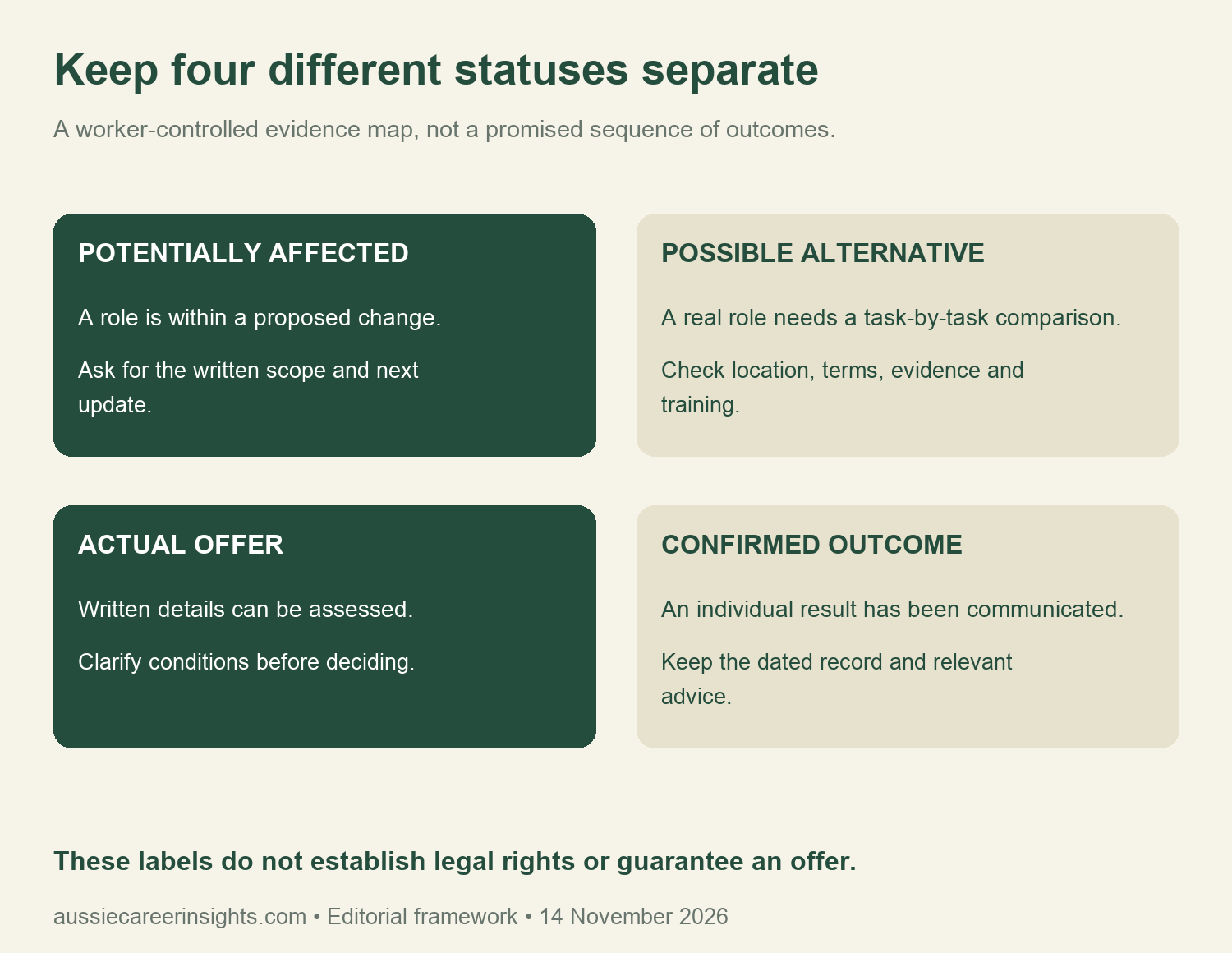
For example, a vacancy title mentioned in a meeting belongs in an options register. It should not be recorded as an offer unless an offer actually exists. Similarly, a training interest is a request to explore support. It is not confirmation that the training will be funded or that a position is reserved.
Build a safe task-to-evidence matrix
First, choose a real, current role description that you are permitted to access. Record its date and source. Then split the work into concrete tasks. A broad phrase such as stakeholder management is less useful than a clear description of the problem, your action and the result you can substantiate.
Next, attach an evidence description to each task. You might explain how you found an exception, clarified a definition or improved a handover. Keep quantities only where they are accurate and permitted to share. A method can demonstrate judgment even when commercial figures must remain private.
| Field | What to record | What to avoid |
|---|---|---|
| Target task | The actual requirement and its dated source | Guessing the role from its title |
| Demonstrated result | Your contribution and a safe evidence reference | Taking credit for an entire team’s work |
| System knowledge | Dependencies, checks and general workflow insight | Credentials, customer records or proprietary exports |
| Training gap | The difference between current evidence and the target task | An unsupported claim of full competence |
Do not copy confidential company files into a personal portfolio. Avoid customer data, access credentials, internal screenshots, colleague information and restricted operational details. Ask the appropriate workplace contact what may be retained or discussed. Where permission is unresolved, record the question rather than uploading the material.
Read the fictional example without turning it into a score
Our example has six invented target tasks. Four have an identified safe description of evidence. Two still need evidence. That is a small inventory for demonstrating the worksheet, not a sample of Qantas employees, an audit of advertised roles or a probability of successful redeployment.
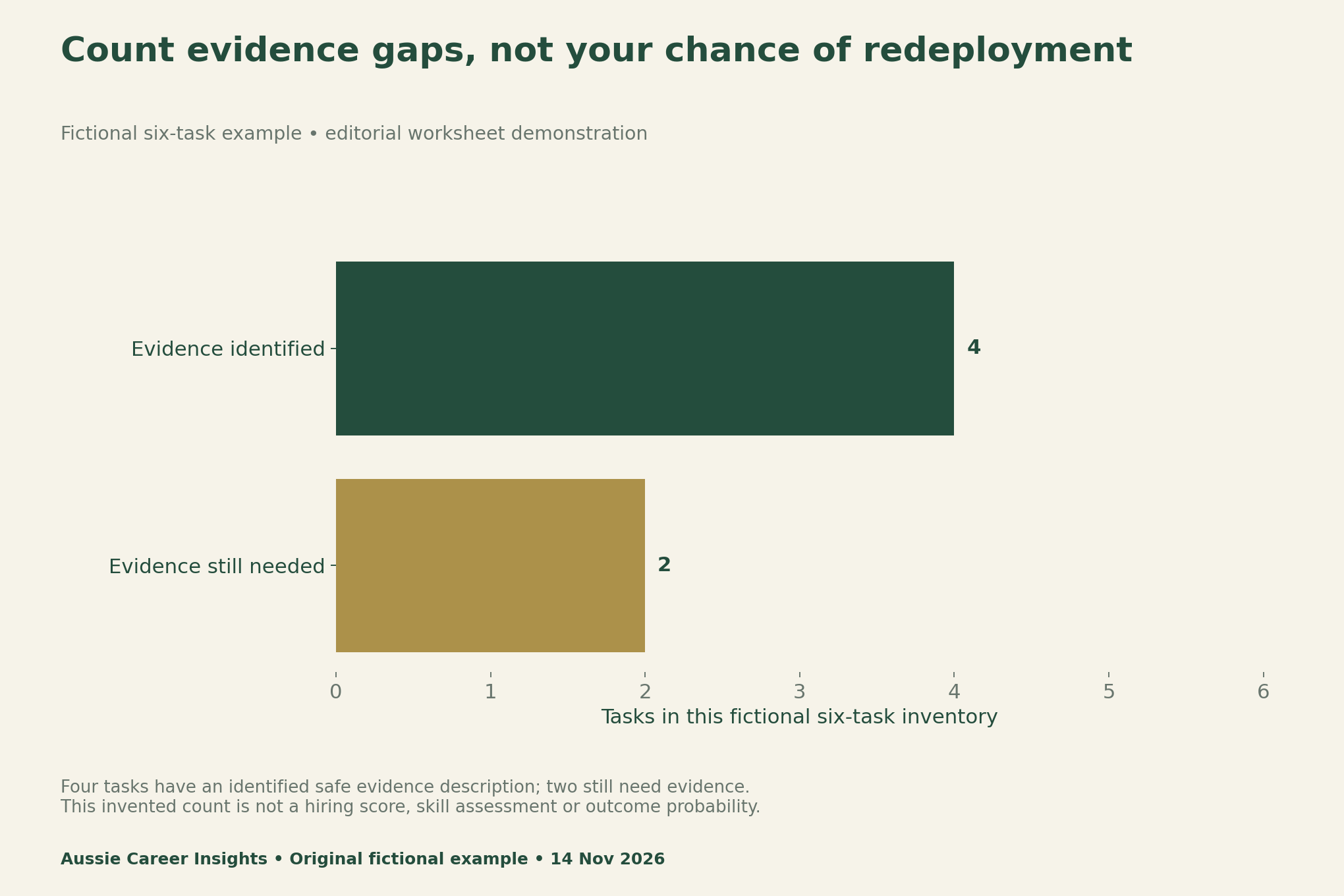
A missing item can matter more than several completed ones if it is essential to the real position. Therefore, read the full requirement and ask about mandatory qualifications, location and working arrangements. Avoid adding task counts into a single fit percentage. The worksheet does not establish which requirements an employer may lawfully use.
Compare an actual alternative before accepting assumptions
When a genuine option becomes available, compare duties, location, hours, reporting lines, conditions and training arrangements. Record what is written and what remains unclear. Separate information supplied by the employer from your own assumptions, and date each update so that an earlier possibility does not look current.
You can use our job-offer checklist for its general habit of checking written hours and conditions, while recognising that its hospitality context differs from corporate aviation work. Our transferable-skills guide also illustrates why tasks deserve more attention than job titles.
Use consultation questions to reduce specific unknowns
Prepare questions that can receive a clear answer. Which tasks are in scope? When will the next written update arrive? How will actual alternatives be communicated? What evidence would help a discussion about a particular position? Who can clarify a training request? Keep the answer reference and next action beside the question.
The Fair Work Ombudsman’s redundancy guidance explains that consultation and the relevant award or agreement matter. The Fair Work Commission’s redeployment guidance addresses the circumstances of reasonable redeployment. These resources do not determine an individual reader’s rights. Seek qualified advice about your own agreement, circumstances or deadlines.
Your Personalized Career Strategy
Unlock your potential with tailored career consulting. Get clear, actionable steps designed for your success. Start now!
Get StartedFor meetings, a short factual note is more useful than an unsupported conclusion. Record the date, channel, question and answer status. If a point was not answered, leave it unresolved. Do not treat silence as consent, or a general expression of support as a particular offer.
Download the Qantas restructuring redeployment tools
Start with the blank matrix using one real role description. Use the consultation log for questions and written updates. The fictional example shows the file structure; replace its invented content before using your own copy. These files are private planning tools and do not request personal information from readers.
- Announced measures, qualifiers and source notes (CSV)
- Fictional six-task evidence example (CSV)
- Blank role-to-role evidence matrix (CSV)
- Consultation question and update log (CSV)
Methods, limitations and the next update
We transcribed three selected measures from the employer’s release and kept their units, qualifiers and time scope separate. The second chart counts evidence descriptions in an explicitly invented six-row example. No workers, internal vacancies, agreements or employee records were audited. No outcome model or legal entitlement calculation was produced.
The evidence pack is an editorial preparation method, not a validated employment intervention. It cannot guarantee a role, training, retention or a particular redundancy payment. Refresh the announcement status, actual vacancy requirements and written employer updates before relying on an old copy. Keep unresolved items visible rather than filling them with assumptions.
Suggested citation: Aussie Career Insights (14 November 2026), “Qantas Restructuring: Build a Redeployment Evidence Pack”, employer-announcement analysis and original fictional evidence worksheets. Retain the distinction between announced plans and individual outcomes when reusing the figures.


