






Entry-level jobs and AI in Australia are easier to assess when you separate a national signal from the work in a specific advert. A business can change its vacancies without dismissing existing staff. Meanwhile, an occupation’s exposure to AI does not prove that every employer has adopted it.
New ABS business responses and a 9 November 2026 RBA staff analysis offer useful context for junior applicants. However, they answer different questions. This guide explains two original charts, then helps you examine a live vacancy and show how you check your work. Four free CSVs make the source values and private planning process reusable.
What the ABS business survey actually counts
The ABS August 2026 Job Vacancies release added its AI results on 4 November. In August, 81.8% of responding businesses reported no AI effect on their vacancy level, while 3.8% reported a decrease. These percentages describe businesses answering the questions, not the share of Australian jobs eliminated.
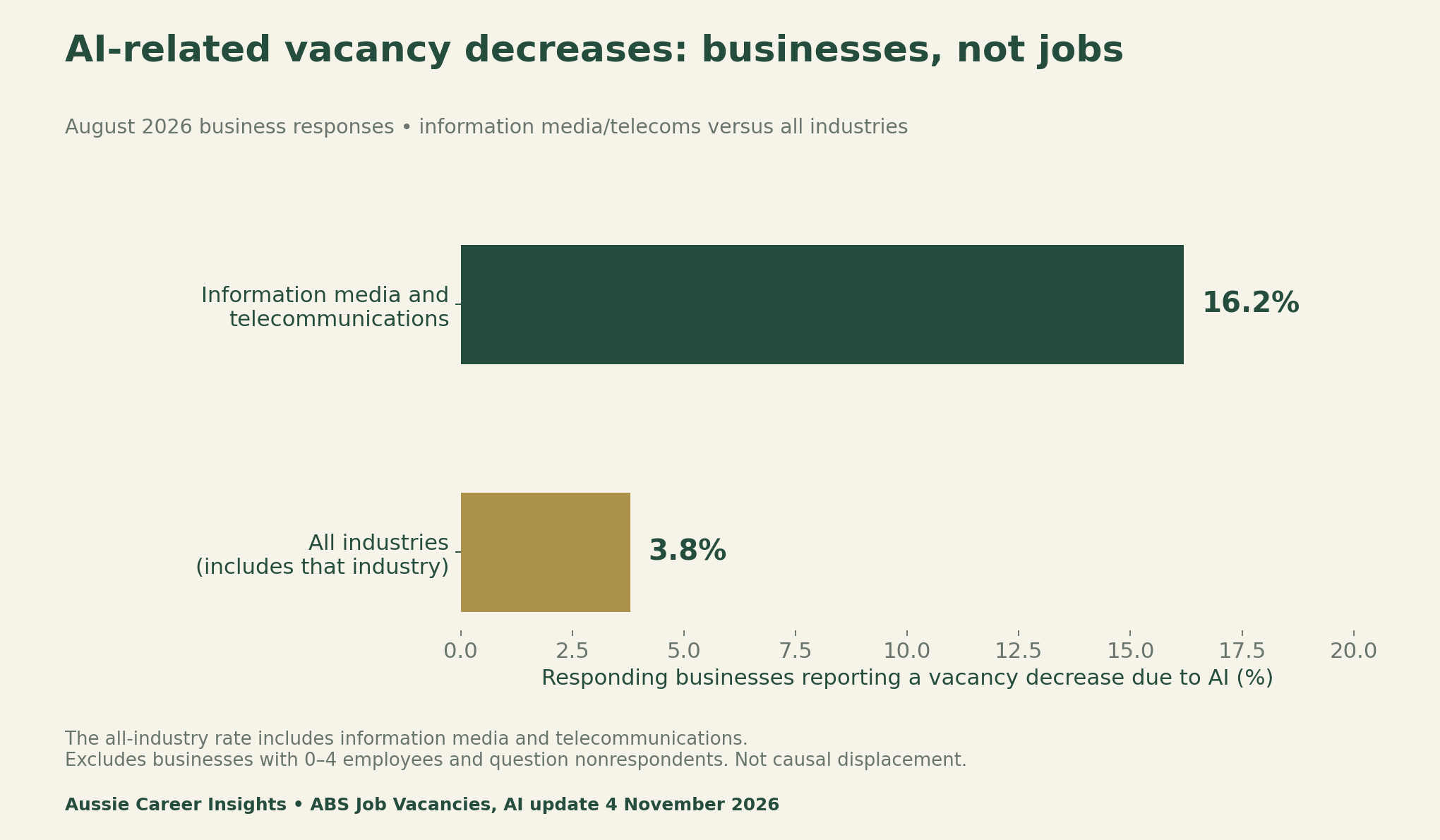
Information media and telecommunications recorded 16.2% reporting a decrease. The subtraction is 16.2 − 3.8 = 12.4 percentage points. However, the overall group includes that industry. Neither this subtraction nor the survey establishes your chance of finding a junior role at a particular employer.
The ABS methodology explains the survey and its AI questions. These AI results exclude businesses with zero to four employees and businesses that did not answer the questions. Keep those limits beside the figures, especially when discussing small employers that fall outside this evidence.
Entry-level jobs and AI in Australia: expectations are a different question
ABS reports an official aggregate of 4.3% experiencing an AI vacancy impact in August and 9.6% expecting one over the next year. Use that published aggregate. Adding separately rounded increase and decrease cells can produce 4.4%, which would replace the official number with rounding error.
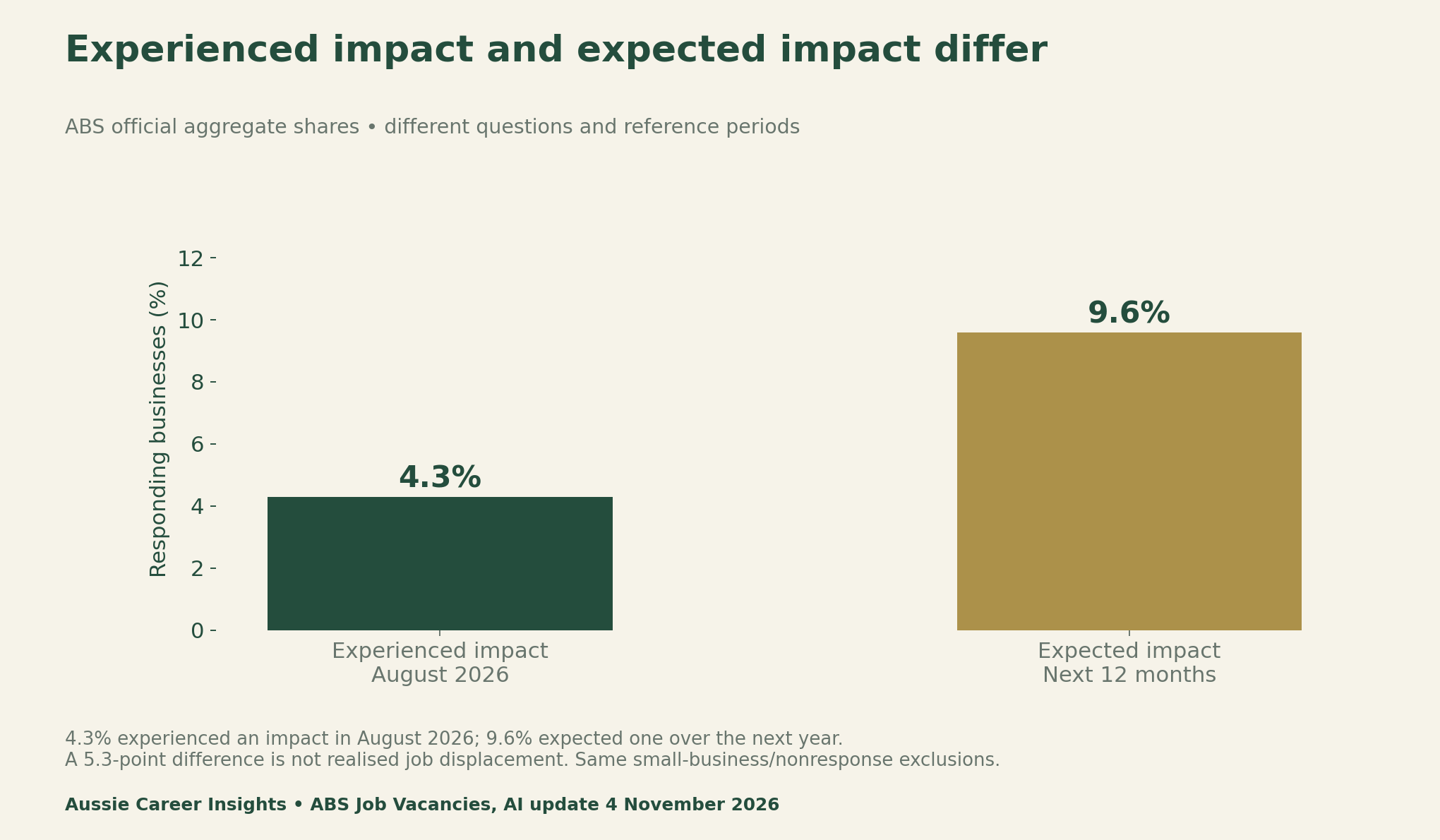
An expectation may change before an employer acts. Also, a vacancy effect is not the same measure as an effect on all existing jobs. Therefore, avoid translating either bar into an “AI-proof” career ranking. Use it as a reason to ask a more specific question about the work and supervision on offer.
What the RBA says about younger workers
The RBA staff Insight identifies tentative weaker outcomes for younger workers in more AI-exposed occupations, alongside limited evidence of material economy-wide disruption. Its latest complete occupational observations are from February 2026, with partial May data. November is the publication date, not the date of every observation.
The analysis is descriptive. Exposure concerns potential task effects, and other cyclical or structural changes can affect the same groups. It is not proof that AI caused a particular applicant’s rejection. The staff paper is also not necessarily the view of the RBA Board. We have not digitised chart points into invented official values.
Our earlier 139,000-job scenario explanation deals with a different headline and method. Read it for that distinction, while using this article for the new business responses and early-career questions. Neither source supplies a personalised forecast of displacement.
Read a junior vacancy through three lenses
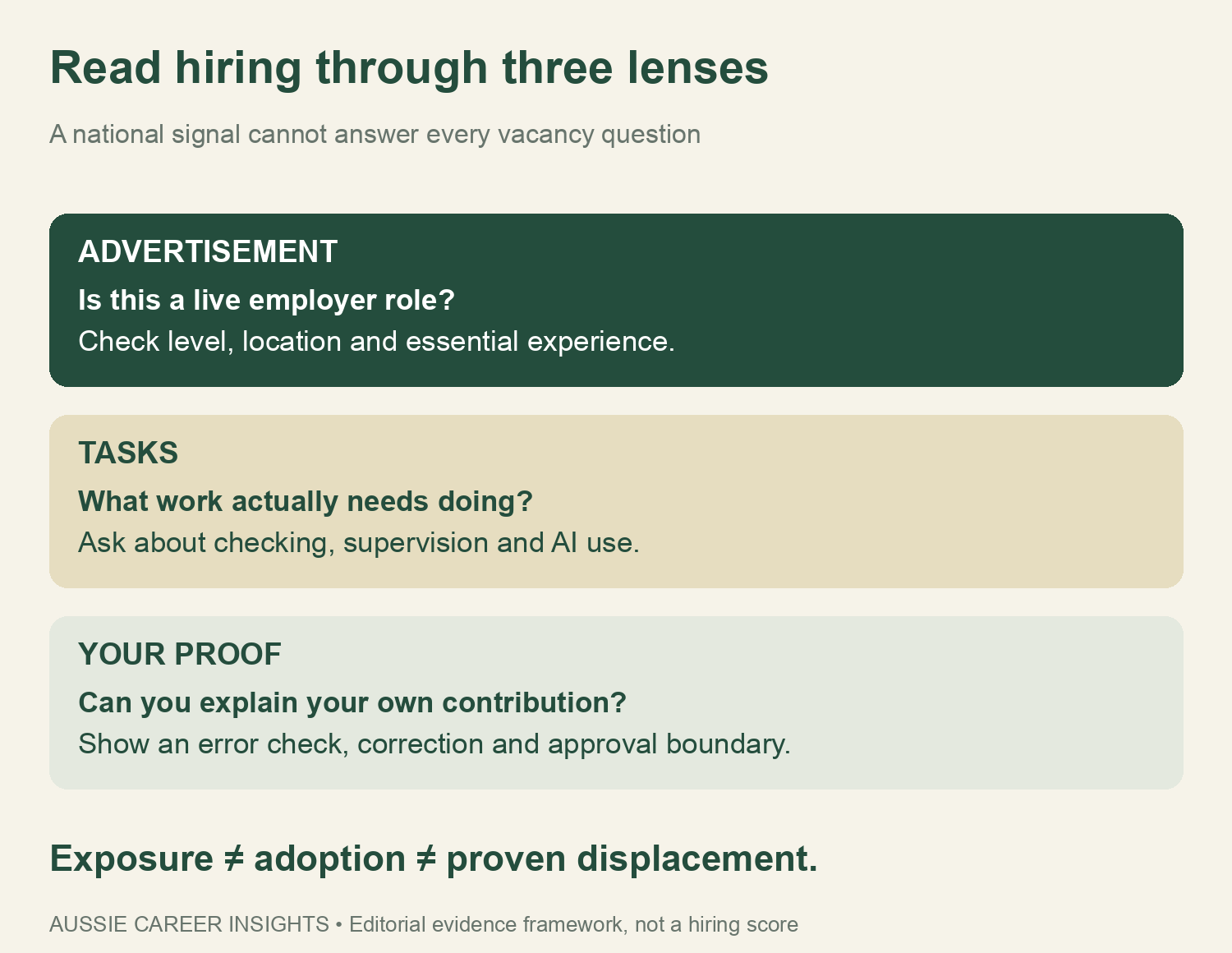
First, establish that the advert is live on the employer’s own site. Record the location, role level, essential experience and checked date. Keep “graduate”, “junior” and “entry-level” wording with the actual requirement. A friendly title can still sit above a demanding experience threshold.
Next, read the task verbs. Does the role involve producing an initial draft, checking an output, resolving exceptions or approving a result? Ask how work is reviewed and who handles an error. An advert that mentions AI does not, by itself, explain how much autonomy a new starter receives.
Then compare your evidence with one requirement at a time. Explain a relevant project, your own work and the point where you asked for help. For applicants with overseas experience, check working-rights and credential conditions directly with the employer. A national exposure measure cannot establish sponsorship, recognition or local eligibility.
Build a portfolio around verification
| Evidence item | Question to answer | Boundary to state |
|---|---|---|
| Problem and initial work | What were you trying to achieve, and what did you create? | Separate your contribution from shared or generated material |
| Check and correction | How did you test a result and respond to an error? | Explain what your check could and could not establish |
| Privacy and approval | What information could you use, and who approved the final action? | Keep confidential data and decisions outside a public portfolio |
For a wholly fictional practice project, imagine a small report with an incorrect total. Preserve the initial result, show the independent recalculation and explain the correction. Also state who would need to approve a real release. Use synthetic data or material you have permission to share; never publish confidential client records to make the example seem realistic.
If you used AI, describe its contribution honestly when an application or employer policy calls for it. You should still be able to explain the final work and the checks. Do not describe a generated answer you cannot evaluate as proof of independent competence. Likewise, do not claim that this planning exercise guarantees better hiring outcomes.
Your Personalized Career Strategy
Unlock your potential with tailored career consulting. Get clear, actionable steps designed for your success. Start now!
Get StartedDownload the data and private evidence tools
No vacancies were sampled for this article. The blank log becomes useful only after you add checked direct employer adverts. The portfolio sheet contains questions rather than a numerical score. Keep both files privately, recording evidence references instead of identity documents or confidential employment material.
- ABS business-response source data (CSV)
- Percentage-point calculations and limits (CSV)
- Blank junior-vacancy evidence log (CSV)
- Blank portfolio-verification worksheet (CSV)
Methods, limitations and updates
Research checked on 10 November 2026. Both charts reproduce ABS published percentages with their populations and periods intact. Differences use subtraction, not a conversion to jobs lost. The ABS media notes explicitly distinguish vacancies from existing jobs. Our career questions are original editorial guidance, without a worker survey or hiring-outcome study.
Recheck adverts when their status changes. Future RBA comparisons also need to account for the transition in occupation classifications rather than splicing incompatible series. Suggested citation: Aussie Career Insights, “Entry-Level Jobs and AI in Australia: Read the Hiring Evidence,” 10 November 2026. Cite ABS or RBA alongside the particular figure and preserve its limitations.


