




An underpayment evidence checklist helps you organise a suspected pay difference before asking for help. Start with dated work records and payslips, then record what remains uncertain. Keep gross pay, bank deposits, deductions, leave and superannuation in separate fields. A tidy file supports a review; it does not establish your legal entitlement or prove wrongdoing.
The Fair Work Ombudsman’s new results provide the news context. However, national recovery totals cannot predict your payout or tell you whether your employer made an error. This guide offers five figures and four CSV tools for preparing clear questions, with no personal employment records collected.
What the latest FWO figures actually measure
The FWO release dated 29 October 2026 reports roughly A$453 million recovered for more than 181,000 workers in financial year 2025–26. It also records 31,596 anonymous reports, compared with 25,608 a year earlier. Those counts describe regulatory activity, rather than underpayment prevalence across Australia.
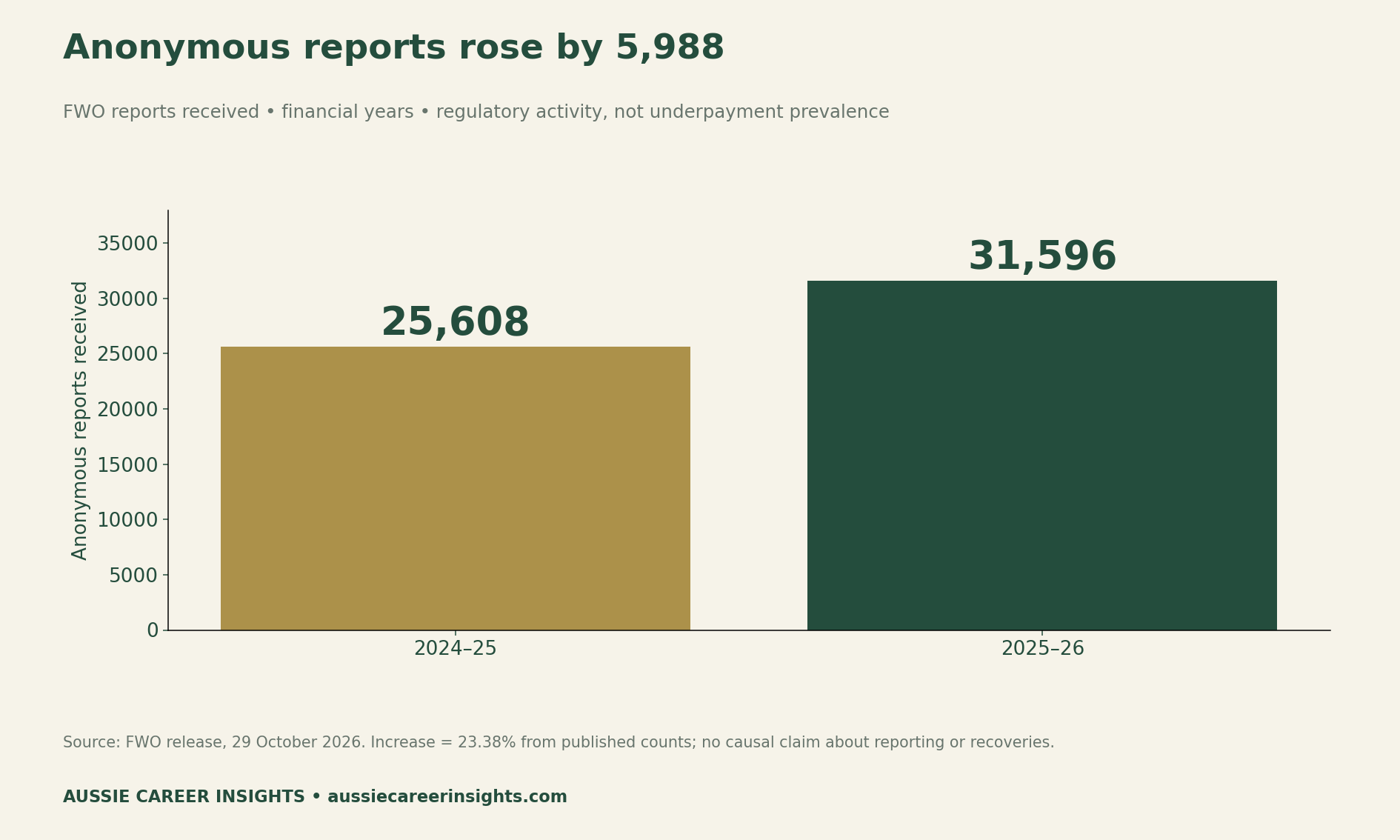
For example, greater reporting could reflect several factors. These two observations do not separate awareness, reporting behaviour and underlying workplace problems. Nor does an anonymous report necessarily become an individual recovery. Avoid using this chart to estimate a claimant’s chance of success.
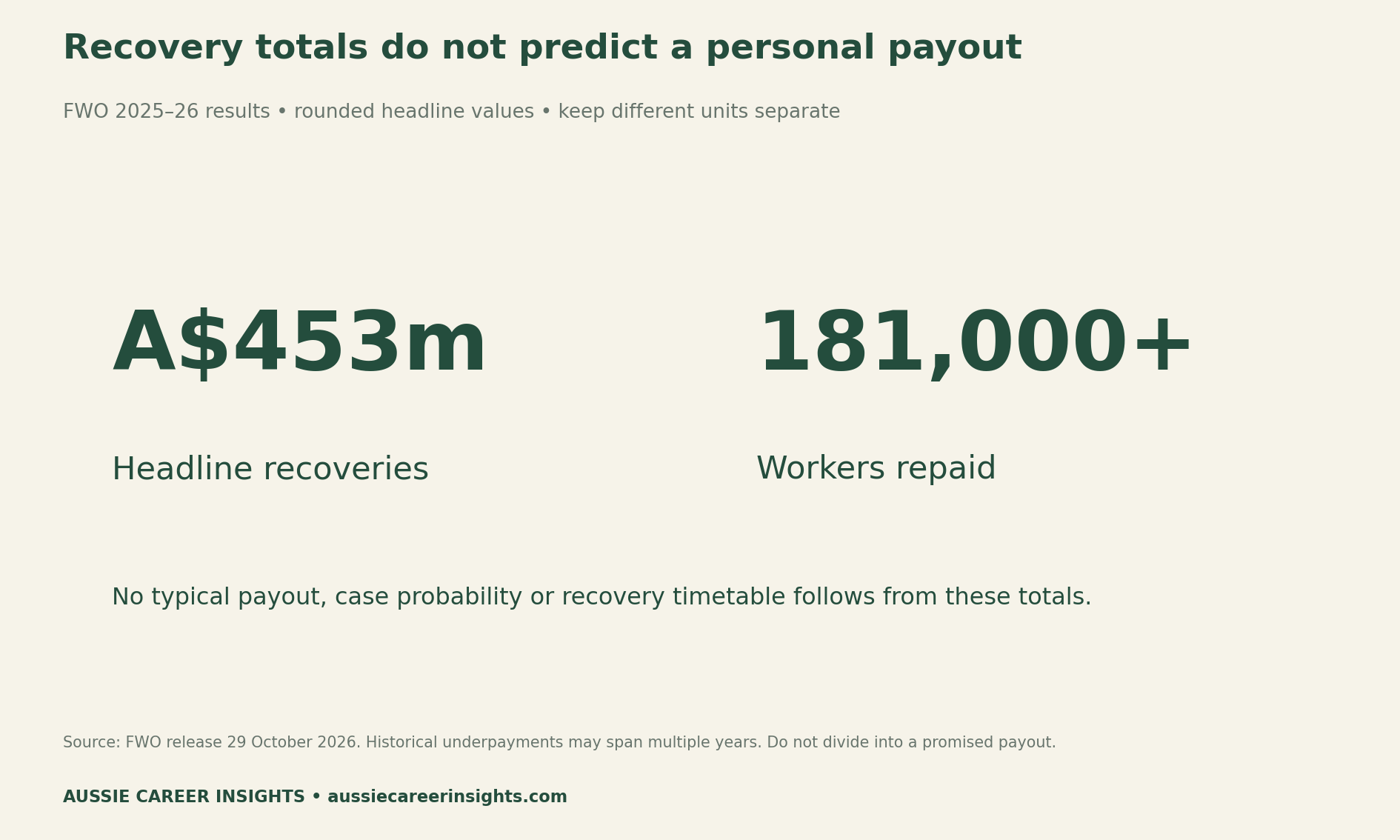
The annual report’s introductory performance discussion, printed page ix, separately identifies more than A$10.1 million recovered for 2,976 workers through dispute assistance. That service figure sits within the broader results. Do not add it to the headline as a second nationwide pool.
Build the underpayment evidence checklist by pay period
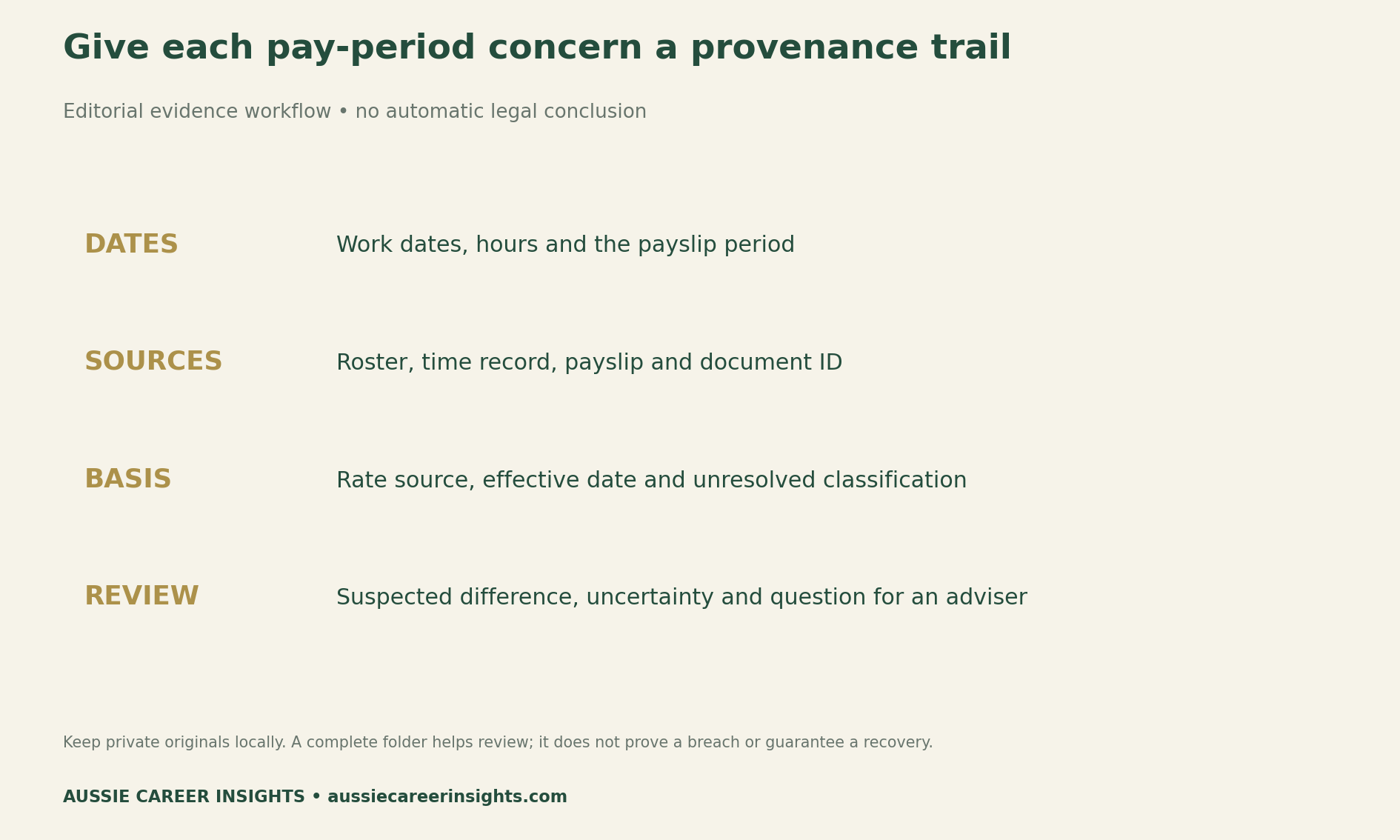
First create one row for each period you want someone to review. Record the payslip’s start and end dates alongside the dates you worked. Then identify the source of each hours entry: a roster, a time record, a calendar note or another retained document. If sources disagree, preserve both versions and explain the difference.
Next, record the gross amount shown on the payslip. Add a document ID that points to your private copy. A reviewer should be able to trace an entry without guessing which payslip you used. Keep the original file separate from any working spreadsheet and avoid overwriting it while adding notes.
Leave the rate or classification unresolved when you have not verified it. Where you have a relevant source, record its URL, effective date and the question you believe it answers. A current webpage may not establish a historical rate. Duties, employment arrangements and applicable rules can change the analysis.
Reconcile gross pay separately from the bank deposit
A bank deposit alone cannot tell you whether gross wages are correct. In our entirely fictional example, gross pay of A$1,000 less A$180 of illustrative tax and A$20 of other deductions leaves an A$800 deposit. The A$200 gap between gross and net is arithmetic, not evidence of an underpayment.
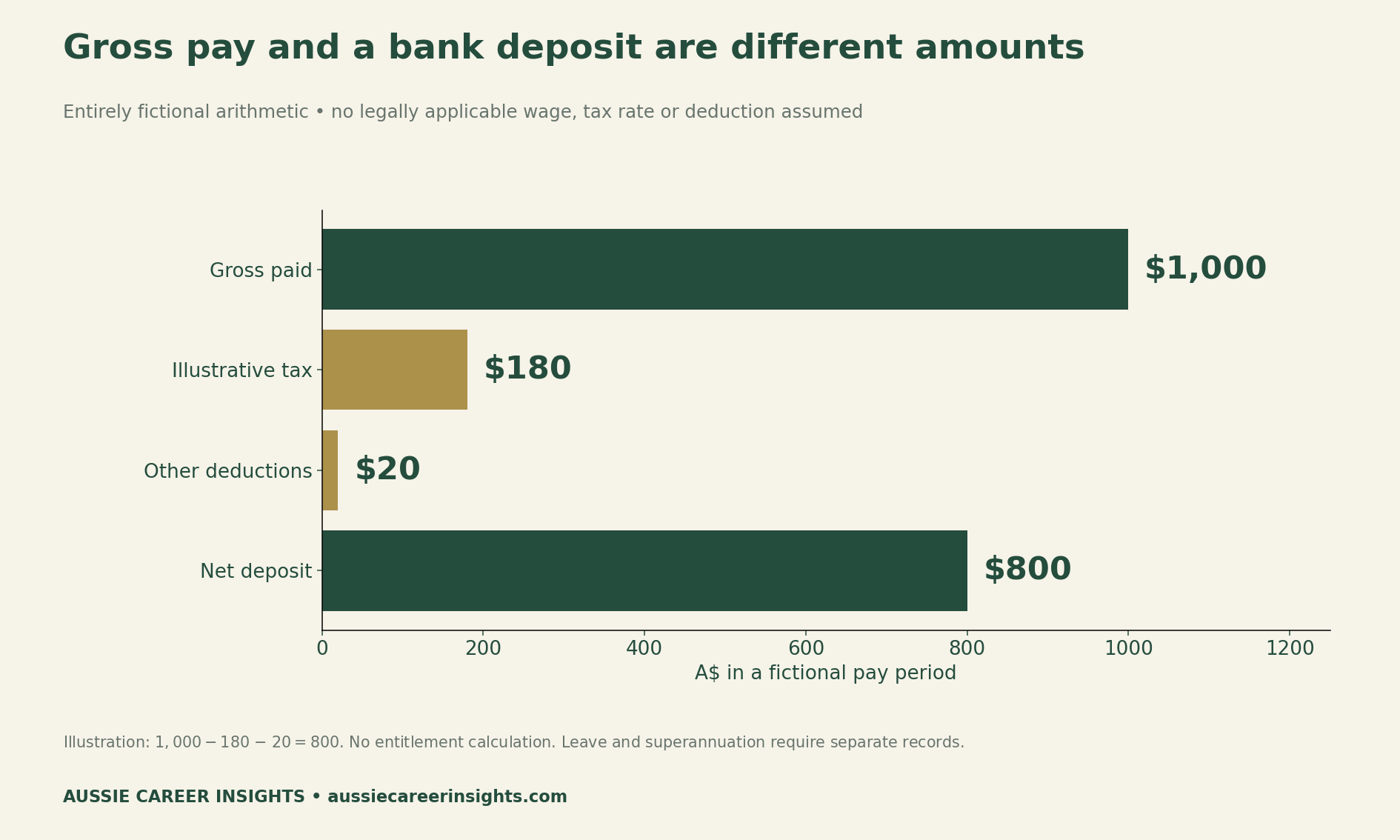
Check deductions on their own evidence rather than assuming every deduction is valid. Likewise, keep leave balances and superannuation records separate from the wage-deposit comparison. Their treatment requires the relevant documents and circumstances; this worksheet does not resolve those questions.
When you record a suspected gross difference, show the basis and mark it provisional. If the underlying rate is uncertain, an unsupported total can create false precision. A useful review question is which rule or classification needs checking before anyone treats that difference as established.
Keep a document index and an uncertainty log
Use simple IDs for contracts, rosters, time records, payslips and payroll correspondence. For each item, note the period covered, where you keep the original, when you obtained it and what it supports. Also record missing pages, unclear dates or a revised payslip. Missing evidence stays missing; it does not become zero.
For instance, a roster may describe planned work while another record describes hours actually worked. Label those sources accurately. A message about an amended shift might explain a difference, but it should remain linked to the relevant date and pay period rather than floating in an unlabelled folder.
Keep completed files and identifying employment records locally. Do not publish allegations, tax file numbers, banking details or colleagues’ information. If an adviser needs documents, use the channel they specify and ask what to redact. Our blank templates do not send information to us or to a regulator.

Anonymous reporting and direct help serve different purposes
FWO’s anonymous-reporting guidance says that it does not contact reporters after submission. Its form cannot accept document or photo attachments, and it instructs users not to include tax file numbers. The regulator uses the information for education and enforcement planning; anonymity is not an individual case-management promise.
Your Personalized Career Strategy
Unlock your potential with tailored career consulting. Get clear, actionable steps designed for your success. Start now!
Get Started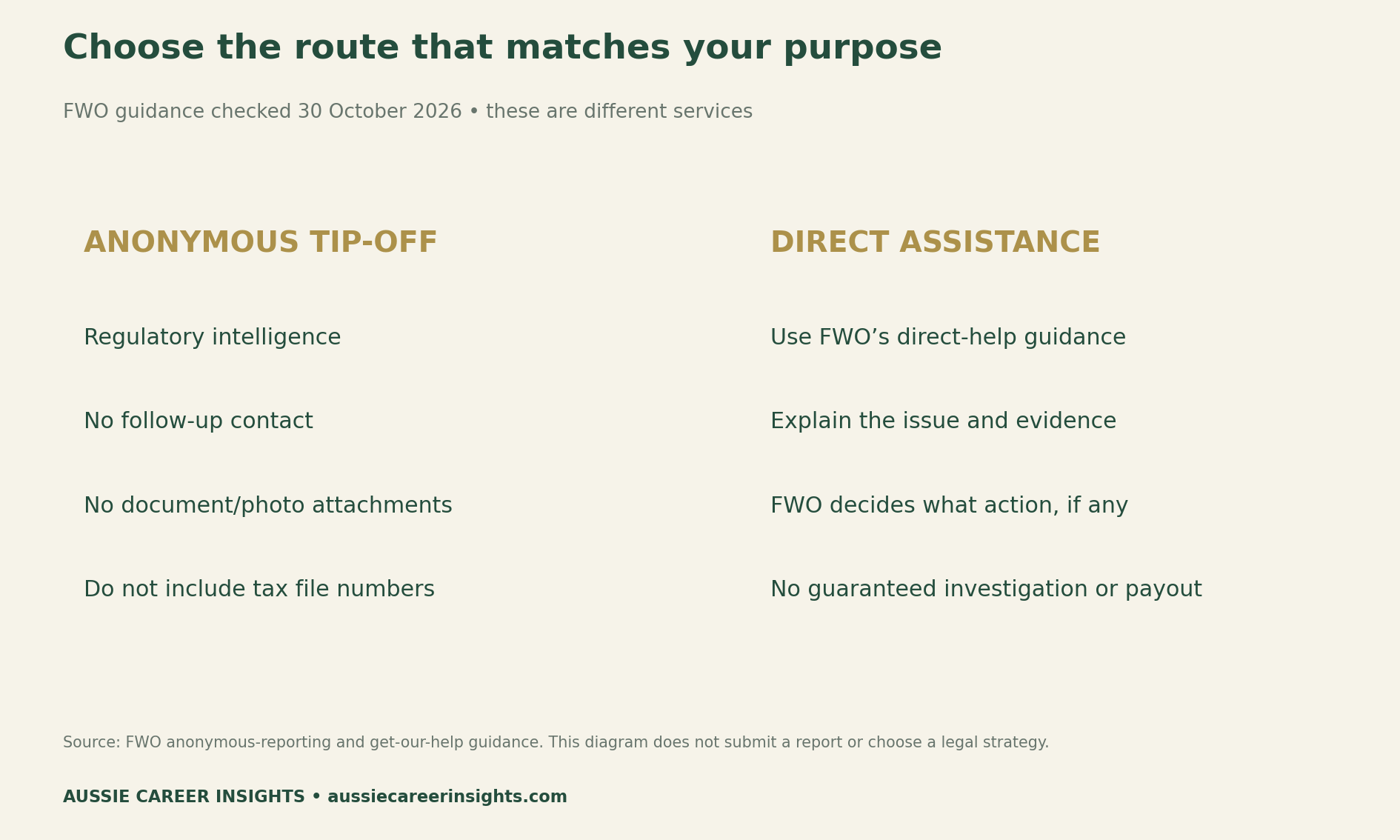
If you want direct assistance, read FWO’s get-our-help guidance instead of expecting an anonymous report to produce a reply. FWO explains that it reviews information and decides what action, if any, to take. A private evidence file can help you explain a concern clearly, without selecting a legal strategy for you.
Download the evidence tools
Pay-period evidence ledger (CSV). Record dates, hours, gross pay, the rate source and its effective date, provisional differences and review questions.
Private document index (CSV). Link document IDs to retained originals and note gaps without uploading personal records.
Fictional gross-to-net example (CSV). Reproduce the A$1,000 less A$180 less A$20 arithmetic. It contains no legally applicable rates.
FWO indicator data (CSV). Retain the published measures, units, periods, qualifiers and original-source URLs.
The files are plain CSVs, not automated entitlement calculators. After opening a blank worksheet, save a private working copy. You can begin with one pay period and a short list of questions rather than inventing a complete historical claim from incomplete records.
Method, review and limits
We checked the regulator’s release, annual-report discussion and anonymous-reporting guidance on 30 October 2026. Our scripts reproduce the reported counts and calculate the report-count change. We keep dollar amounts, people and report counts in separate units and do not derive a personal payout from aggregate totals.
The evidence framework is our editorial tool, not an FWO-tested intervention. Correct entitlements depend on the applicable rules and employment circumstances. Seek appropriate qualified advice for your situation. For related offer-stage questions, see our hospitality hours and roster checklist. It also keeps unknowns visible rather than treating them as facts.
Suggested citation: Aussie Career Insights, “Underpayment Evidence Checklist Australia: Build a Pay-Period File,” 30 October 2026. Cite FWO for regulator figures and identify our worksheets as editorial organisation tools. Corrections log: figures, units, route distinctions and fictional examples checked on this date.


