




Construction careers offer several routes into skilled work, but Australia’s building sector is not one job market. New Jobs and Skills Australia analysis projects residential building employment to grow 22.9% between May 2025 and May 2030. Heavy and civil engineering construction has a much smaller projected increase: 0.4%.
That 22.5 percentage-point difference matters when choosing an employer or training route. Yet it does not tell you which trade guarantees a job. This report separates industry growth, occupational earnings and training outcomes, then provides a practical checklist for an adult career change.
Construction careers: start with the employer’s work
JSA published its Construction profile: Industry insights on 16 October 2026. The report combines several datasets with different reference dates. Construction employed about 1.37 million people in February 2026, representing 9.3% of national employment. However, the opportunities vary across residential building, civil projects and specialist services.
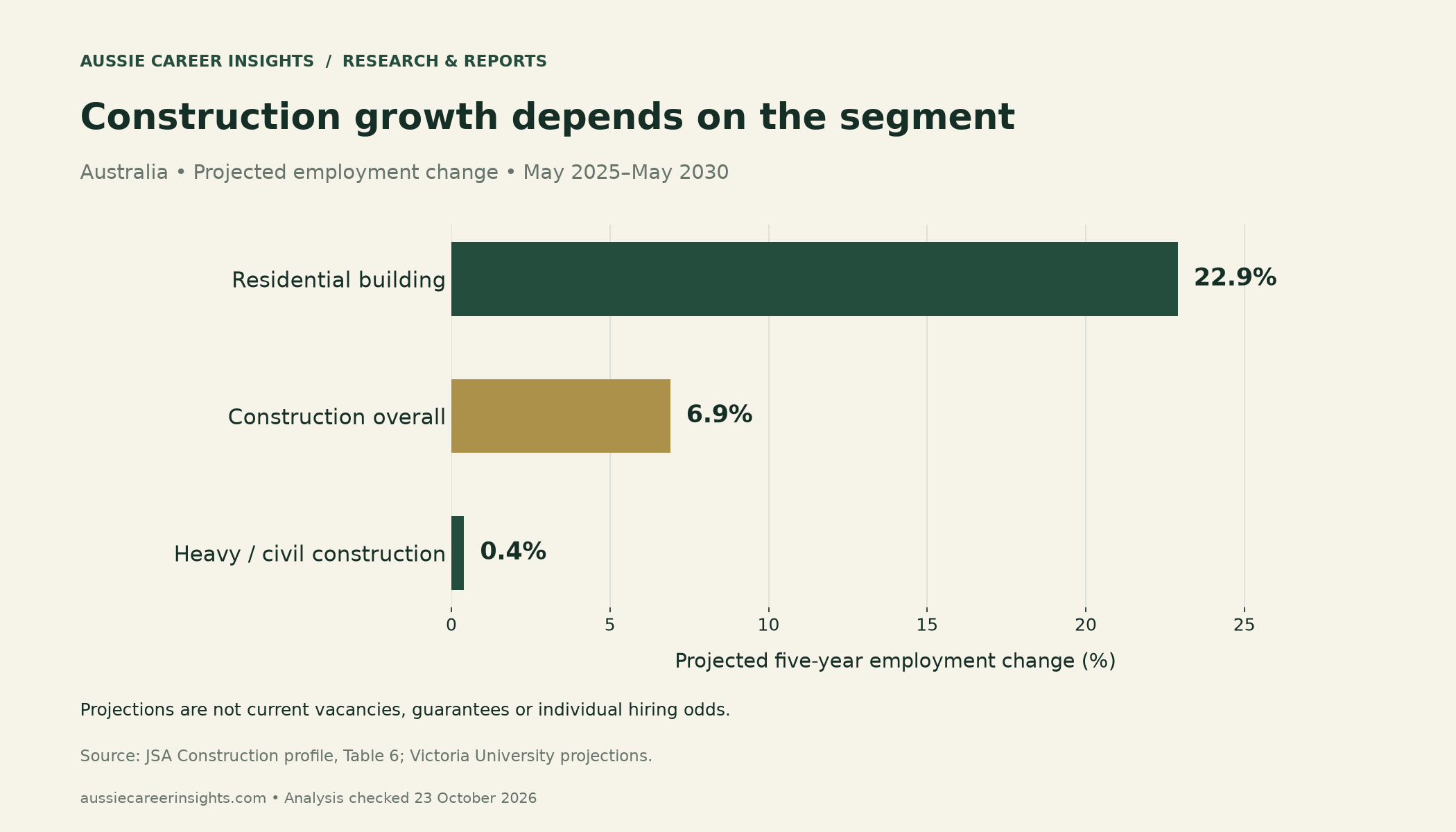
Residential building’s projection is well above the 6.9% increase for construction overall. Nevertheless, a projection describes a possible future workforce, not today’s advertised positions. The report also records 19,900 construction vacancies in May 2026, down 10.8% from a year earlier. Those vacancy estimates come from a different ABS series.
Therefore, ask a prospective employer about its project mix and confirmed workload. A company’s current contracts, location and training capacity may matter more to your next year than a national five-year forecast. Our 2026 shortage-list analysis explains why demand labels alone cannot settle a career decision.
Compare trade pay without treating it as a starting offer
Among three common trades, electricians had median weekly earnings of A$2,191, compared with A$1,760 for carpenters and joiners and A$1,379 for painting trades workers. The electrician–painting gap is A$812. These are May 2025 earnings for adult-rate full-time non-managerial employees, before tax.
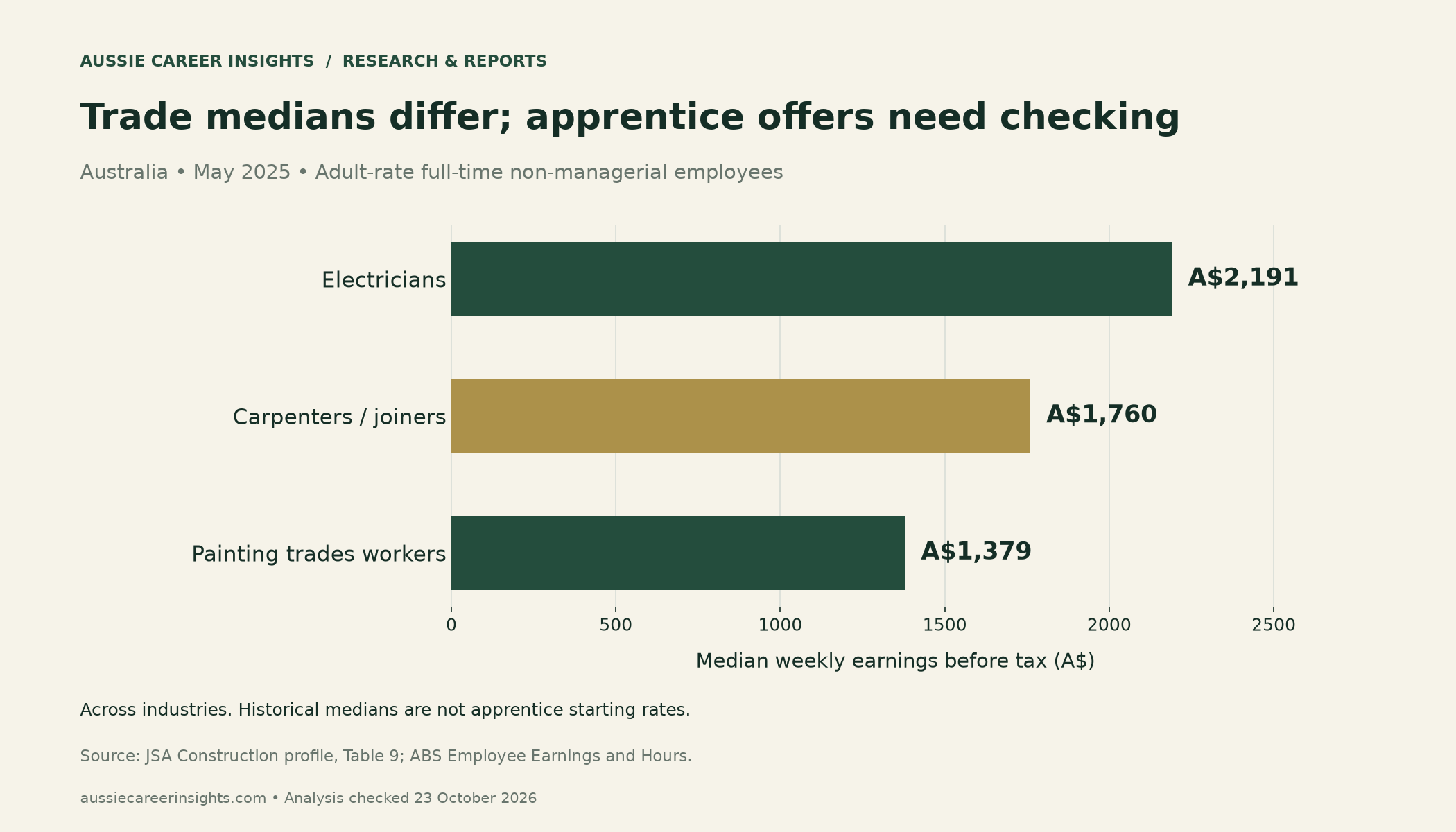
The figures describe different groups of workers. They do not show the pay rise you would receive by changing trades. Experience, hours, location and the work itself can differ. Also, the occupation estimates include workers outside construction employers.
For an adult apprentice, use an actual offer and the applicable pay rules instead. Fair Work’s apprentice pay guidance explains that adult apprentices are generally those aged 21 or older when they start. The applicable award or agreement, training stage and other conditions determine the rate. Check the Pay and Conditions Tool or the relevant agreement before budgeting.
Training completion deserves attention too
The report provides a useful historical comparison of six-year apprenticeship completion rates. Among people who commenced in 2019, the rate was 71.7% for electricians, 63.7% for carpenters and joiners, and 62.0% for plumbers. The all-occupation benchmark was 56.5%.
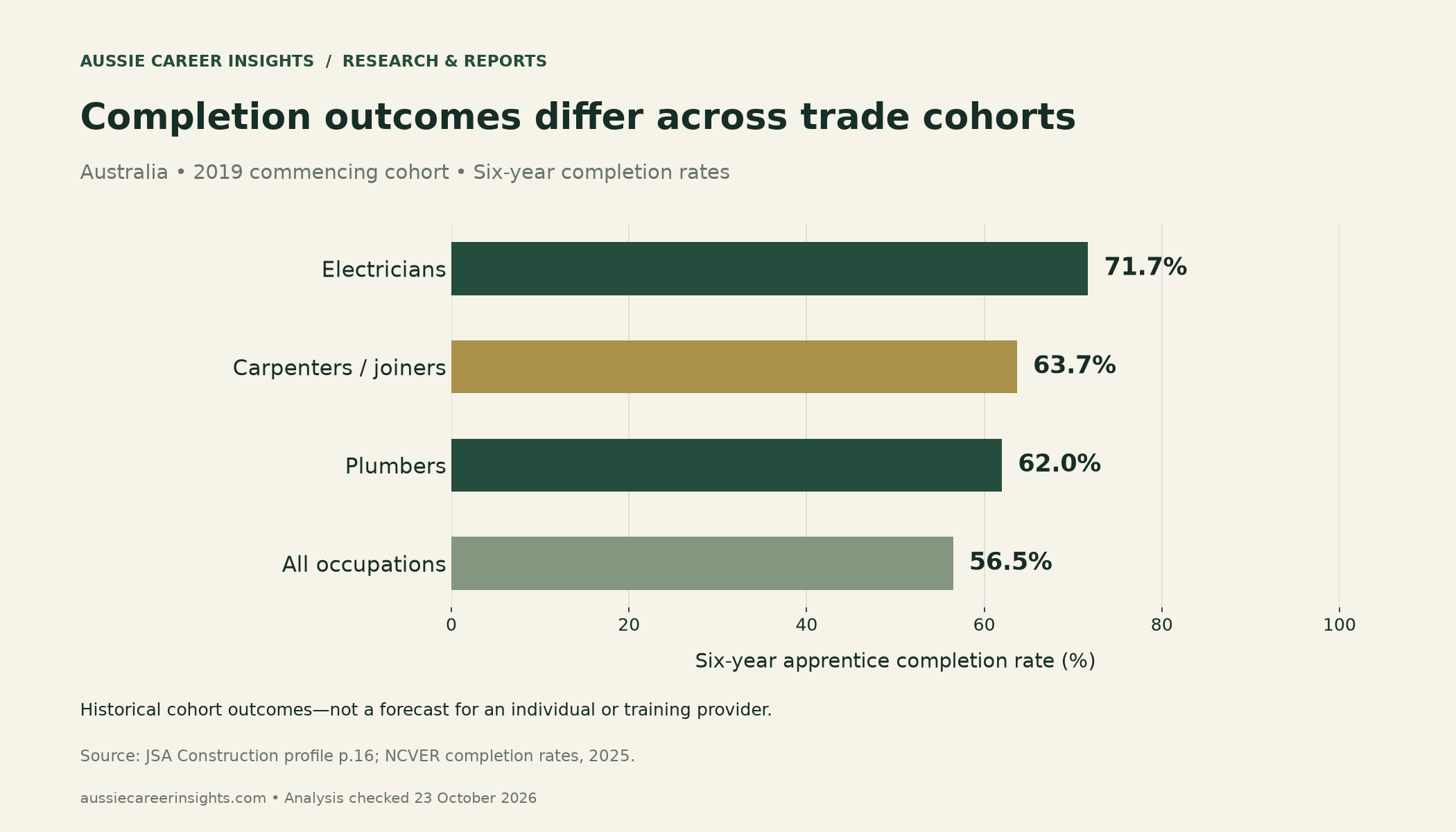
Electricians were 15.2 percentage points above the overall benchmark. That difference does not establish that electrical training is easier or that one provider is better. The cohorts can differ in many ways, and the chart does not isolate the causes of completion.
Instead, use the findings to ask about support. Who supervises your work? How will you attend training? What happens if the employer loses a contract? A clear training plan and stable support are practical matters you can investigate before committing.
Industry growth and occupation growth answer different questions
A residential builder can employ several trades, while an electrician can work outside residential construction. This distinction helps explain why the 22.9% residential projection should not become a claim about every construction occupation.
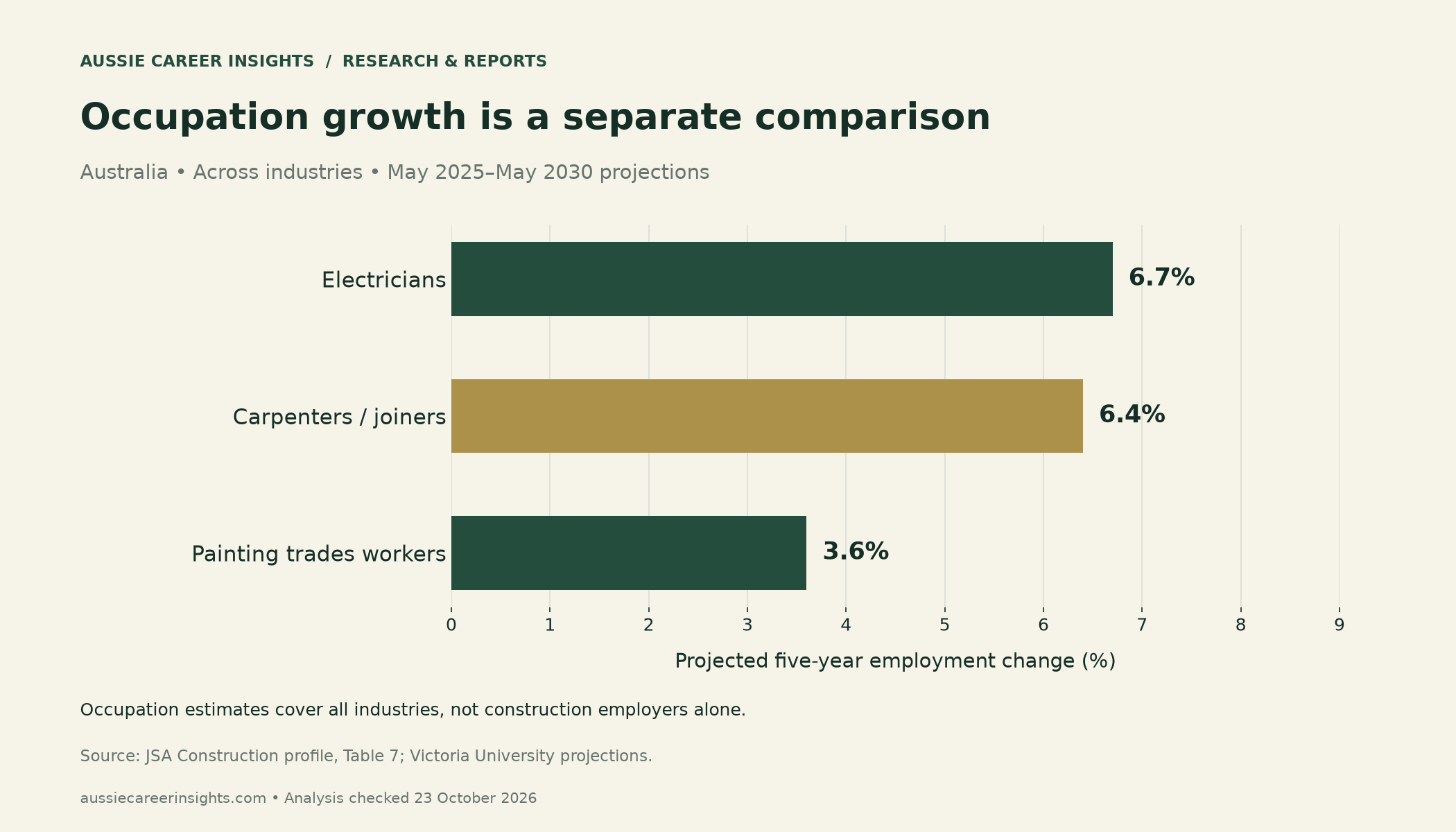
The three occupation projections range from 3.6% to 6.7%. They indicate the projected change in employment, not the number of job openings. Replacement hiring, local conditions and the skills needed for individual vacancies require separate evidence. Thus, compare the exact occupation and employer segment rather than choosing from the largest percentage alone.
Qualifications are common, but each trade has its own route
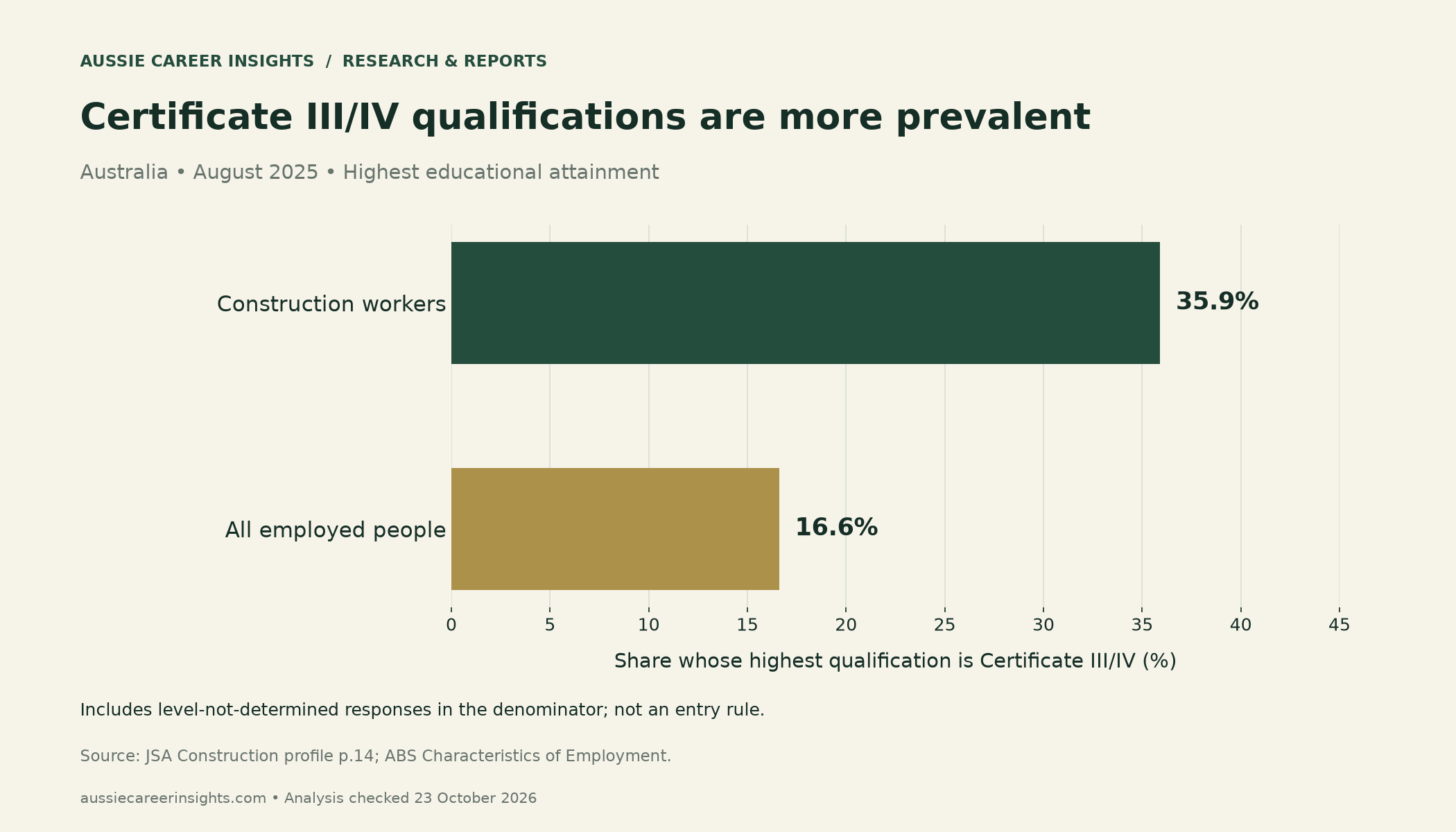
In August 2025, 35.9% of construction workers had a Certificate III or IV as their highest qualification. The corresponding share across all employed people was 16.6%. This shows the importance of vocational pathways in the existing workforce. It is not a universal entry requirement for every construction role.
Consider a NSW electrical apprenticeship as one concrete example. TAFE NSW’s Certificate III in Electrotechnology Electrician, UEE30820 requires apprentices to have relevant employment and the required training arrangements. Its separate recognition pathway has experience and employment conditions. It is not a shortcut for someone entirely new to the work.
Your Personalized Career Strategy
Unlock your potential with tailored career consulting. Get clear, actionable steps designed for your success. Start now!
Get StartedAlso distinguish site induction from trade training. The NSW white card confirms completion of general construction induction training. It does not replace an electrical qualification or the regulator’s licensing requirements. Other states and territories have their own rules, so verify the jurisdiction where you will work.
Under the published NSW fee-free apprenticeship rules, eligible Smart and Skilled-funded apprenticeships that start training before 30 June 2027 can have no student course fee. Eligibility and the training place still need confirmation. A fee-free course does not mean that tools, travel, household costs or foregone earnings disappear.
A construction careers decision worksheet

Complete this worksheet before resigning or enrolling. Ask the employer and provider to resolve missing details. If you are comparing another route, our retail-to-warehouse research offers a complementary pay-and-hours worksheet.
| Check | Evidence to obtain |
|---|---|
| Actual pay | Written starting rate, hours, penalties, allowances and whether superannuation is additional. |
| Training arrangement | Employer, registered training provider, training contract and timetable. |
| Fees and equipment | Written funding eligibility, course charges, tools, protective equipment and who pays. |
| Time and travel | Worksite locations, early starts, study attendance and realistic weekly travel costs. |
| Support and continuity | Named supervisor, progress reviews and arrangements if work or employment changes. |
| Qualification and licence | Exact qualification, required experience and separate regulator requirements. |
Finally, calculate a normal week using guaranteed income and realistic expenses. Keep uncertain overtime separate. Fair Work’s apprenticeship guidance also explains training-time and reimbursement rules; the applicable award and individual circumstances matter. Use those rules to check your written terms rather than assuming every offer includes the same support.
Methodology, sources and limitations
Research checked on 23 October 2026. We transcribed five comparisons from the JSA Construction profile paper: Tables 6, 7 and 9, plus qualification and completion figures on pages 14 and 16. Earnings refer to May 2025; qualifications to August 2025; completion to the 2019 commencing cohort; projections span May 2025–May 2030.
Calculations are reproducible: 22.9 − 0.4 = 22.5 percentage points; A$2,191 − A$1,379 = A$812; and 71.7 − 56.5 = 15.2 percentage points. Each chart keeps its own population and period. We do not combine them into a score or rank the best trade for everyone.
The employment projections use Victoria University modelling calibrated to Treasury forecasts. They represent projected employment where supply meets demand, not guaranteed vacancies. Historical medians and cohort outcomes cannot predict an individual result. NSW pathway examples are jurisdiction-specific and require current provider and regulator checks.
Charts: Aussie Career Insights analysis of Jobs and Skills Australia, ABS and NCVER figures. Readers may reuse the comparison values with attribution, reference dates and caveats intact. Conceptual illustrations are AI-generated.


