




Moving from retail to warehouse work can change your hours more than your headline pay. In Jobs and Skills Australia’s historical profiles, 68% of storepersons worked full-time, compared with 25% of sales assistants. Meanwhile, their median weekly earnings differed by A$87.
Those figures offer a starting point, not a promise. A warehouse offer still needs to work for your roster, travel costs, physical capacity and existing skills. This report combines dated national benchmarks with three employer advertisements checked on 23 October 2026. Use the comparison worksheet below before accepting a role or paying for training.
Retail to warehouse: compare hours first
The full-time share was 43 percentage points higher among storepersons than sales assistants. Transport and despatch clerks had an even higher share, at 89%. These figures describe people already working in each occupation. They do not measure your chance of receiving a permanent full-time offer.
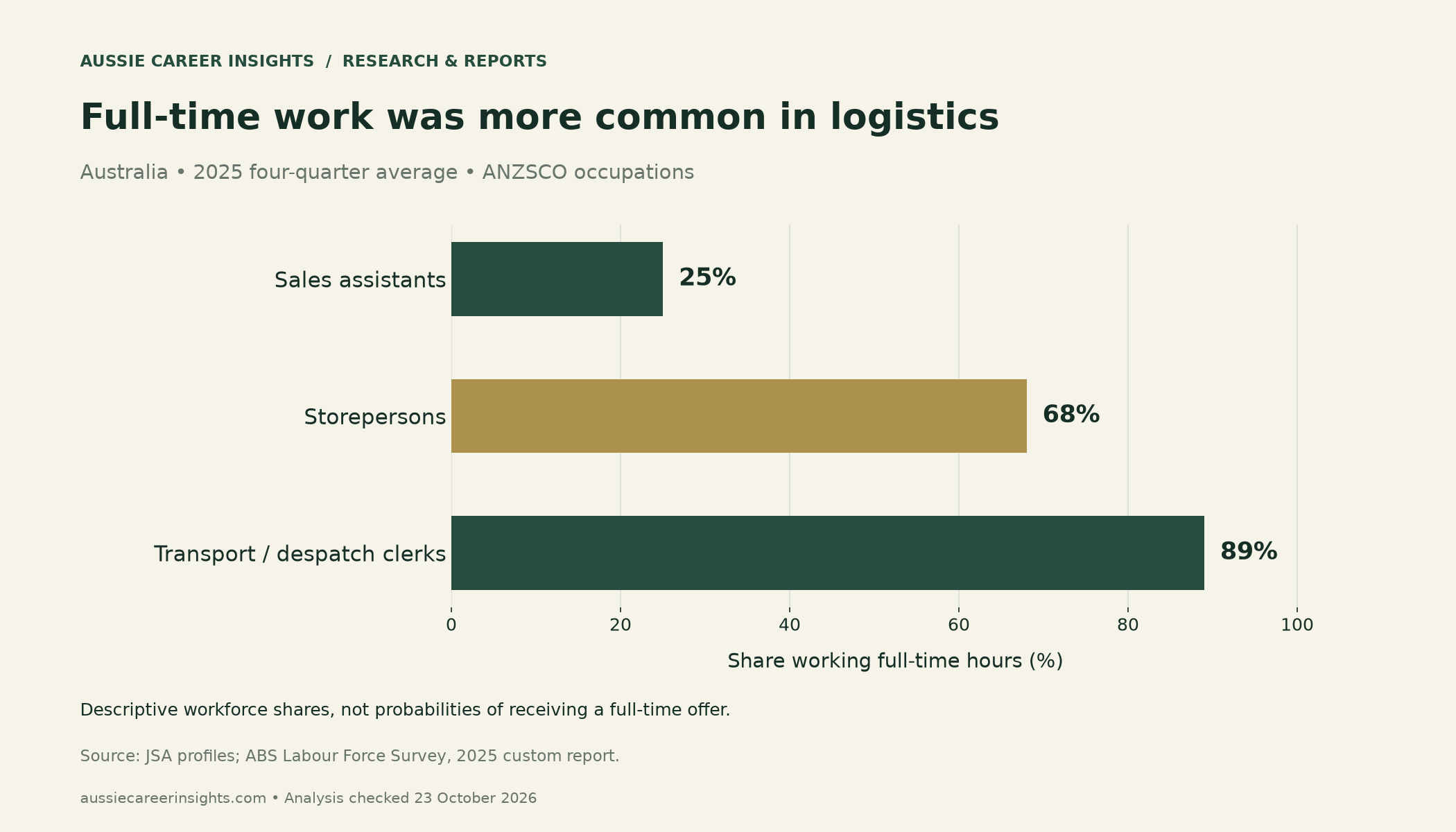
For someone juggling changing retail shifts, predictable hours may matter more than a small hourly increase. However, confirm the contract type separately. A job described as full-time can still require questions about casual status, guaranteed hours and the actual roster.
What the pay benchmarks really show
The sales assistant profile reports median weekly earnings of A$1,241. The storeperson profile reports A$1,328, a difference of A$87, or about 7.0%. Both weekly measures cover adult-rate full-time non-managerial employees in May 2025, before tax.
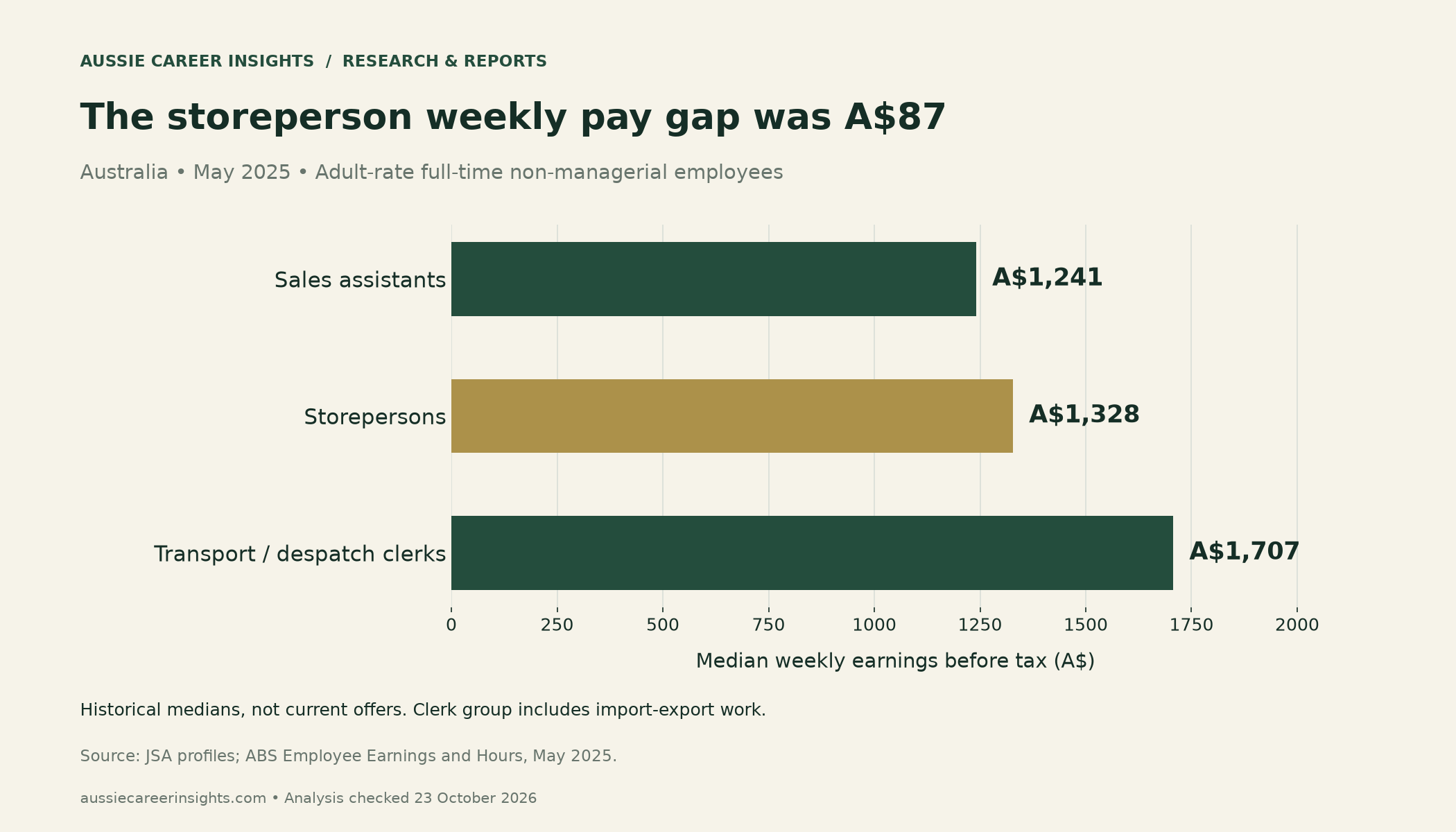
The transport and despatch clerk group had a higher weekly median of A$1,707. Yet this group includes import-export work as well as receiving and despatch tasks. It is not an entry-level warehouse salary estimate. Compare the duties and experience requirements before treating that number as a target.
Published hourly medians add another reference point: A$32 for sales assistants, A$34 for storepersons and A$46 for transport and despatch clerks. We use those published values directly. Dividing weekly earnings by a separate hours estimate would mix different statistics.
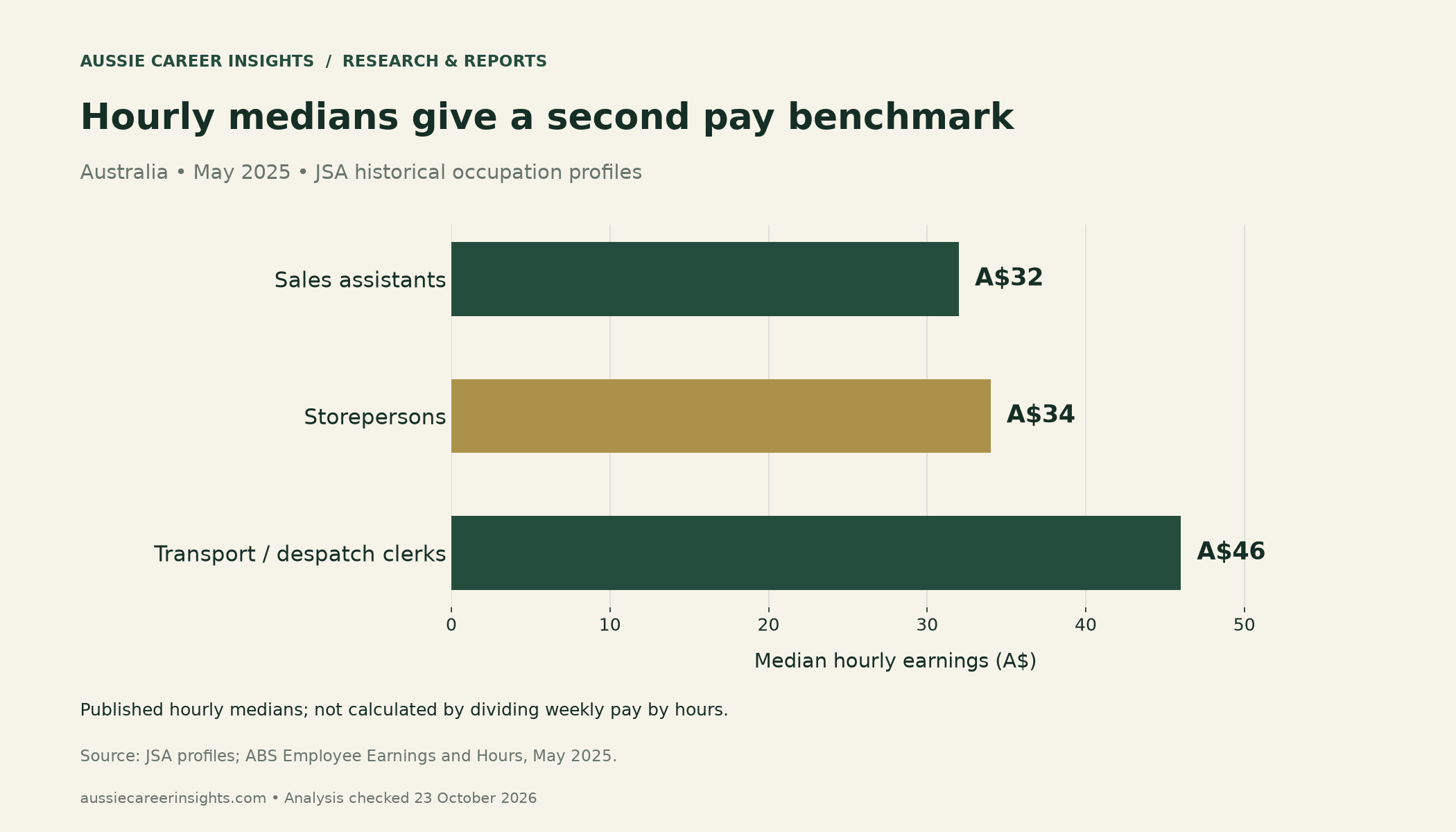
In practice, ask whether an offer includes casual loading, penalties, overtime or allowances. Also establish whether quoted remuneration includes superannuation. A median cannot resolve those details. Nor does the A$87 gap prove that an individual would earn that much more after switching.
What September 2026 advertisements can tell you
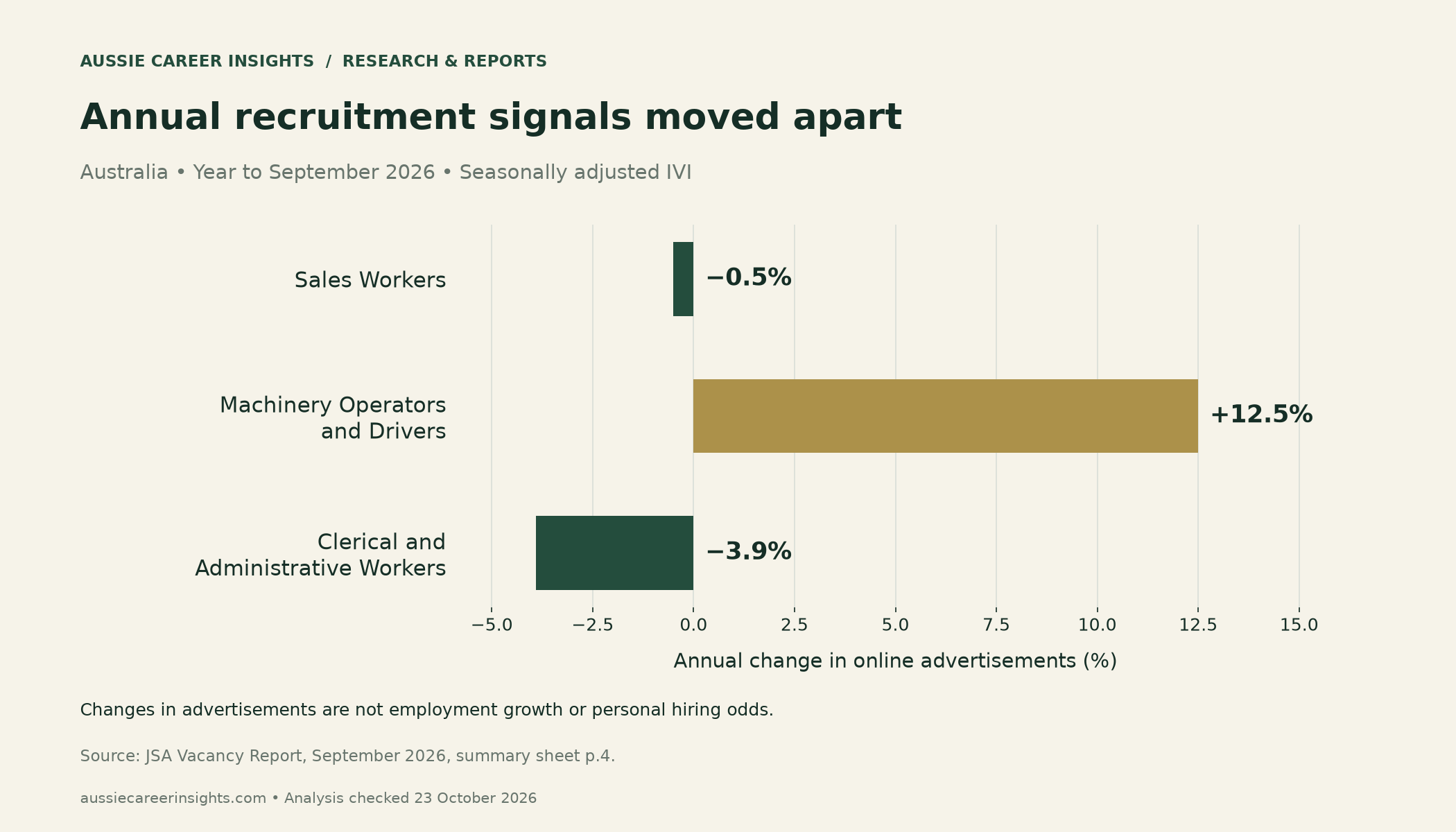
The September 2026 JSA Vacancy Report, released on 21 October, provides a more recent recruitment signal. It recorded 16,300 online advertisements for Sales Workers, 14,100 for Machinery Operators and Drivers, and 30,100 for Clerical and Administrative Workers. These are broad occupation groups, not industry totals.
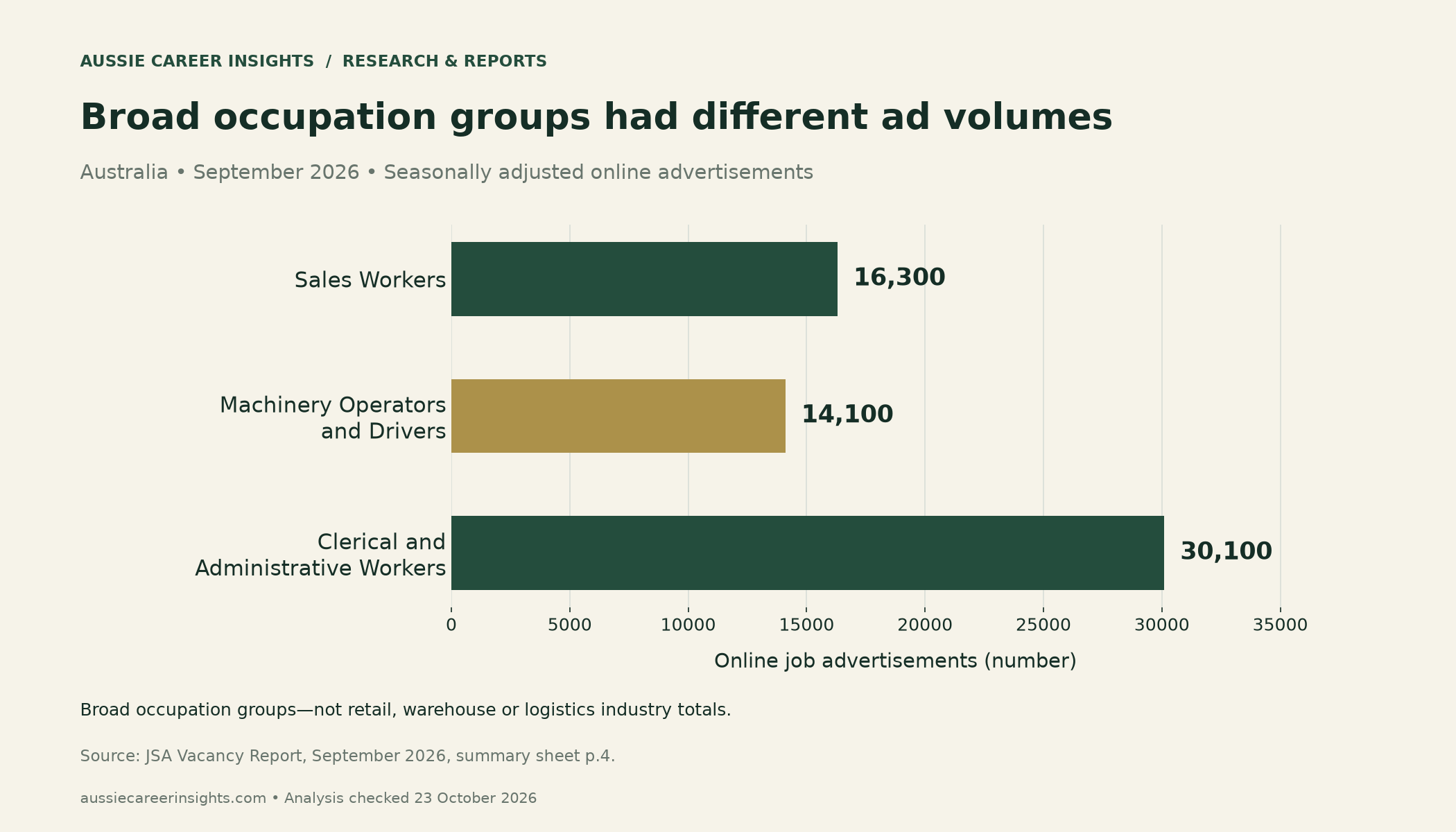
Compared with September 2025, advertisements fell 0.5% for Sales Workers and 3.9% for Clerical and Administrative Workers. They rose 12.5% for Machinery Operators and Drivers. That last result does not establish a 12.5% rise in warehouse jobs: the group covers many other roles.
Use these signals to guide a local search. Then inspect the actual job, location and shift. Our 2026 shortage-list analysis explains why a national demand label still leaves important hiring barriers.
Three employers, three different entry screens
We reviewed three live employer pages as examples, not a representative survey. They show why “warehouse job” is too broad to describe one entry route. Listings can change or close after our access date.
| Employer and role | What the advertisement asks for | Question for an applicant |
|---|---|---|
| Kmart, Moorebank experienced forklift drivers | Relevant forklift licence and at least two years’ specified forklift experience. | Do my licence and equipment experience match this experienced role? |
| The Star, Sydney warehouse storeperson | Permanent full-time; stock accuracy, software skills and roster flexibility. High-volume experience is highly regarded. | What training is available, and what are the physical tasks and shift times? |
| FedEx, Banksmeadow operations support / storeperson | Current Australian forklift licence, warehouse experience, RF/WMS and computer skills. | Why does the page show Full Time alongside a casual worker subtype? Confirm status and guaranteed hours. |
Primary employer pages: Kmart Moorebank, The Star Sydney and FedEx Banksmeadow. The Star page did not state a forklift licence requirement when checked. Absence from an advertisement does not prove that no licence will be needed for assigned tasks.
Retail experience can supply useful evidence: accurate stock counts, delivery checks, safe handling, customer communication and working to deadlines. Describe what you actually did. For example, explain how you found and corrected a stock discrepancy. Avoid claiming forklift or warehouse-system competence without the relevant experience.
Check licences before buying a course
A retail to warehouse move does not automatically require one particular qualification. In NSW, SafeWork’s forklift guidance distinguishes LF forklift work from LO order-picking forklift work. A manual pallet jack does not require a high-risk work licence, although site-specific training remains necessary. Check your state or territory regulator and the exact equipment involved.
Your Personalized Career Strategy
Unlock your potential with tailored career consulting. Get clear, actionable steps designed for your success. Start now!
Get StartedFor broader study, TAFE NSW’s Certificate III in Supply Chain Operations, TLI30325 offers 14 units. The qualification has no entry requirements, but delivery locations can set additional conditions. Course options, fees and eligibility need individual checking. Treat it as a possible pathway, not a universal prerequisite for every warehouse vacancy.
A retail to warehouse offer worksheet

Copy this table and fill both columns from written terms. Leave unknown figures blank until the employer answers. Include your household schedule and travel time, rather than making the decision from a national pay median alone.
| Item to verify | Current retail job | Proposed warehouse job |
|---|---|---|
| Employment status and guaranteed hours | Enter current terms | Confirm in writing |
| Base pay; loading, penalties and allowances | Record separately | Record separately |
| Superannuation included or additional? | Check | Check |
| Start / finish times and roster notice | Record | Confirm |
| Weekly travel cost and travel time | Calculate your route | Calculate the actual shift route |
| Required licence, equipment and training costs | Record | Ask who pays |
| Physical tasks, support and progression | Describe current work | Discuss before accepting |
Next, compare a normal week and a low-hours week using your actual terms. Keep uncertain overtime separate from guaranteed pay. If the proposed roster creates extra travel or care costs, include those too. The stronger option is the one that fits your needs after those checks, not simply the occupation with the higher median.
Methodology and limitations
Research date: 23 October 2026. We transcribed three JSA ANZSCO occupation profiles and the September 2026 Vacancy Report. The ANZSCO profiles are historical and no longer updated; pay refers to May 2025 and full-time shares to the 2025 four-quarter average. We retain those dates rather than presenting them as current offers.
Our calculations are transparent: A$1,328 − A$1,241 = A$87; A$87 ÷ A$1,241 × 100 ≈ 7.0%; and 68% − 25% = 43 percentage points. Comparisons describe different workforces. They do not control for location, experience, age, hours or selection into each job.
The IVI methodology covers newly lodged advertisements on SEEK, CareerOne and Workforce Australia, with deduplication. It excludes other recruitment channels. One advertisement can cover multiple jobs, and seasonally adjusted series are not necessarily additive. Our three-employer convenience sample illustrates requirements only. It cannot estimate how common each requirement is nationally.
Charts: Aussie Career Insights analysis of Commonwealth of Australia / Jobs and Skills Australia and ABS data. Readers may reuse the comparison table with attribution and its dates and caveats intact. Conceptual illustrations are AI-generated.


