




Australia’s 2026 shortage list can help you choose where to investigate a career move. It cannot tell you whether an employer will hire you. The useful next step is to check the exact role, the entry requirements and the conditions behind the vacancy.
Jobs and Skills Australia (JSA) released its new findings on 21 October 2026. This analysis checks the national figures, compares hiring outcomes and turns the evidence into a practical shortlist checklist. Research checked: 23 October 2026.
Australia’s 2026 shortage list: the headline numbers
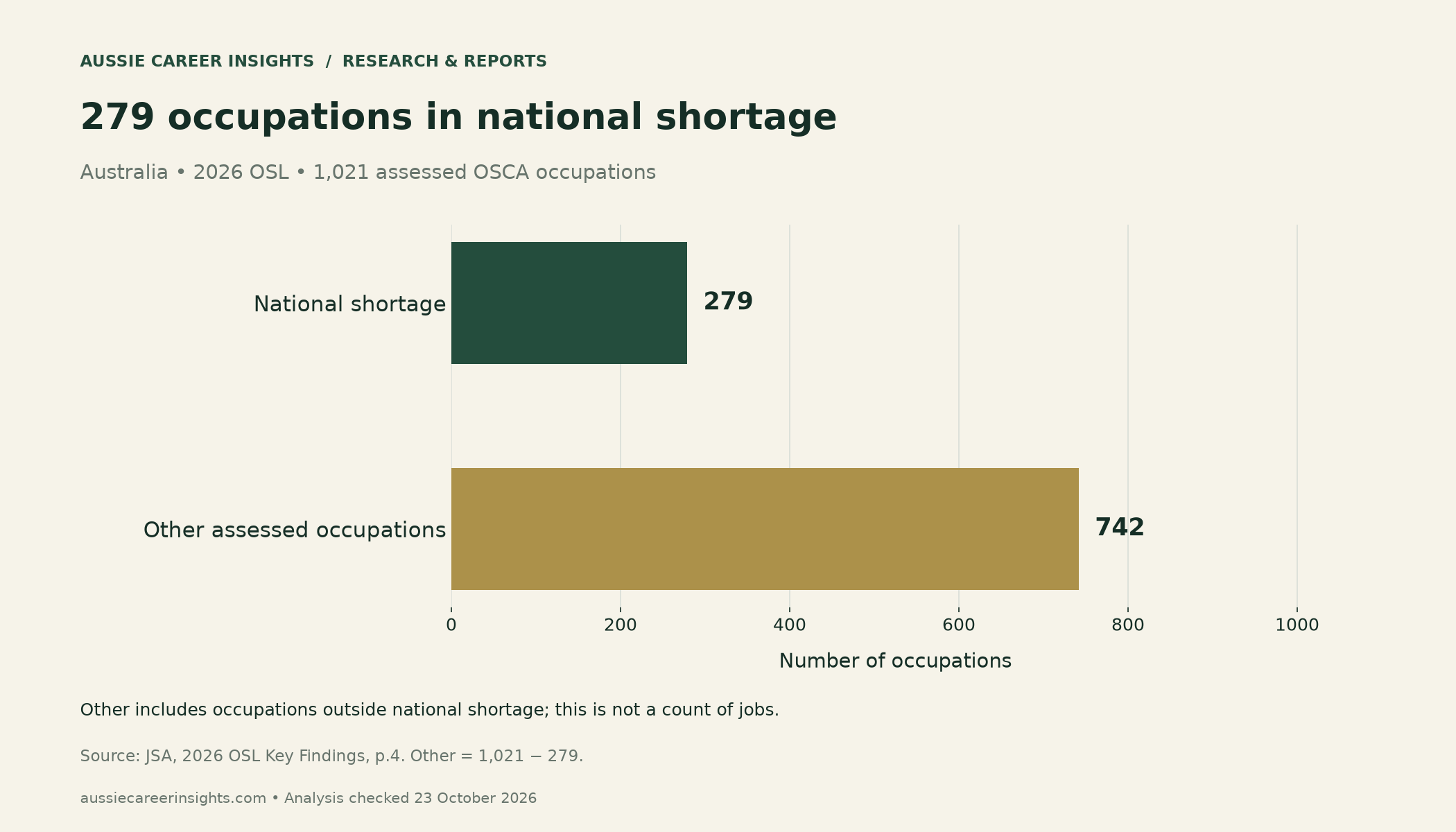
JSA counted 279 occupations in national shortage out of 1,021 assessed on the Occupation Standard Classification for Australia (OSCA) basis. That is 27.3% using the published counts, or 27% rounded as in the official report. These are occupation categories, not numbers of vacancies or workers.
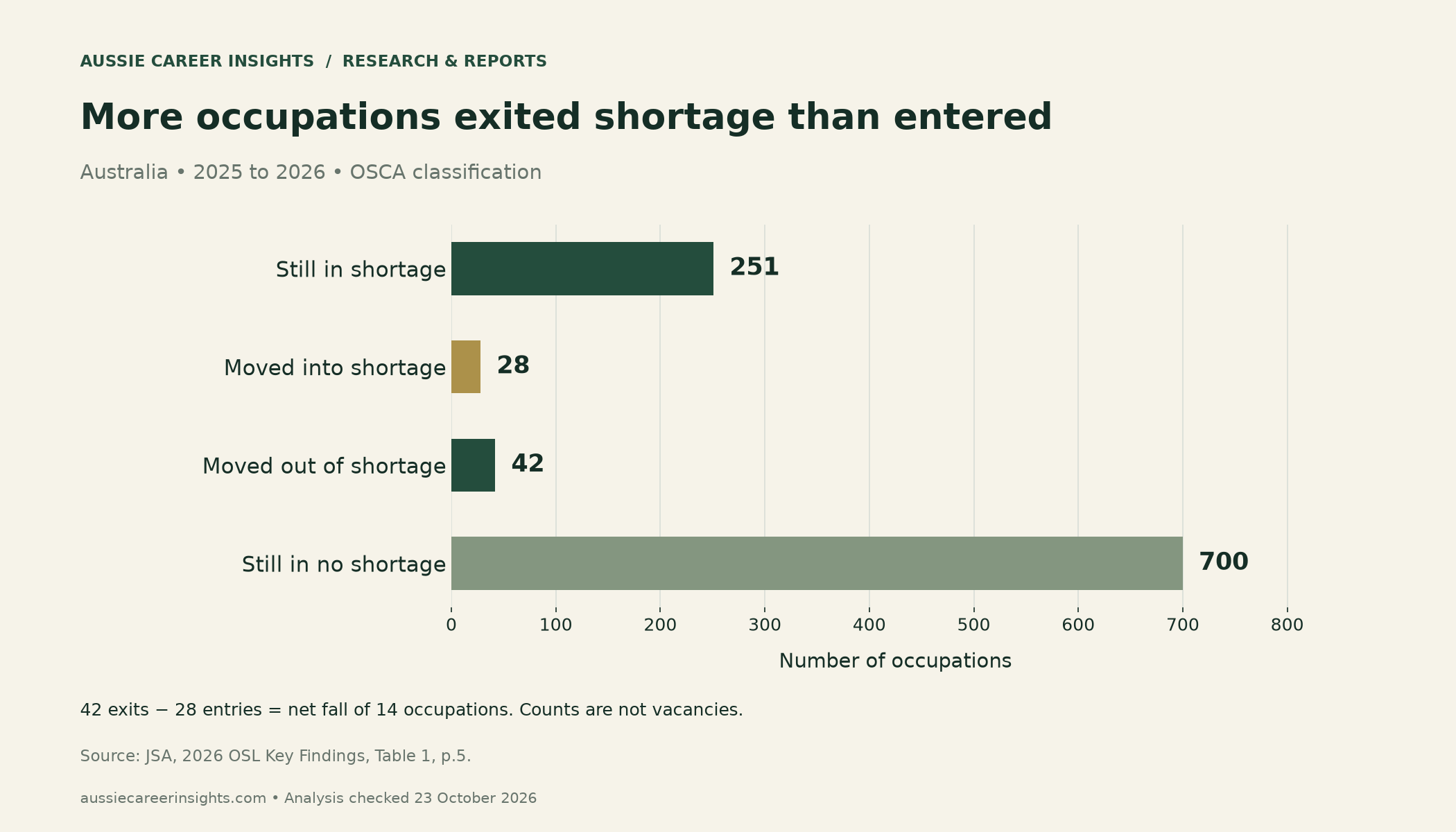
The official Key Findings Report also provides a consistent comparison of rating changes. In its Table 1, 251 occupations stayed in shortage, 28 entered and 42 exited. Another 700 stayed outside shortage.
For a reader, the distinction matters. A national list helps you decide what to investigate. However, an offer comes from an employer filling a particular role in a particular place.
Harder to recruit does not mean easier to enter
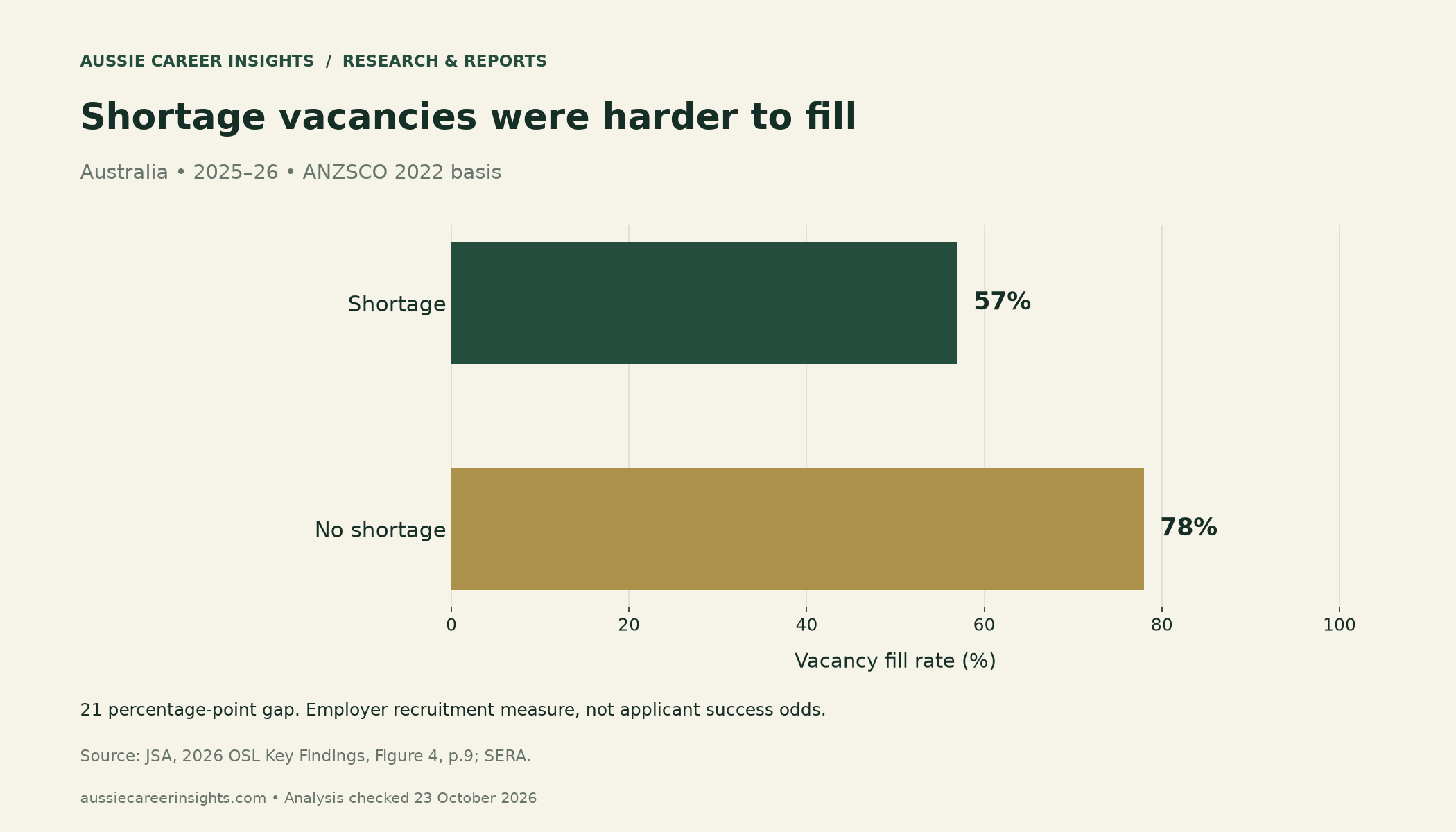
The recruitment evidence uses ANZSCO 2022, a separate occupation classification. For 2025–26, the vacancy fill rate was 57% in shortage occupations and 78% in occupations without a shortage. The gap is 21 percentage points.
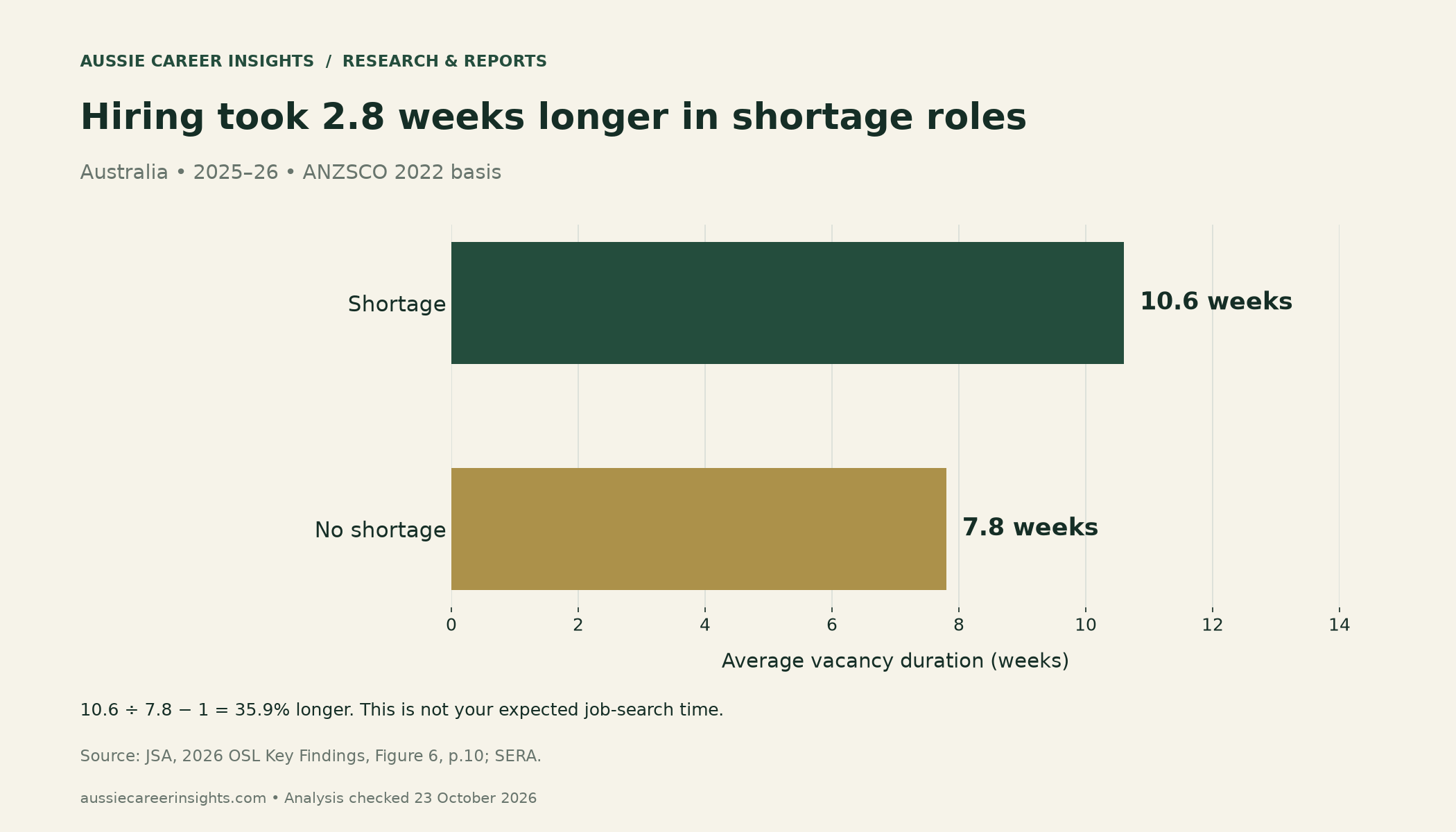
Average vacancy duration also differed: 10.6 weeks against 7.8 weeks. Our calculation gives a 2.8-week gap, or 35.9% longer relative to the non-shortage figure. Both measures come from JSA’s Survey of Employers who have Recently Advertised, reproduced in Figures 4 and 6 of the report.
Imagine two applicants seeing the same vacancy. One already has the required credentials and recent evidence of the tasks. The other would need training before doing the work. The shortage label is identical for both, but their next steps differ. This is an illustrative example, not a measured hiring result.
Three questions behind a shortage
The separate 2026 Occupation Shortage Drivers report groups shortages by their main driver. Among 100 ANZSCO unit groups in shortage, suitability was the main driver for 43, education and training for 36, and retention for 21.
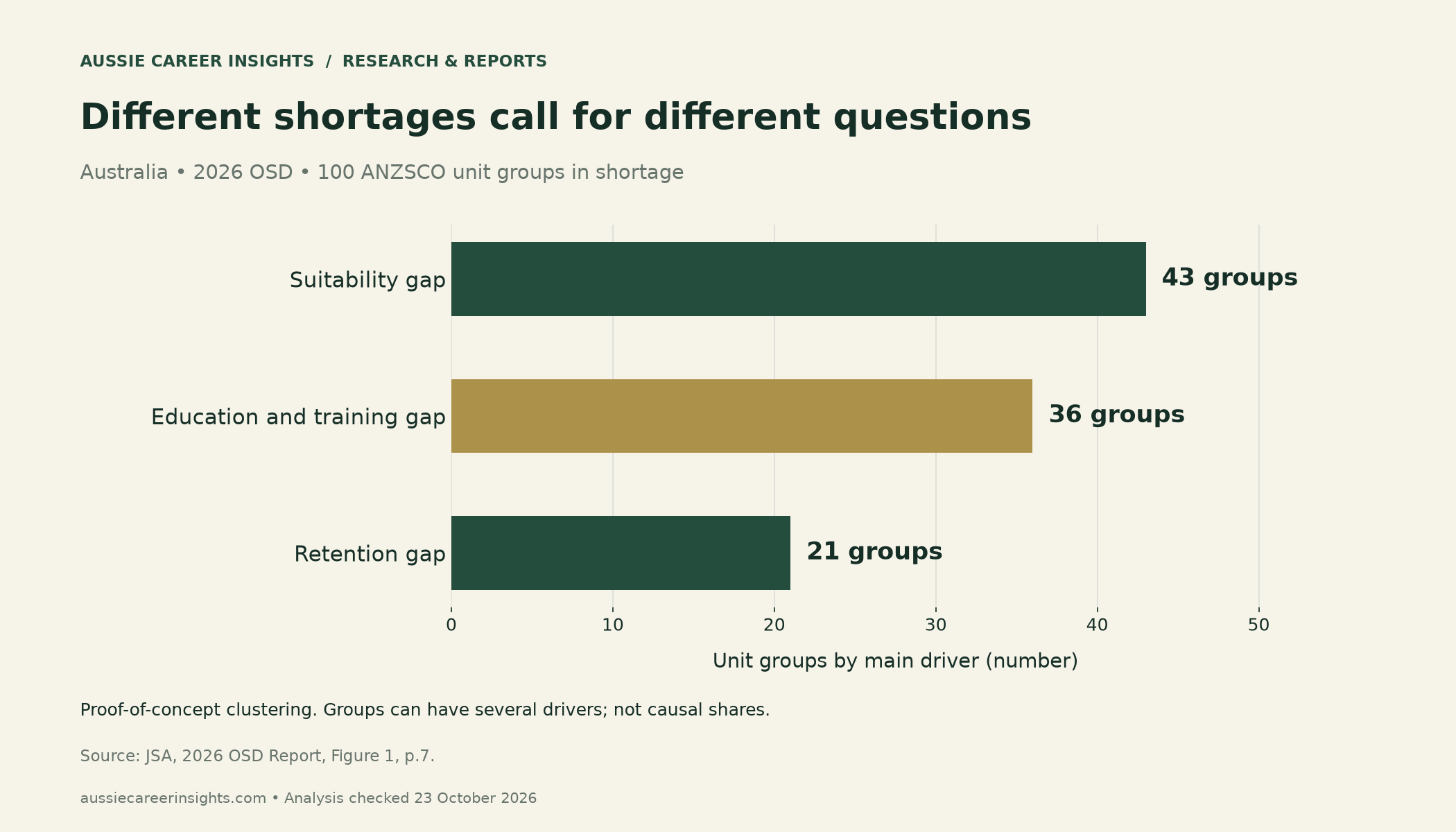
JSA describes this clustering as proof of concept. A group can have several drivers, even when one is largest. The results do not establish that a stated percentage of all vacancies has one cause.
We use those themes to organise the checklist below. This is our editorial decision tool, not a JSA assessment of you or a particular employer.
1. Training: what must you complete before entry?
First, identify the exact occupation and the state where you want to work. Then check the relevant regulator, training provider and employer. Write down the qualification, supervised experience and registration steps that apply to that specific path.
Ask the provider for the full course cost and timetable in writing. Include materials, travel, placements and any period when you would reduce paid work. Keep unknown amounts blank until you can verify them. A shortage headline cannot fill those gaps in your plan.
For newcomers with overseas qualifications, check recognition requirements before paying for a new course. Do not assume either that your experience is unusable or that an overseas credential gives automatic permission to practise.
2. Suitability: what evidence would make your application credible?
Next, read current advertisements for the exact role and location. Separate essential requirements from preferences. For each essential task, list a truthful example of your work, the result and your own responsibility.
Your Personalized Career Strategy
Unlock your potential with tailored career consulting. Get clear, actionable steps designed for your success. Start now!
Get StartedFor example, a technical applicant might explain a supervised project and the checks they completed. A service applicant might show how they handled a difficult customer situation. Use examples appropriate to the role. Never present another person’s work as your own or disclose confidential employer material.
Ask a recruiter or hiring manager which gaps would prevent an interview. Their answer is more useful for that vacancy than assuming a broad shortage rating means experience requirements disappear.
3. Retention: would you want to stay in this job?
Finally, examine the actual offer. Ask about guaranteed hours, roster notice, travel, supervision, workload and progression. Request a clear explanation of the base rate and any conditional payments.
A frequently advertised role deserves questions. It may reflect growth, staff turnover or other circumstances. The advertisement alone does not establish the reason. Ask what happened to the previous holder and how the employer supports new starters.

A shortage-to-offer checklist you can reuse
Use one row per possible role. Compare evidence at the same level: a real vacancy against another real vacancy, rather than a national occupation average against one unusually attractive offer.
| Decision check | Evidence to record | Question to resolve |
|---|---|---|
| Occupation and place | Exact title, occupation code, state and commuting area | Does the rating describe the work I would actually do? |
| Entry pathway | Official requirements and provider’s written timetable | What must happen before I can start? |
| Total transition cost | Verified fees, equipment, travel and reduced paid hours | Can I fund the transition without assuming a future offer? |
| Application evidence | Essential criteria matched to truthful work examples | Which requirement can I not yet demonstrate? |
| Offer quality | Written hours, pay structure, roster and location | Does this fit my household and existing commitments? |
| Staying power | Supervision, training support and progression discussion | Would I want to remain after the initial move? |
For wider background, see our guide to skilled labour shortages and trade pathways. Use that overview alongside the new official data and current local requirements.
How we calculated these comparisons
We transcribed the displayed national counts and recruitment indicators from JSA’s October 2026 reports. The chart data and calculations use the same values as this article. The reusable tables above and the source reports allow readers to check the comparisons.
- National share: 279 divided by 1,021, multiplied by 100 = 27.3%.
- Net change from entries and exits: 28 minus 42 = minus 14 occupations.
- Fill-rate gap: 78% minus 57% = 21 percentage points.
- Duration gap: 10.6 minus 7.8 = 2.8 weeks.
- Relative duration gap: (10.6 divided by 7.8 minus 1), multiplied by 100 = 35.9%.
Checks: the four rating-change counts total 1,021; 251 plus 28 equals 279; and the three main-driver counts total 100. We round only the final derived percentages.
Limits that matter for a career decision
The OSL methodology explains that this is an employer-focused, point-in-time assessment. It does not forecast future shortages or measure shortage severity. Its scope excludes some occupations, so the headline share is not a share of every job in Australia.
OSCA occupation counts and ANZSCO recruitment or driver measures are kept separate here. We make no individual occupation joins across the classifications. The driver results are exploratory; our calculations are descriptive and do not establish causation or statistical significance.
Australia’s 2026 shortage list is most useful as a prompt for better questions. Before committing to a move, obtain evidence for the entry pathway, your suitability and the specific working conditions. A completed checklist gives you a clearer basis for action than the label alone.
Suggested citation: Aussie Career Insights (23 October 2026), Australia’s 2026 Shortage List: Why “In Shortage” Does Not Mean an Easy Job. Analysis of Jobs and Skills Australia’s 2026 OSL and OSD reports.
Source data: © Commonwealth of Australia, Jobs and Skills Australia, used under Creative Commons Attribution 4.0. Charts and calculations are our adaptations; they do not imply government endorsement.


